Get Full Government Meeting Transcripts, Videos, & Alerts Forever!
Get email alerts on the Mold Remediation topic
No spam. Unsubscribe anytime.
House Environment and Transportation Committee advances mold assessment and remediation bill, delays tenant-reimbursement amendment
Summary
The committee voted to pass the mold assessment and remediation measure with amendments that limit local governments' obligations and require state rulemaking by June 1, 2027; a proposed amendment to require landlord reimbursement to tenants was not adopted and will be circulated for later consideration.
The House Environment and Transportation Committee on April 4 voted to advance Senate Bill 856, legislation that would require the Maryland Department of the Environment (MDE), in consultation with several state agencies, to develop centralized public information and to adopt uniform standards for mold assessment and remediation by June 1, 2027.
The bill directs MDE, in consultation with the Department of Health, the Department of Housing and Community Development, the Department of Labor, and the Department of General Services, to maintain a centralized website and to prepare an informational pamphlet with resources about mold remediation and dampness. Committee members adopted an amendment from Delegate Ruth clarifying that nothing in the statute requires local health departments or local governments to conduct mold assessments or remediation; the amendment also states that when a local government owns or manages residential property it must comply with the statute for that property.
Why it matters: The measure creates a statewide framework for mold assessment and remediation and sets a timetable for state rulemaking, which could affect landlords, tenants and local housing authorities across Maryland. Supporters say uniform standards and public resources will help address health and habitability concerns; opponents raised questions about costs, enforcement and interaction with existing landlord-tenant law.
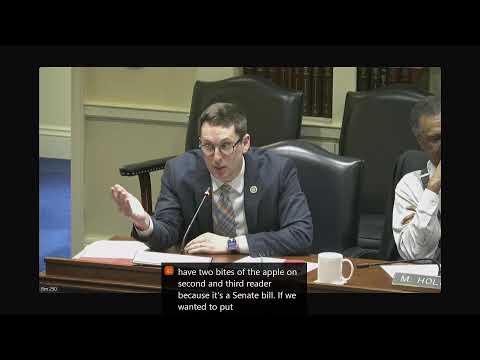
Key details: The committee record shows the Ruth amendment passed. Delegate Foley offered a separate amendment that would have required landlords to reimburse tenants for necessary expenses — including reasonable alternate housing costs — incurred because of detected mold unless the tenant was at fault. Committee members did not vote on the Foley amendment at the meeting; the chair and several delegates said the amendment was substantial and should be circulated for review. Committee counsel noted that, under current law, tenants often must sue to recover such costs.
Committee debate focused on scope and timing. Delegates asked whether the Realtors' earlier unfavorable testimony remained unchanged; members said some changes requested by the Maryland Association of Counties were incorporated but that the association remained “not supportive.” Delegate Stewart and others urged caution about adding the Foley reimbursement language without time to review it; several members said a floor amendment could be considered later if needed.
Outcome and next steps: The committee voted to report SB 856 favorably as amended (excluding the Foley reimbursement amendment). The record lists members who asked to be recorded in opposition on the final passage vote: Delegate Jacobs, Delegate Otto, Delegate Silberde, Delegate Naraki, Delegate Morgan and Delegate Baker. Delegate Foley agreed to circulate her draft amendment to committee staff for distribution.