Get Full Government Meeting Transcripts, Videos, & Alerts Forever!
Get email alerts on the Solid Waste Recycling topic
No spam. Unsubscribe anytime.
Josephine County to receive about $23,000 DEQ rebate; commissioners approve DEQ recycling authorization 2-1 after public concerns
Summary
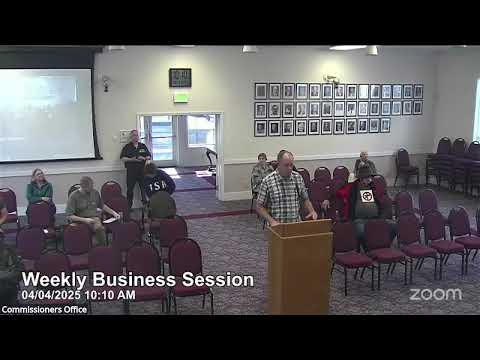
The Josephine County Board of Commissioners accepted a roughly $23,000 rebate from the Oregon Department of Environmental Quality and approved a separate DEQ authorization form governing producer responsibility for recycling, after county staff and residents debated who should run local recycling efforts.
The Josephine County Board of Commissioners on a weekly business session acknowledged a roughly $23,000 rebate from the Oregon Department of Environmental Quality and approved an authorization form about statewide producer responsibility for recycling, after discussion about who should administer local recycling programs.
Rob Brandes, Public Works director for Josephine County, told the board the DEQ payment is “about $23,000 rebated,” money that arrived because the county is among the nine most economically impacted counties in the state and is calculated on per-ton disposal. He said the funds can be spent on several types of solid-waste activities allowed by DEQ, including reducing disposal fees, recycling and contamination reduction programs, and household hazardous waste collection.
Brandes said the county has not yet designated a final use and that the money has historically been parked in the county solid-waste fund. He noted a June 7 household hazardous-waste event planned in the county and urged commissioners to consider local priorities for the rebate. “When you pay that $30 a month for your can out front, a portion of that does go for reduction activities like that,” Brandes said.
The board voted to accept the rebate as item 4(a). The motion passed on a roll call of three to zero: Commissioner Smith — yes; Commissioner Barnett — yes; Commissioner Black — yes.
The board then considered a DEQ authorization form tied to Oregon’s Recycling Modernization Act and the state’s producer responsibility organizations, which steer funding for five broad categories: transportation of covered materials, contamination evaluation, contamination reduction programming, service expansion needs assessments, and purchase of post-consumer recycled-content collection containers.
Director Bridal (county staff presenting the authorization form) told commissioners the county’s two local franchise haulers — Southern Oregon Sanitation and Republic Services — already provide the services the DEQ funding would support and that any county involvement would be on a reimbursement basis. “My recommendation…is we don’t want a piece of this because they already have all those processes in place,” Bridal said. “The county does not wanna take any of those functions on.”
Commissioner Black pressed about amounts; in discussion a county staff member estimated the scale of outreach costs could be on the order of a postcard mail cost and that a single outreach or study could consume a large portion of a modest allocation. One staff estimate cited in the discussion put a similar DEQ-stream funding amount at roughly $25,000.
The board approved the DEQ authorization form as item 4(b) by a 2–1 vote: Commissioner Smith — yes; Commissioner Barnett — yes; Commissioner Black — no.
During the public comment period several residents raised related solid‑waste concerns. Connor Kirkpatrick, who identified himself as a property‑cleanup business owner and thrift‑store operator, criticized the Solid Waste Agency and urged the county to press for participation in a state mattress‑recycling program. “They get recycled. They don’t end up in the landfill,” Kirkpatrick said of his participation in the program. He said local transfer stations decline to join the state mattress program because they earn more from landfill disposal than from recycling.
Resident Catherine Smith said her nonprofit thrift store had been refused access to local dumps and that the Solid Waste Agency had not acknowledged the nonprofit’s exemption; she asked the board to resolve the conflict so local nonprofits could use transfer facilities.
No formal action was taken in response to the public comments beyond the DEQ items on the agenda; Brandes and Bridal told the board the rebate money and DEQ decisions would remain subject to the county’s spending rules and guardrails. Brandes reiterated that the rebate funds are currently routed to the county solid‑waste fund pending a board decision on use.
The board did not set a specific expenditure for the rebate during the meeting and left staff to track the DEQ funds and the April filing for the authorization form.
Ending: Staff said they will return with options for how to allocate the DEQ rebate and that the county’s existing franchise agreements and haulers already perform much of the recycling outreach the DEQ program would fund; commissioners who want a different approach may direct staff to present alternatives at a future meeting.