Get Full Government Meeting Transcripts, Videos, & Alerts Forever!
Get email alerts on the State Water Resources Control Board topic
No spam. Unsubscribe anytime.
State Water Resources Control Board chair defends board after administrative‑hearing "Zoom bombing," outlines water-quality, funding and cross‑border work
Summary
Joaquin Esquivel, chair of the State Water Resources Control Board, described the board’s water‑quality, drinking‑water and financing responsibilities and recounted a coordinated “Zoom bombing” that disrupted a Delta Conveyance water‑rights hearing.
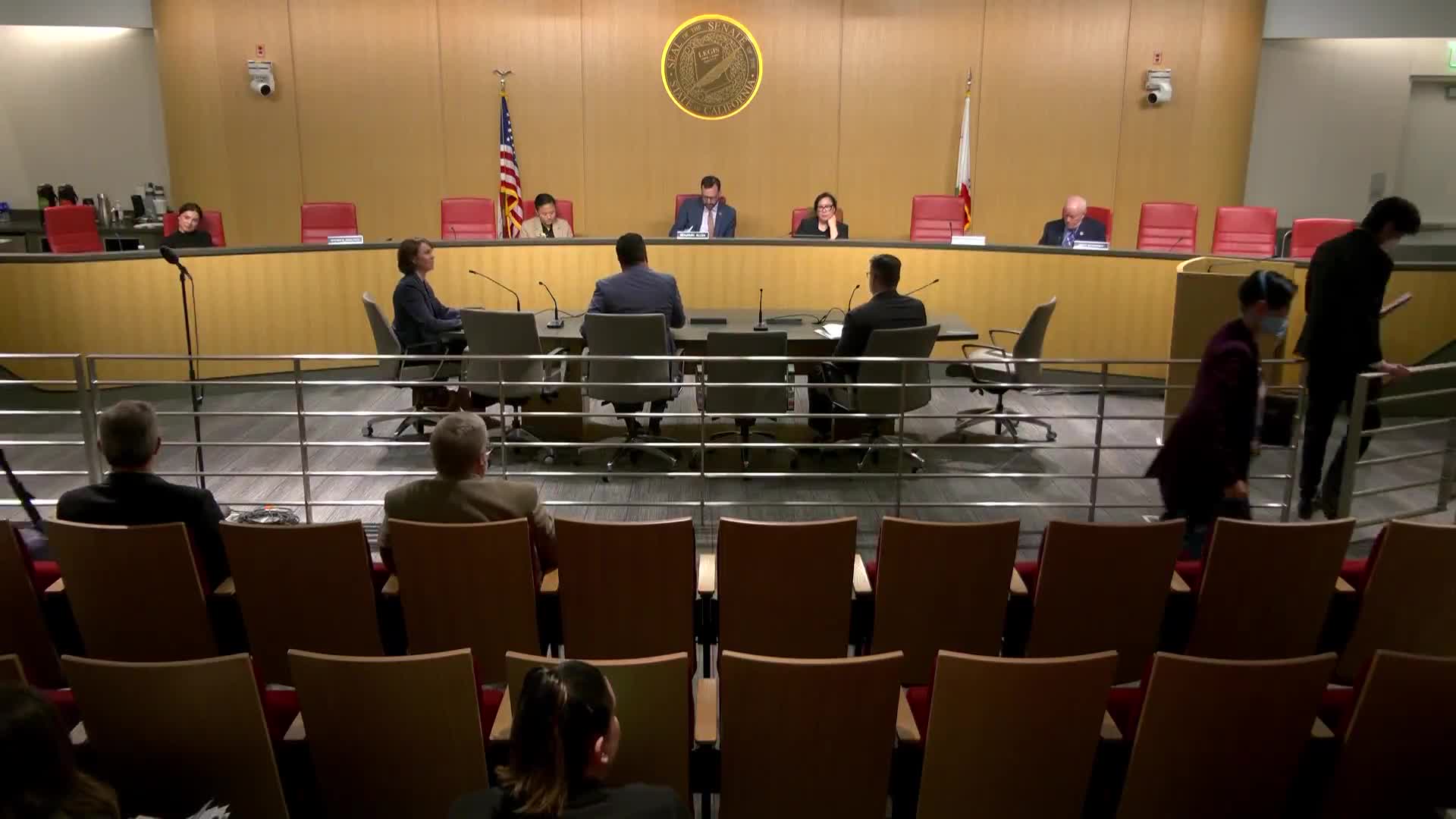
Joaquin Esquivel, chair of the State Water Resources Control Board, told the Senate Budget Subcommittee that the board oversees water quality and water-rights administration across California, manages drinking-water regulation for community systems and provides financial assistance through the state revolving funds.
The board’s mission and recent work: Esquivel summarized the board’s responsibilities under Porter‑Cologne and its role overseeing nine regional boards, noting the board’s transfer of the Division of Drinking Water from the Department of Public Health a decade ago and the board’s investments to address drinking-water access. He said the state has reduced the number of Californians lacking access to safe drinking water from approximately 1.6 million in 2019 to about 1.5 million today through combined state and federal funding.
Administrative-hearing disruption: Esquivel described a coordinated “Zoom bombing” last week during a water-rights administrative hearing on the Delta Conveyance Project referred to the Administrative Hearings Office. The hearing was disrupted by participants posting pornographic images and racist language. Esquivel said the incident occurred because the AHO had permissive virtual‑meeting settings (allowing participants to unmute and share video/camera without permission) and that the board has since tightened security protocols, retrained staff and coordinated with the state’s Department of Technology and law enforcement. He said the hearing resumed with stricter access controls and that the board will conduct yearly reviews of hearing security.
Funding and financial assistance programs: Esquivel highlighted the State Water Board’s Division of Financial Assistance, which has invested more than $5 billion in water infrastructure in recent years covering drinking water, wastewater, recycling and stormwater capture; he described the state revolving funds (SRFs) as essential financing tools. He and staff warned that federal capitalization grants have faced increasing earmarks and that reliance on federal SRF capitalization grants is uncertain in future years; the board said that would constrain long‑term lending capacity to local projects.
Tijuana River/Transboundary pollution: The chair said the board is tracking cross‑border sewage flows into the Tijuana River Valley. He reported recent federal commitments and funding to the International Boundary and Water Commission and said additional investments are planned through the recent federal and state funding packages; he urged durable, long‑term solutions to the recurring transboundary pollution problem.
Other priorities and programs: Esquivel noted the board’s role in groundwater recharge and the State Water Board’s temporary groundwater recharge permits, its involvement in water-rights proceedings (including Delta Conveyance water-right permits), and the board’s focus on implementing the human right to water with loans and grants. He said the board’s financial-assistance model provides low-interest loans, grant forgiveness and leveraged bond market access.
What the transcript shows: Esquivel’s presentation emphasized the board’s legal authorities and large-scale financing role. He acknowledged a high-profile security failure in virtual hearings, described actions taken to prevent recurrence, and underlined continuing work on drinking water, transboundary sewage and SRF funding capacity.
Ending note: Esquivel told the subcommittee the board will continue to strengthen hearing security, pursue water-rights proceedings as required by statute and seek to preserve federal and state funding to support water-quality and drinking-water investments.