
DWR director outlines Delta Conveyance status as questions linger over cost, permits and benefits
Get AI-powered insights, summaries, and transcripts
Sign Up Free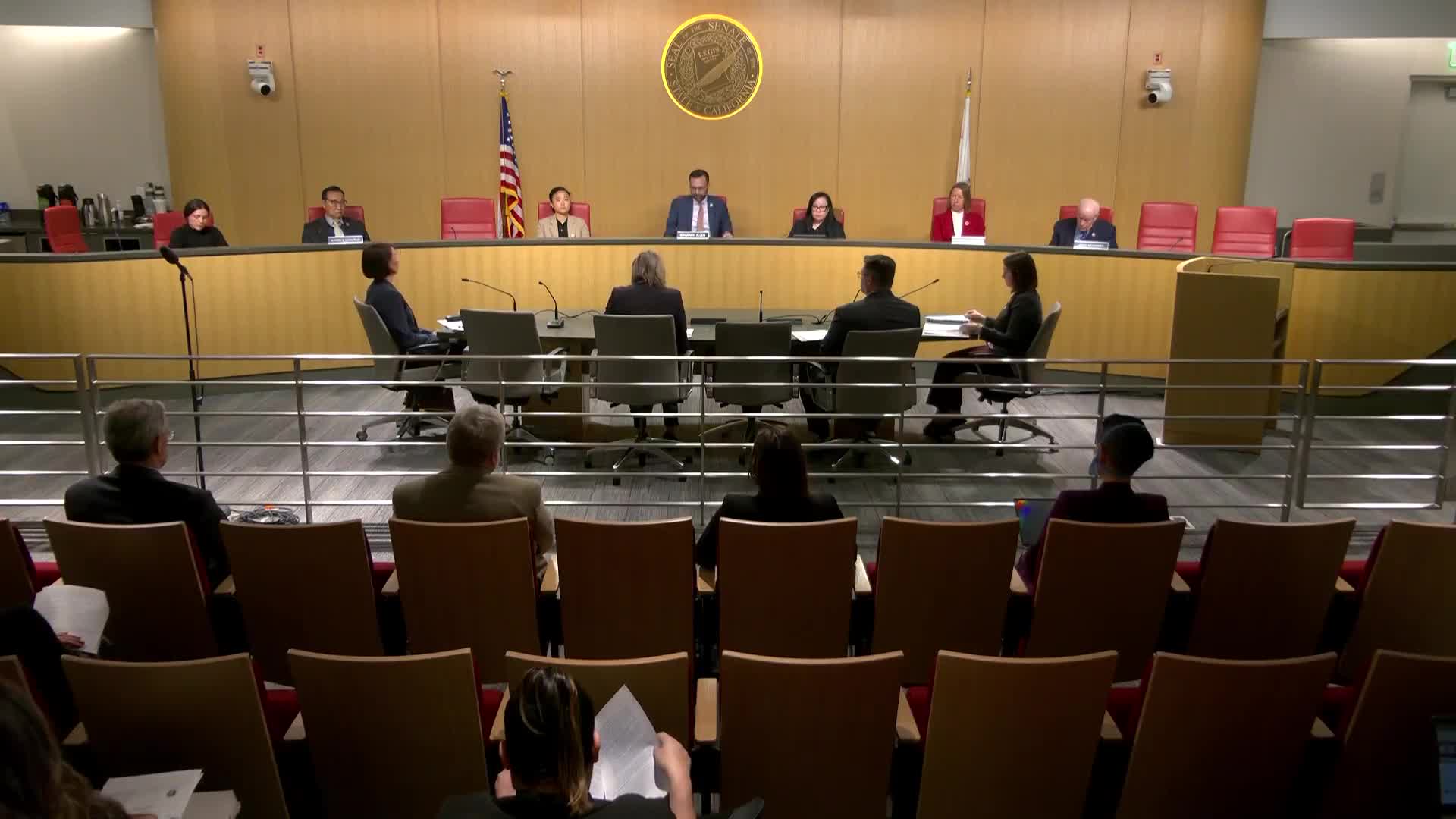
Summary
Carla Namath, director of the California Department of Water Resources, told the Senate Budget Subcommittee on Water that the Delta Conveyance Project remains under active design and permitting and is intended to help the State Water Project adapt to changing hydrology caused by climate change.
Carla Nameth, director of the California Department of Water Resources, told the Senate Budget Subcommittee on Water that the Delta Conveyance Project remains under active design and permitting and is intended to help the State Water Project adapt to changing hydrology caused by climate change.
The project, now configured as a single, 6,000 cubic feet per second tunnel, was reduced from prior larger designs and is funded by the state water contractors; Nemeth said the current planning estimate is about $20 billion and that a recent benefit-cost analysis shows roughly $2 of benefit for every $1 invested. She also described a $200 million community benefits fund to compensate affected communities and noted DWR aims to complete state permits within the governor’s term.
Nemeth framed the project against this water year’s volatility, saying California’s snowpack and inflows are increasingly variable and that the tunnel would create operational flexibility to capture and move water during short, intense storms. “If we had had the Delta Conveyance Project in place for our State Water Project system, we would have already filled San Luis Reservoir by that February storm,” Nemeth said, adding the project could have moved about 75,000 acre-feet in a three-day event for groundwater recharge.
Why it matters: The Delta Conveyance Project is billed as a long-term infrastructure response to sea-level rise, levee vulnerability and shifting storm patterns. Nemeth said the State Water Project supplies about 27 million Californians and that protecting the Bay-Delta system is critical to public safety and water supply reliability.
Key details and debate - Design and history: Nemeth traced the project’s evolution from a 15,000-cfs, above-ground canal concept during the Schwarzenegger administration to a two‑tunnel 9,000-cfs plan, and now to a single, 6,000-cfs tunnel under Governor Newsom. The alignment shifted east to avoid central-Delta impacts, she said, adding five miles to tunnel length but eliminating the need for a forebay. - Cost, financing and contractors: Nemeth said the planning estimate rose from $16 billion to $20 billion mainly because of inflation. The project is funded by the State Water Project contractors that benefit from it; bonds issued by the State Water Project would be the funding instrument, she said, and contractors must vote to participate before DWR can issue debt. Nemeth said previously included contingencies and recent design savings reduced some uncertainty, but she warned that “time is not on our side” financially. - Permitting and legal process: Nemeth said DWR completed its CEQA document and obtained a permit under the California Endangered Species Act in late January, and is pursuing a water-right permit from the State Water Resources Control Board to add a point of diversion. She described a “validation action” in court to confirm DWR’s authority to construct the project as part of the State Water Project; a superior court decision found the department’s 2020 validation filing too broad because a specific project had not yet been defined. DWR has appealed that decision and re-filed with a more specific project description after the CEQA process. - Delta Reform Act and stewardship: Nemeth said the project must demonstrate reduced reliance on the Delta per the Delta Reform Act and Delta Plan; the department will present data at the member‑unit level for contractors (for example, Metropolitan, Santa Clara Valley Water District) to show planned local supply investments that would accompany the tunnel.
Lawmakers and local officials pressed DWR on costs, community impacts and alternatives. Senator Jerry McNerney, who co-chairs the Delta Caucus and represents Delta communities, said construction would last about 10–15 years and raise concerns about disruption, levee impacts and cost to ratepayers. “It’s going to be a massive and unavoidable impact on the Delta communities,” McNerney said. He urged stronger emphasis on levee restoration, local groundwater storage and water recycling as alternatives or complements.
Public comments and opposition - Restore the Delta and Delta Counties Coalition: Public commenters including Cynthia Cortez of Restore the Delta and Karen Lang of the Delta Counties Coalition told the committee they remain opposed, citing perceived incomplete permitting, water-right records, litigation history and the project’s projected impact on Delta communities and economies. Cortez told the subcommittee she is “gravely concerned about the department’s management of funds and the execution of their authority for the Delta Conveyance Project,” and asked the Legislature to consider audits and oversight.
Outstanding questions and next steps - Validation and litigation: DWR’s validation action remains under legal challenge; Nemeth said DWR appealed an initial superior court ruling and filed an updated validation after CEQA completion. If the court denies validation, Nemeth acknowledged the department would need alternative approaches to finance and authorize construction. - Financial plan and contractor votes: Nemeth said the next two years will focus on more detailed design, an updated cost estimate and a formal financial plan so contractors can make informed votes. She stressed DWR does not want contractors to “over-buy” into the project in ways that would crowd out local supply investments. - Federal interaction: Lawmakers asked how federal actions could affect future operations. Nemeth said the State Water Project must comply with both state and federal laws and water-right conditions established by the State Water Resources Control Board; as the permit holder she emphasized she is bound to follow those laws.
What the transcript shows: The committee hearing recorded an extended exchange between DWR and several senators, with public commenters reiterating longstanding opposition and calling for legislative oversight. Nemeth’s presentation emphasized system‑level benefits, permit milestones and a staged approach to financing and design.
Ending note: DWR has signaled a goal of finishing state permitting during the governor’s term and producing a financial plan to inform contractor decisions. The project’s future remains contingent on ongoing litigation, contractor votes, and how the department addresses Delta community impacts and affordability concerns.