Get Full Government Meeting Transcripts, Videos, & Alerts Forever!
Get email alerts on the Drought Contingency Survey topic
No spam. Unsubscribe anytime.
Regional drought‑contingency survey shows broad support for a common plan; parks and golf courses remain contentious
Summary
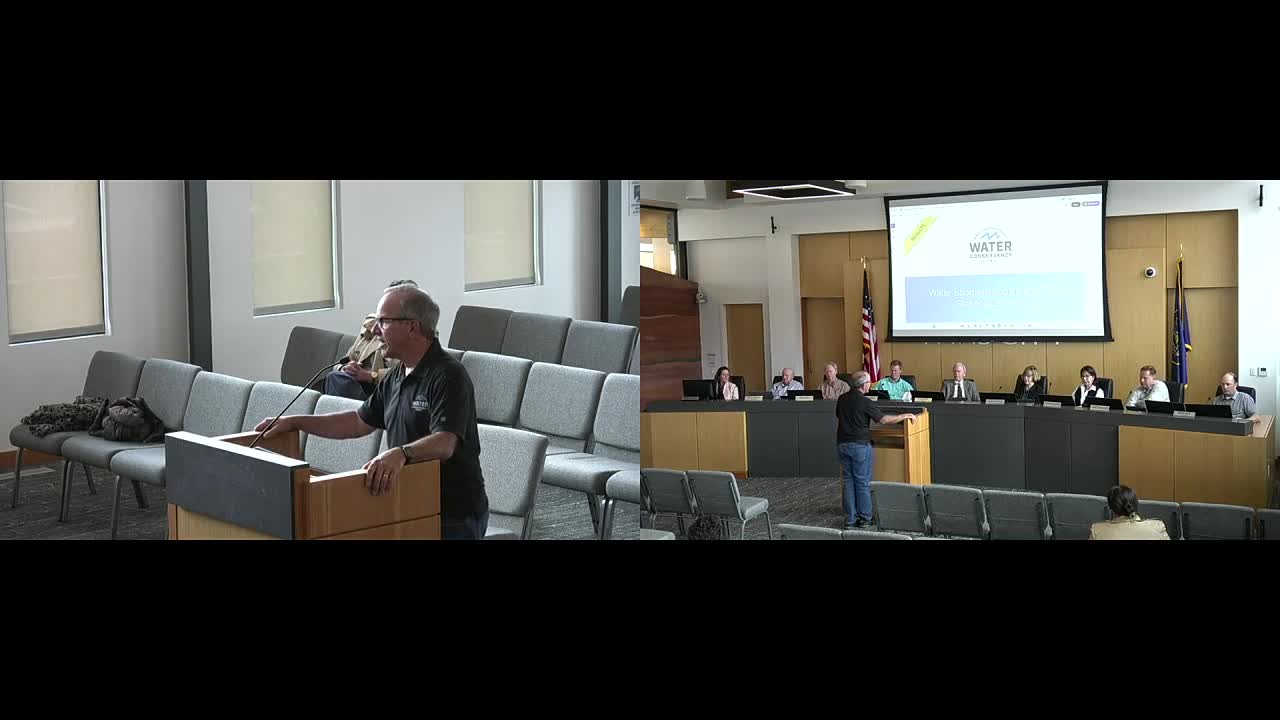
Doug Bennett of the regional water district presented April 3 survey results showing broad stakeholder support for a common regional drought‑contingency plan, but he said disagreements persist over when to restrict decorative lawns, how to treat public parks and how to work with the golf industry.
Ivins — Doug Bennett of the regional water district presented April 3 survey results showing broad stakeholder support for a common regional drought‑contingency plan, but he said disagreements persist over when to restrict decorative lawns, how to treat public parks and how to work with the golf industry.
Bennett said the district conducted a two‑phase survey of technical staff, trustees and elected officials across eight partner communities to identify where measures should sit within staged drought responses. The next step, he said, is to present a formal drought‑contingency proposal to the district’s Administrative Advisory Committee on April 23 from noon to 2 p.m.
Survey participation included mayors, city managers and technical advisory members; Bennett said there were 39 city council members across the eight agencies and roughly 56% of those elected officials responded. The survey used four drought stages; Bennett characterized stage 4 as an emergency: “Stage 4 basically means no one can water anything outside. Nobody can wash a car,” he said.
Bennett described areas of consensus and divergence. He said most technical committee recommendations landed in stage 2 (early action) while some elected officials preferred to move certain measures earlier. For example, hand‑watering of plants had been recommended for stage 4 by the technical committee but scored 2.86 among city council members — a sign elected officials favored earlier restrictions in some cases.
On regional coordination, the survey found strong support for equivalent measures across municipalities. Bennett said the consensus average for the statement “all cities in the region should enact equivalent measures during drought” was 8.7 on a 10‑point scale. “I felt like we have consensus here,” he said.
However, the survey showed less agreement on decorative lawns versus parks. “Is it appropriate to restrict the watering of decorative lawns before restricting watering on community parks and athletic fields?” Bennett asked; he said responses ranged widely and contained many neutral “5” answers. Council members raised concerns about equity and access if neighborhood pocket parks were allowed to dry while decorative commercial grass remained watered.
Golf courses emerged as another area needing more discussion. Bennett said golf courses are extremely high water users and that his recommendation was to set percentage‑reduction targets and allow the golf industry to use its expertise to meet those targets, rather than applying the same day‑of‑week watering limits that might be imposed on homeowners.
Bennett also addressed a misunderstanding about municipal reporting. Technical staff said they already compile monthly water‑use numbers and did not want another onerous technical report; elected officials, Bennett said, wanted public‑facing communications so residents can see the city’s conservation actions. “We wanna communicate, but we don't have a need to over communicate the details in every case or cause people additional work in the middle of that,” Bennett said.
Bennett warned of urgency: he said the Santa Clara Basin snowpack was at zero on April 1 and the Virgin River and Santa Clara were both projected to run far below average flows for the year, making planning and staged restrictions more pressing. He said the district’s recommendation is to seek incremental measures early in a shortage and to convene an interagency drought committee to work with the golf industry and to study public sentiment about protecting community recreation areas versus decorative commercial turf.
Next steps the district outlined include the April 23 advisory committee review and additional outreach to golf courses and the public; Bennett said municipalities would still need to adopt any specific codes or ordinances to implement district guidance because the district does not have direct regulatory authority over municipal codes.