Get Full Government Meeting Transcripts, Videos, & Alerts Forever!
Get email alerts on the Water Efficiency Development Standards topic
No spam. Unsubscribe anytime.
Water district proposes voluntary ultra‑efficient home standard to cut per‑household water by about one‑third
Summary
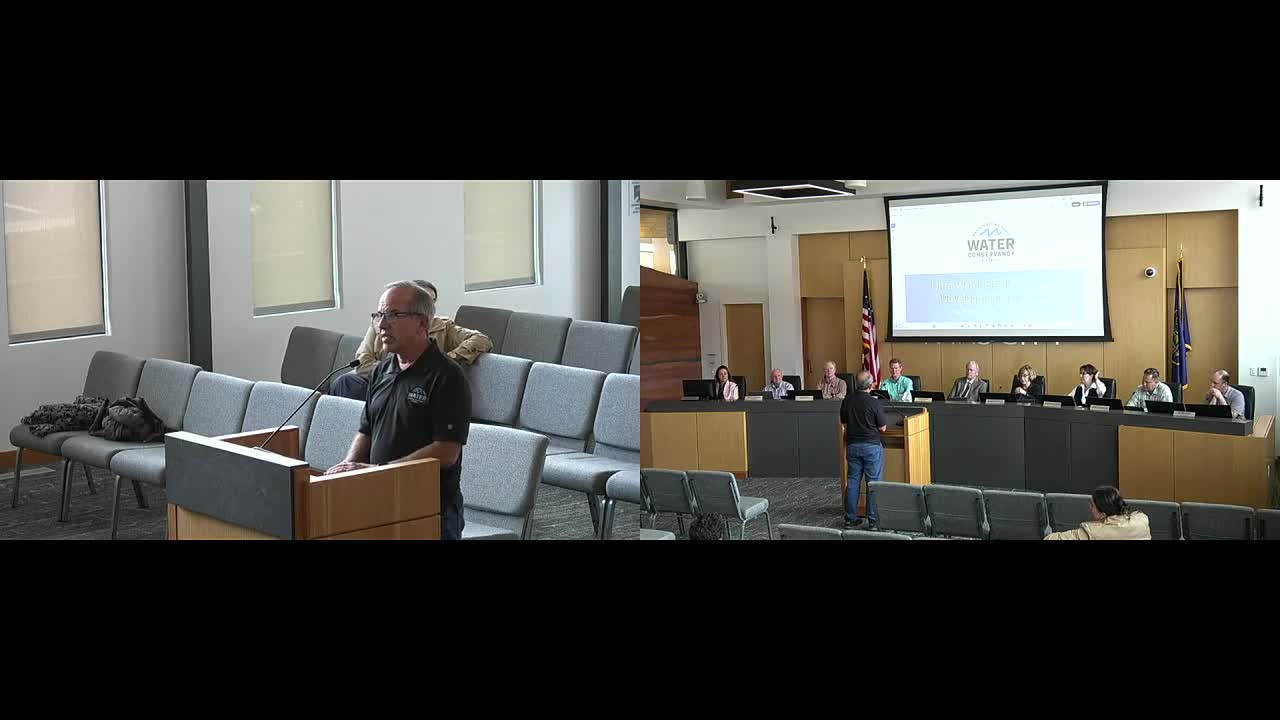
At a work meeting April 3, Doug Bennett of the regional water district presented a voluntary “ultra water efficient” development standard that would aim to reduce typical household water supply from about 0.59 acre‑feet to 0.39 acre‑feet, or roughly one third less than the prior standard.
Ivins — At a work meeting April 3, Doug Bennett of the regional water district presented a voluntary “ultra water efficient” development standard that would aim to reduce typical household water supply from about 0.59 acre‑feet to 0.39 acre‑feet, or roughly one third less than the prior standard.
Bennett told the Ivins City Council the program is intended to be voluntary and adaptable to both small urban lots and larger rural lots. “The objective of this program was to come up with a design that would encourage new single family homes that would use a third less water than the current standard,” he said. The district would offer reduced regional impact fees as an incentive; Bennett said current impact fees are calculated on a typical 10,000‑square‑foot lot and are currently $13,500, and an impact‑fee study underway is expected to raise fees in the future.
The proposal would pair smaller water allocations with site and landscaping rules. Bennett said houses built to the standard would have no private irrigated lawns, 2,000 square feet allocated for drip‑irrigated plantings or a 25‑foot perimeter “envelope” of landscaping around the dwelling, and would generally use drip irrigation. He said the district prefers developers not provide secondary (non‑potable) systems to these neighborhoods because of cost and maintenance, noting such systems can leak and add expense to developers.
To ensure performance, the standard would require participating neighborhoods to form homeowners associations (HOAs) and include program requirements in HOA governing documents. Bennett said there would be an 8,000‑gallon monthly threshold; homes using more than that would incur the existing post‑2023 surcharge, which Bennett described as $10 per 1,000 gallons in excess.
Indoors, Bennett said, fixtures would be the same high‑efficiency types already in use across the district. He recommended discouraging salt‑based water softeners because they increase salinity in recycled wastewater and add to demand, but he stopped short of a ban: “It's not a hard no,” he said, adding that homeowners would not violate the program rules by installing a softener after purchase.
Bennett also proposed limiting private pools and encouraging community pools. Under the draft approach, a group of 15 homes that enrolled in the program could have a 1,500‑square‑foot communal lawn or a 600‑square‑foot community pool; additional homes would add modest square footage allotments (for pools, Bennett said an additional 10 square feet per home). He said no single body of water would be allowed to be larger than an Olympic swimming pool and recommended separate metering for community water‑play features to track leaks and use.
Bennett presented modeled water bills using St. George water rates to illustrate potential savings. He said a typical 2020 home would have annual water costs of about $665 under older standards, post‑2023 homes would peak at about 20,000 gallons in summer with a roughly $531 annual bill, while homes built to this ultra‑efficient standard would peak at about 8,000–9,000 gallons in summer with an approximate $400 annual bill.
Council members asked questions about market demand and equity. Councilman Anderson asked about the timing of impact‑fee payments; Bennett said his understanding is that impact fees are paid before a building permit is issued and are not sold years in advance for speculative projects. Mayor Hart and other council members pushed Bennett to consider family needs for nearby play space and pointed to pocket‑park designs as one way to provide functional grass within the compact model.
Bennett said home builders he had met were generally receptive and that the district would continue to refine the standard: “Every time I present this, I wind up with one new tweak,” he said.
Next steps include further conversations with developers and tailored adjustments for local conditions; no code changes or votes were requested at the meeting.