Get Full Government Meeting Transcripts, Videos, & Alerts Forever!
Get email alerts on the Permitting Omnibus Sf570 topic
No spam. Unsubscribe anytime.
Senate committee advances permitting reform bill after stakeholder compromises; roll call 7‑0
Summary
The Minnesota Senate Committee on the Environment, Climate, and Legacy on April 4 adopted amendments and recommended Senate File 570 to be referred to the Committee on State and Local Government by a roll‑call vote of 7‑0.
The Minnesota Senate Committee on the Environment, Climate, and Legacy on April 4 adopted amendments and recommended Senate File 570, the permitting reform package, to be referred to the Committee on State and Local Government by a roll‑call vote of 7‑0.
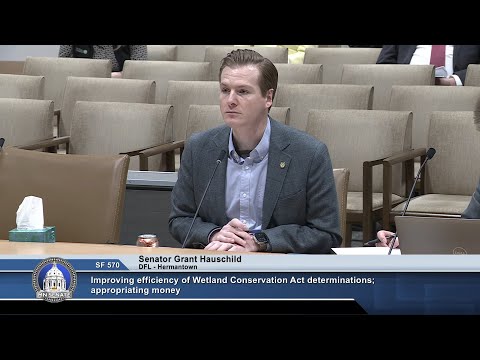
Senator Hauschildt, the bill’s author, described SF 570 as an effort to restore public confidence by making permitting “more predictable, more transparent, and more accountable.” The amended package includes: changes to how agencies determine whether an application is administratively complete (including a short grace period before deeming an application incomplete); separate treatment of construction and operation permits in the air program for many facilities (with mandatory environmental‑review projects carved out); new reporting requirements on the number and percentage of permits issued within statutory goals and the staffing needed to meet those goals; an expedited permitting option applicants could request and pay for; clarifications that local governments may begin reviewing feedlot permit applications while environmental review is underway; and additional funding to resource Minnesota Business First Stop at the Department of Employment and Economic Development to serve as a business permitting assistance hub.
Tom Johnson of the Minnesota Pollution Control Agency, who participated in stakeholder negotiations, said the amendments reflected compromises that reduced the bill’s fiscal note and allowed some changes to be implemented within existing rule structures. Johnson said the bill clarifies when the 90‑ and 150‑day permitting goals do not apply, for example when permits are required because of agency enforcement actions.
Andrew Morley of the Minnesota Chamber of Commerce said the bill reflected “good faith negotiations” and incorporated recommendations from a Chamber Foundation report that found Minnesota’s permitting times lag peer states. Morley said the separating of construction and operating permits is intended to bring Minnesota in line with other states and shorten timelines.
Environmental groups supported many of the changes but objected to one provision that would restrict who may petition for an Environmental Assessment Worksheet (EAW). Aaron Clems of the Minnesota Center for Environmental Advocacy said the change that would limit petitions to residents of the county or adjoining counties “seeks to solve a non‑problem” and could undermine the purpose of environmental review; he said MCEA remained opposed to that provision. Committee members discussed the language and identified an drafting error that could allow out‑of‑state signers; Senator Tarkovsky offered an oral amendment to insert the word “Minnesota” to clarify intent. Senator Hauschildt accepted the amendment as friendly.
The committee adopted an A‑1 amendment and an A‑2 amendment earlier in the hearing (both were moved and accepted on voice votes), and later took a roll‑call on the recommendation to pass the bill as amended. The formal motion to recommend passage and referral to State and Local Government was moved by Senator Sarah Rosenberg; the roll call recorded seven yes votes and zero no votes, and the motion prevailed.
Ending: Committee members said further work will continue on the broader environment omnibus, and the Senate committee signaled it will mark up the environment omnibus next week.