Get Full Government Meeting Transcripts, Videos, & Alerts Forever!
Get email alerts on the Committee Votes Rollcall topic
No spam. Unsubscribe anytime.
Ways and Means Committee: roll call and outcomes on April 3 voting list
Summary
The committee acted on a short voting list April 3, taking favorable action on several Senate bills and making concurrence decisions on multiple House bills, including several education-related conference committee appointments.
The Ways and Means Committee on April 3 considered a short voting list and recorded outcomes on several Senate bills and a series of House bills and concurrence motions.
Key outcomes at a glance:
- Senate Bill 308 — Passed favorably. The bill requires each polling place to have an equal number of election judges from each major political party, including the chief judge; if it is impractical to appoint equal numbers of chief judges, an unaffiliated or minor-party judge may be appointed as chief judge. (Passed by voice vote.)
- Senate Bill 352 — Passed favorably as amended. The bill reduces from four to three the number of county Republican central committee members elected from each councilmanic district and makes conforming changes to the Democratic central committee membership in the cross-file. (Passed by voice vote.)
- Senate Bill 708 — Passed favorably as amended. Subject to contingencies in the amended language, the bill requires certain sports wagering licensees and operators that advertise in the state to contract with a licensed independent evaluator to evaluate and rate wagering content, experts and influencers. The Senate-passed amendments also repeal a prohibition on certain campaign contributions by video lottery license applicants and alter distribution of video lottery proceeds in some counties. (Passed by voice vote after amendment adoption.)
Concurrences and conference committee actions:
- Task Force to Improve Attendance and Reduce Chronic Absenteeism — Motion to concur with Senate amendments passed. The Senate amendments add a sponsor and require collection of data on reasons for chronic absenteeism in each local school system. (Passed by voice vote.)
- House Bill 59 (property tax sale heir-occupied residence protections) — Motion to concur with Senate amendments passed. The amendments include withholding from tax sale residential property occupied by an heir in some cases, require withholding when taxes are under specified thresholds, create a registry of heir-occupied properties, and amend tenant-notice timelines after foreclosure. (Passed by voice vote.)
- House Bill 161 (curriculum guides and courses of study discrepancies) — Motion to concur with Senate amendments passed; nays recorded: Delegates Hornberger, Long, Miller and Griffith. See separate article for detail on this item.
- House Bill 593 (Public Libraries automated external defibrillator program, "Romano Russell Act") — Motion to concur with Senate amendments passed. The Senate amendments adjust definitions to align the House and Senate language. (Passed by voice vote.)
- House Bill 504 (education blueprint) — Motion NOT to concur; committee appointed a conference committee (Chair Barnes, Delegate [unnamed], and Delegate Stephanie Smith) to work out differences. The Senate version made numerous changes including delaying collaborative time for four years and making certain funding increases contingent on state and federal revenue levels.
- House Bill 185 (therapeutic child care grant funding) — Motion NOT to concur; conference committee appointments were made to negotiate funding (motion passed).
- House Bill 702 (special education services publication requirements) — Motion NOT to concur; committee did not concur with Senate amendments limiting published information to only local school system services (motion passed).
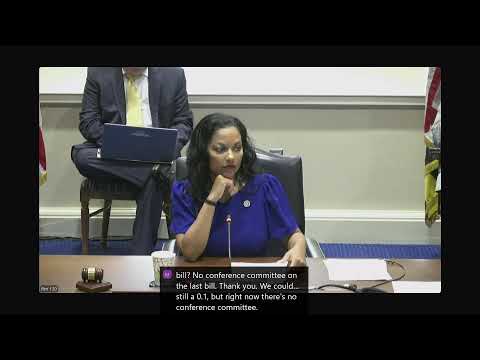
Procedural notes and attendance: Chair Barnes opened the session by welcoming student guests shadowing the committee from local high schools. Delegates Buckle and Hartman were excused. Several motions and amendment adoptions were carried by voice vote. For items where the transcript recorded named nays, those names are recorded above. Other motions passed by voice vote without individual tallies captured in the transcript.
The committee noted that one or two bills may proceed out of rules and may require floor votes if not otherwise finalized in time.
Ending: The session concluded after the voting list and brief announcements; committee staff and members reminded guests and student shadows and adjourned to the floor for remaining business.