Get Full Government Meeting Transcripts, Videos, & Alerts Forever!
Get email alerts on the Education Curriculum topic
No spam. Unsubscribe anytime.
Ways and Means Committee backs measure allowing state to withhold school funds over misaligned curriculum
Summary
The committee voted to concur with Senate amendments to House Bill 161, which establishes a process for the state superintendent to require county school systems to align local curriculum guides and courses of study with state content standards and, if uncorrected, to withhold funds.
The Ways and Means Committee on April 3 voted to concur with Senate amendments to House Bill 161, a measure that sets a process for the State Superintendent to require county boards of education to make local curriculum guides and courses of study conform to state content standards and, if they do not, to withhold funding.
The bill requires county boards to ensure local curricula align with content standards developed by the Maryland State Department of Education. Under the amended bill, if the state superintendent receives notice or determines that a county’s curriculum guides are not aligned with state standards, the county has 30 days to meet with the superintendent to discuss identified discrepancies and propose a corrective plan. If the county fails to act, the superintendent will issue a second warning after 30 days, and if the problem remains unresolved after 60 days the superintendent is required to notify the comptroller to withhold funds.
Alistair, a staff member briefing the committee, described the process and legal mechanics: “If the state superintendent determines that they have not done so, they will send another warning after 30 days. But if that is unheeded after 60 days, the state superintendent is required to withhold funding from the counties in accordance with currently existing provisions” about notifying the comptroller.
Committee members sought clarity on what the measure changes versus existing practice. Delegate Christopher Miller asked whether the bill simply codifies existing regulations into law. Alistair responded that a statutory process already exists for the Department to develop content standards, but the amended bill “sets up a process by which if on this specific subject you’re not following education law, there’s a process through which the state superintendent will meet with the counties, try and come up with a corrective plan” and that withholding funds is the built-in remedy if those steps fail.
Delegate Katie Fair asked whether the framework already exists and must be followed; Alistair confirmed that county boards are required under current law to follow the framework and that this bill formalizes the remedial process tied to withholding funding, with the amount to be determined by the state superintendent.
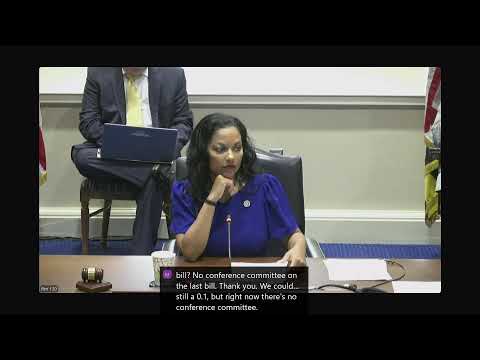
The committee approved the motion to concur. Nays were recorded from Delegate Hornberger, Delegate Long, Delegate Miller and Delegate Griffith.
The bill does not itself specify the dollar amount to be withheld; Alistair told the committee the amount would be determined by the state superintendent if the statutory remedy is triggered. The language discussed references existing statutory authority for development of content standards and the current process by which the Department develops curriculum resources in consultation with teachers; the amendment ties an explicit remediation and funding-withholding timeline to that authority.
What happened next: the committee’s vote to concur moves the amended version of House Bill 161 forward per the legislative process. The bill’s language references the state superintendent and the comptroller as the actors who would carry out withholding if the remedial steps are not completed.
Which parts of government this affects: county boards of education across Maryland, the Maryland State Department of Education (MSDE), the office of the State Superintendent, and the Comptroller’s office when funds would be withheld.
Why it matters: the bill creates a stepwise enforcement path with timelines for resolving alleged misalignment between local curricula and state-developed content standards and makes withholding state funds an explicit statutory remedy if the county does not cure identified discrepancies.
Ending note: Committee debate focused on process and statutory authority rather than on specific curricular content; the measure leaves discretion to MSDE and the state superintendent to determine remedies and the amount of withheld funds if the statutory timeline is not followed.