Get Full Government Meeting Transcripts, Videos, & Alerts Forever!
Get email alerts on the Urban Development topic
No spam. Unsubscribe anytime.
Los Angeles City Council approves Staples-area Sports and Entertainment District with community benefits, sets hotel and convention parcels aside
Summary
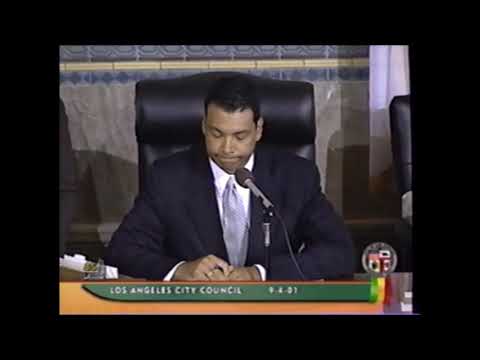
The Los Angeles City Council on Sept. 4 approved land-use entitlements, a development agreement and the environmental clearance for the Los Angeles Sports and Entertainment District, the master plan to develop property adjacent to Staples Center into a mixed-use entertainment, retail, housing and hotel area.
The Los Angeles City Council on Sept. 4 approved land-use entitlements, a development agreement and the environmental clearance for the Los Angeles Sports and Entertainment District, the master plan to develop property adjacent to Staples Center into a mixed-use entertainment, retail, housing and hotel area.
The Council approved the specific plan, a new zoning designation (the L.A. S.E.D. zone), a development agreement and related ordinances after more than two hours of public comment and debate. The actions include a requirement for an annual community-benefits status report from the developer and a direction that the City Administrative Officer and Chief Legislative Analyst study the feasibility of dedicating a portion of the district’s tax increment to the city’s housing trust fund.
Why it matters: Council members and dozens of community groups, labor unions, business leaders and neighborhood organizations described the package as unprecedented for the degree of community benefits negotiated with a private developer. Supporters said the project is intended to spur downtown economic activity, produce thousands of jobs and add affordable housing, parks and program funding. Opponents and some attorneys urged more analysis — especially on the environmental review and on whether a promised hotel and convention-center expansion are sufficiently certain.
The plan and what the council approved The entitlements approved by the council create a new L.A. Sports and Entertainment District (L.A. S.E.D.) specific plan that governs roughly 3,750,000 square feet of potential development and includes provisions for transfer floor-area ratio (some parcels could reach up to 13:1 within overall limits), a traffic program and parking standards, and a negotiated framework for up to 21 on-site and three off-site alcohol retail uses with community conditions attached. The project’s environmental review was certified by the council, and the development agreement (DDA) authorizing the developer’s commitments was adopted.
The council also voted to: have one amendment to the DDA continued for one day for technical review; require the developer to produce an annual community benefits report; and direct the CAO and CLA to study whether a portion of tax increment from the entertainment district could be devoted to the Housing Trust Fund. The council’s final adoption vote on the planning and DDA entitlements was unanimous as recorded on the council floor.
Public comment and community benefits At the public hearing, more than three dozen speakers — representing labor unions, business groups, neighborhood coalitions, social-service providers and downtown stakeholders — urged approval while emphasizing parts of the negotiated community benefits package. Supporters included Gene Hale, chairman of the Greater Los Angeles African American Chamber of Commerce, Stan Melota of Forest City Residential West, Richard Slauson of the Los Angeles and Orange County Building and Construction Trades Council, Carol Schatz of the Central City Association, and Laura Chick, the city controller, among many others. Several neighborhood groups and community advocates described results they secured in negotiations: an affordable-housing set-aside (speakers cited a 20 percent set-aside in the negotiated plan), an enforceable jobs and training program, commitments for parks and a community advisory group to consult on alcohol uses and operations.
“I was very involved in the first phase of the arena project, and my support very much was based on the fact that I saw this second phase as being key,” City Controller Laura Chick said, adding her office would release audits addressing convention-center operations that she said could help inform implementation.
Developer position and hotel financing Representatives of the arena/developer team told the council the hotel and a possible expansion parcel for the convention center remain contingent on financing arrangements that were not finalized at the hearing. Developer representative Tim Lewicki told the council the developer will reserve two parcels — one for a hotel and one for potential convention-center expansion — for 20 years so those parcels cannot be used for other development in the interim. Lewicki said the developer expected to commit, privately, “between $200 and $300 million” of additional investment in amenities to help make a hotel operator and lender comfortable, “in addition to the $500 million commitment we have with Staples Center,” and said the city and developer were working on establishing a tax-exempt nonprofit vehicle to improve financing terms for a convention-center hotel.
Concerns, legal and environmental questions Some speakers urged the council to recirculate the environmental impact report (EIR) and to provide more detail on the convention-center expansion and hotel financing before adopting entitlements. Lawrence Teeter, an advocate speaking against certification, argued the EIR failed to analyze the convention-center expansion and other cumulative impacts; the city attorney’s office responded that the Department of Transportation and city attorneys had reviewed public comments and that recirculation was not required under CEQA for the reasons set forth in their report.
Council directions and follow-up During disposition of motions on the floor, Councilmember Jack Weiss said he would move that consultants studying the hotel examine how the city’s general fund could be protected and the likely impacts on city services; the motion to study housing-trust-fund options was carried unanimously. Councilmember Ed Reyes — chairing the committee that heard the item — requested language requiring the DDA include an annual report “on the status of each action of the developer” in the community benefits program; that annual reporting requirement was adopted as an amendment and incorporated into the action.
Formal actions and outcomes The Council adopted the specific plan, the zoning and the development agreement as amended. The council approved a one-day continuance of a single DDA amendment for further technical review, directed staff to study housing-trust-fund options, and required annual reporting on community-benefits implementation. The final entitlements and the DDA were adopted by the recorded votes on the floor; the clerk recorded the final adoption as approved by the council.
What was not decided The council did not approve any direct city capital subsidy for a hotel at this meeting. The hotel financing and any public subsidy mechanisms, including potential tax increment or other financing techniques, remain subject to later negotiations and further council consideration. The developer’s commitment to reserve hotel and convention parcels for 20 years is part of the DDA language the council adopted.
Ending Council members and a broad coalition of labor, neighborhood and business groups characterized the package as a major step toward further downtown revitalization, while some attorneys and neighborhood advocates asked the city to continue careful oversight, to ensure the commitments in the DDA are enforced and to monitor the effects the project will have on traffic, air quality and neighborhood services. The next steps are implementation of the DDA obligations, the staff study of the housing-trust-fund feasibility, and future council consideration if and when a hotel financing transaction is brought forward.