Get Full Government Meeting Transcripts, Videos, & Alerts Forever!
Get email alerts on the Expungement Access topic
No spam. Unsubscribe anytime.
Committee fails to advance bill to allow access to expunged convictions for private security and private detective licensing
Summary
House File 2825, a bill to allow the Board that licenses private detectives and private security officers to access certain expunged conviction records as part of background checks, failed to advance out of the House Judiciary, Finance and Civil Law Committee on a roll call vote April 1.
House File 2825, a bill to allow the Board that licenses private detectives and private security officers to access certain expunged conviction records as part of background checks, failed to advance out of the House Judiciary, Finance and Civil Law Committee on a roll call vote April 1.
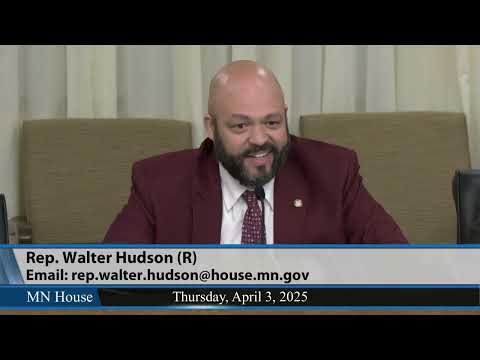
The bill’s sponsor, Representative Hudson, moved that House File 2825 be “passed and placed on the general register.” Richard Hodgson, identified in testimony as the board chair and a public member of the licensing board, told the committee the change would align vetting of private security and private detective applicants with current scrutiny applied to public safety officers.
"We are not looking to expand, or reduce or restrict or any way, who is eligible to be licensed," Hodgson said, adding the board is seeking access only to convictions that the legislature already lists as disqualifying. He cited Minnesota Statute 326.3381, subdivision 3(a), as identifying offenses that can disqualify applicants.
Why it matters: supporters said private security officers and detectives have extensive access to people, facilities and sensitive materials and so warrant the same background scrutiny as peace officers. Opponents and some committee members said the bill risks undermining the purpose of expungement statutes, which they said are intended to help people move past convictions.
Testimony and debate
Hodgson told the committee the statutory expansion of expungement took effect Jan. 1, 2015, and again with automatic-expungement provisions effective Jan. 1, 2025. He said the board has already encountered at least two cases in which applicants applied for expungement and an application became sealed before the board had completed its check, creating a risk the board would inadvertently issue a license to someone statutorily disqualified. "A sealing of the record, according to the Minnesota Supreme Court, doesn't undo the conviction," Hodgson said.
Committee members pressed on statutory intent and equity. Chair Liebling said the committee needed to weigh whether an expungement should remain sealed for these licensing decisions. Representative Frazier said his concern was that expungement and pardon have different legal effects; Hodgson agreed, saying a pardon can have a stronger "set aside" effect than sealing. Representative Ingham (recorded as Inghitt/Engin in the transcript) listed sample offenses that, in his view, would be serious enough to warrant exclusion from security work even if expunged.
Representative Hudson argued that the legislature had already decided some public-safety-sensitive professions should be treated differently and that private security increasingly fills gaps in public safety; he said a licensing standard similar to law enforcement was appropriate.
Vote and procedural outcome
A roll call recorded members as voting as follows: Chair Scott — Aye; Chair Liebling — No; Vice Chair Hudson — Aye; Vice Chair Fraser — No; Representative Bliss — Aye; Representative Corinne — No; Representative Duran — Aye; Representative Ingham — Yes; Representative Feist — No; Representative Finke — No; Representative Mohamud — No; Representative Mohler — (vote not spoken on record); Representative Rearick — Aye; Representative Steer — Aye; (Representative Mueller called but no recorded vote in transcript). The committee clerk announced, "There being 7 ayes and 6 nays but it takes 8 votes to get a bill out of committee, the motion is not adopted." The bill therefore failed to pass the committee on that motion.
Following the failed motion, Representative Hudson moved that House File 2825 be "laid over," a standard procedural step; the committee proceeded to the next item.
What the bill would have done
According to testimony, HF2825 would have allowed the Board that licenses private detectives and private security officers to access sealed or expunged conviction records in order to determine whether an applicant had convictions that Minnesota law lists as disqualifying for licensing. Supporters emphasized that the board is only seeking access to convictions that are already defined by statute as disqualifying offenses.
Legal references cited in committee testimony included Minnesota Statute 326.3381 (subd. 3(a)) and references to the state expungement framework and decisions of the Minnesota Supreme Court distinguishing sealing from pardon.
Next steps
The bill failed to move forward on the passage motion but was laid over for possible future consideration. Committee debate highlighted a continuing tension between the expansion of expungement laws and regulatory limits the legislature has set for safety-sensitive licenses.