Get Full Government Meeting Transcripts, Videos, & Alerts Forever!
Get email alerts on the Land Use Process topic
No spam. Unsubscribe anytime.
Board clears path for city‑sponsored land‑use applications that include properties with code violations
Summary
The board unanimously recommended amending Miami 21 to allow city‑sponsored land‑use or rezoning applications to proceed even when properties in the study area have municipal code violations; staff said the change is intended to enable holistic neighborhood planning rather than require each property to be violation‑free before a plan progresses.
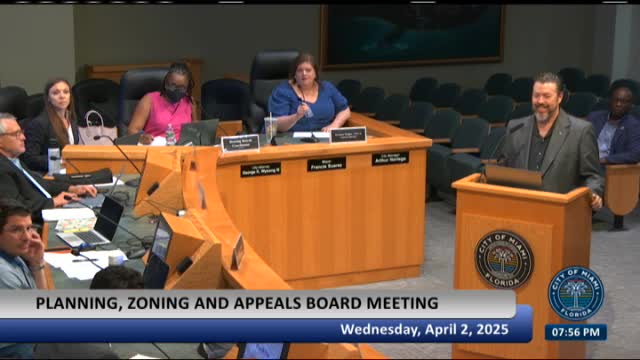
The Miami Planning, Zoning and Appeals Board voted unanimously to recommend an amendment to Miami 21 that would allow land‑use and rezoning applications sponsored by the City of Miami to proceed even if properties within the study area have open code violations.
City planning staff said the current code prevents scheduling or deciding applications when any subject property has active code violations (for example unsafe‑structure, solid‑waste or other violations), with limited exceptions such as when the property owner has a pre‑screened building permit. Planning staff told the board the restriction has produced problematic results when the city seeks to study and rezone whole neighborhoods, because the existence of violations on some parcels forces staff to exclude properties and can lead to piecemeal or “spot” outcomes.
A planning presenter explained: “This would allow applications that are sponsored by the city to move forward, if they have violations.” Board members asked questions about enforcement and whether fines or violations would be forgiven; staff clarified that the amendment would not remove fines or enforcement or change how violations are collected — it only changes whether a city‑sponsored application can be scheduled and processed.
Members discussed hypothetical scenarios in which owners with unresolved violations might remain while a neighborhood plan proceeds and noted the city retains its enforcement tools. After discussion, the board voted unanimously to recommend the code amendment to the City Commission.
The change, if adopted by the City Commission, would allow the Planning Department to advance area‑wide studies, future land use amendments and rezonings that the city sponsors without first requiring every parcel to have all violations closed. Staff said the amendment is intended to reduce procedural barriers and avoid unintended spot zoning in city‑led planning efforts.