Get Full Government Meeting Transcripts, Videos, & Alerts Forever!
Get email alerts on the Community Redevelopment topic
No spam. Unsubscribe anytime.
Board finds Allapattah redevelopment plan consistent with city comprehensive plan, recommends approval
Summary
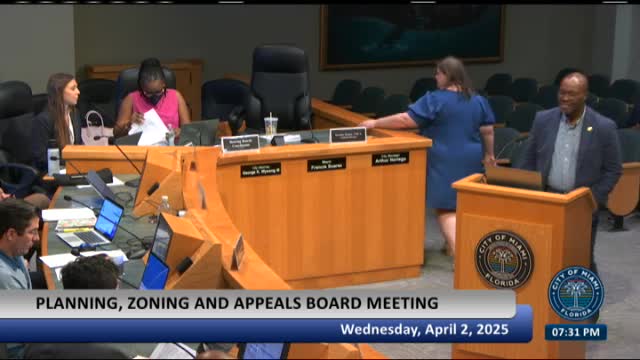
The Planning, Zoning and Appeals Board unanimously found the Allapattah redevelopment plan consistent with Miami’s comprehensive plan and recommended the City Commission consider creation of an Allapattah Community Redevelopment Area (CRA).
The Miami Planning, Zoning and Appeals Board unanimously recommended that the City Commission find the proposed Allapattah Community Redevelopment Area (CRA) plan consistent with the city comprehensive plan and transmit the plan for Commission consideration.
Kevin Crowder of BusinessFlare, the consultant team engaged to prepare the draft plan, described the CRA plan as “not a master plan document, it's sort of a vision document” that authorizes uses of tax increment financing within the district. He reviewed the proposed CRA boundary and the plan’s major themes: economic development and small‑business supports, residential and affordable housing initiatives targeted to the neighborhood’s lower median incomes, infrastructure and parks improvements, and transit and parking strategies tied to three MetroRail stations inside the boundary.
Crowder said the draft plan covers an area bounded roughly by the Airport Expressway to the north, Nineteenth Avenue to the west, the Miami River to the south, and NW Seventh Avenue/20 Second Avenue to the east, and includes opportunity‑zone parcels and brownfield‑designated areas. The consultant noted the district contains an estimated 45,000 residents, a median household income near $36,000 (compared with a countywide median around $73,000), high renter occupancy (about 79%), and rising housing prices. Crowder said findings from public outreach showed a mix of frustration and optimism among residents and stakeholders, with requests for more collaboration, transit improvements, a community center and programs for youth, and attention to small business stability.
The plan proposes tools available to CRAs under Florida Statutes — for example, directing increment revenue to land acquisition and infrastructure, targeted incentives and financing programs, pilot programs for commercial property ownership by local businesses, workforce training, and housing programs including rehabilitation, senior housing and targeted affordability criteria. Crowder and city staff said the draft would allow the CRA to set affordability levels for projects that do not use federal or state affordable‑housing funding, enabling the CRA to target lower local incomes than the countywide affordability thresholds.
Following the presentation there were no public comments and the board voted to recommend the finding of consistency with the comprehensive plan and forward the plan to the Commission. Board members asked questions about parks and schools; staff said the plan document lists two large parks (Moore Park and Duarte Park) and five schools within the boundary.
The board’s recommendation does not itself create the CRA or obligate funding; it is a required step under Florida Statutes section 163.36 allowing the City Commission to consider adoption of the redevelopment plan and CRA boundary.