Get Full Government Meeting Transcripts, Videos, & Alerts Forever!
Get email alerts on the FY2026 Budget Priorities topic
No spam. Unsubscribe anytime.
Somerville councilors outline FY2026 budget priorities as federal ARPA funding winds down
Summary
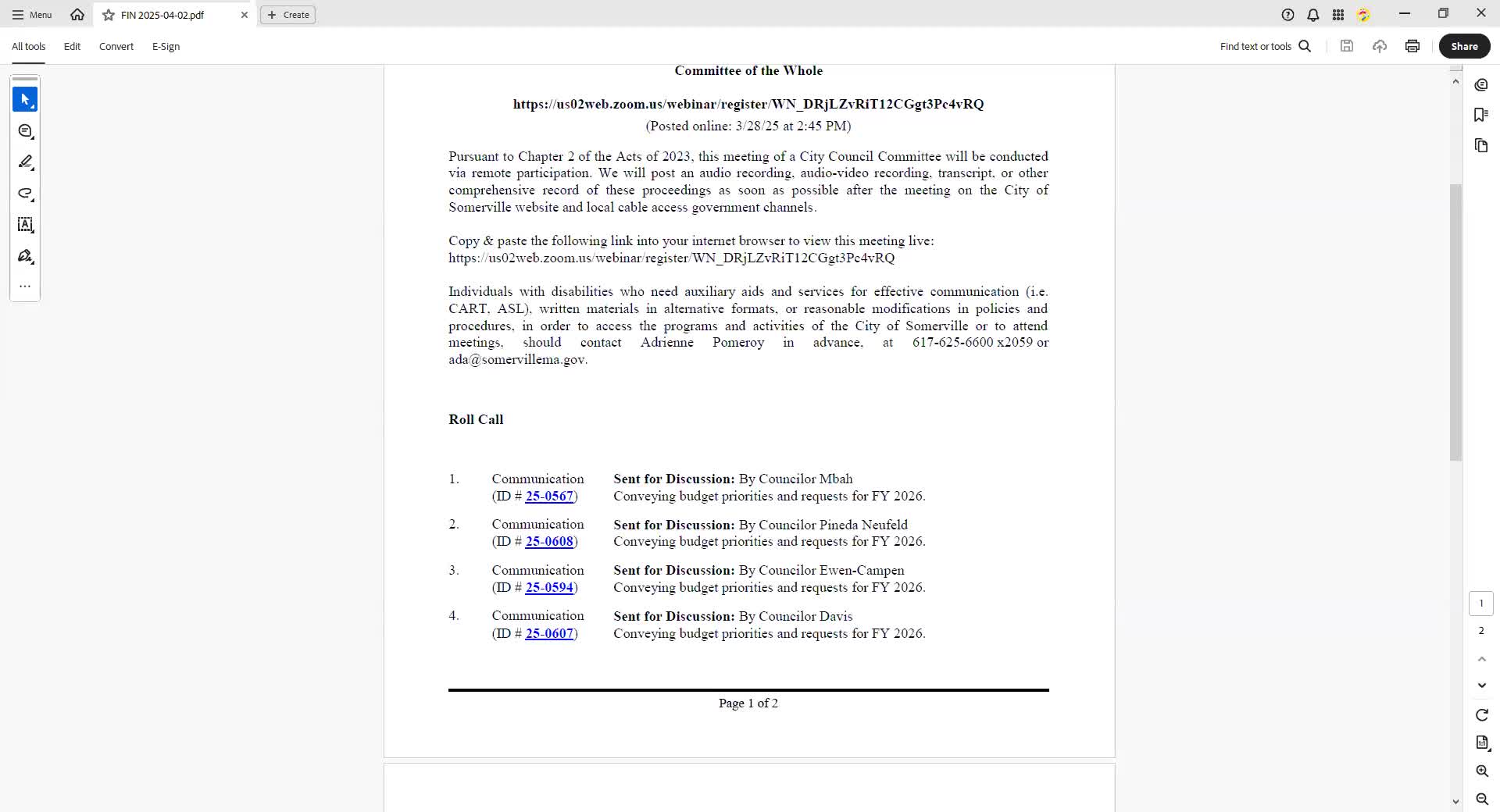
At an April 2 Finance Committee meeting, Somerville City councillors discussed priorities for the FY2026 budget, emphasizing school capital needs, affordable and supportive housing, stabilizing ARPA-funded programs, immigrant services and pilot programs for composting and alternative emergency response.
Councilor Jake Wilson, finance committee chair, called the Finance Committee meeting to order on April 2 and said the session would set the Somerville City Council’s shared priorities for the FY2026 budget.
The discussion centered on possible budget responses to an anticipated reduction in federal ARPA funding and other grant uncertainty. "This is our annual meeting to establish the city council's shared budget priorities this time for the FY 2026 budget," Councilor Jake Wilson said at the start of the meeting.
Councilor Mbah led the detailed priorities, saying the top need was school capital and contingency planning: "Priority number 1, I want to see funding for schools, renovation, and capital planning," Mbah said, urging funding for routine maintenance, HVAC and roofs and a defined "swing space" to avoid displacement if a school building must close.
Other recurring priorities included maintaining funding for affordable housing and housing stability programs, and developing permanent supportive housing. Councilor Mbah summarized the housing funding picture, saying the Affordable Housing Trust has historically drawn on several sources and that combined contributions have averaged about $10,000,000 per year. Mbah noted the Community Preservation Act surcharge will double from 1.5% to 3% and that a 2025 Affordable Housing Assistance Act expands financing options, but added that "robust local contribution will be required to sustain the affordable housing assistance effort."
Councilor Pena Neufeld and several colleagues highlighted the "ARPA cliff"—the expected end of ARPA-funded positions and programs—and urged planning to sustain services currently paid with ARPA. "I want the city to be thoughtful about how we set aside potential funds for not just when we go off our ARPA cliff, but when our community partners that deliver so many of our mental health services, our housing and security, housing assistance services... go off the ARPA cliff," Pena Neufeld said, noting reports that roughly 200 shelter beds in Cambridge and Somerville could be eliminated when ARPA funds end.
Councilors repeatedly endorsed increased support for the Office of Immigrant Affairs and language access. Councilor Strezzo urged prioritizing translation and interpretation funding so the city can distribute materials in multiple languages; several councilors "signed on" to that request during the meeting.
Several members pressed for programs and pilots already funded or partially funded to move forward: Councilor Mbah noted a $350,000 free-cash allocation to start a household food-waste composting pilot and a pending federal grant of about $400,000 that could expand the pilot to as many as 2,500 households; Mbah asked the Office of Environment to clarify the federal grant status and to include a carry-forward budget line if the grant is not awarded.
Multiple councilors called for expanded investment in municipal capacity rather than additional contractor spending. Councilor Scott urged the mayor and budget staff to consider hiring full-time employees to replace some contracted work, citing maintenance gaps in public spaces and the unspent opioid settlement funds that councilors want used for harm reduction and treatment immediately. "Our health and human services team could be standing up treatment, harm reduction programs... rather than taking a wait-and-see approach," Scott said.
Supportive housing and permanent supportive housing planning were raised by several councilors. Councilor Wilson asked the city to accelerate planning for new school construction after the Winter Hill School ceiling collapse and recommended funding a task force and consultant to plan permanent supportive housing so the city can act when capital becomes available.
Other priorities raised during the meeting included: making 165 Broadway ADA-accessible and a functioning teen center; a pilot for HEPA air filtration along I‑93; expanded safe-streets and automated traffic enforcement pilots (including camera enforcement discussed as legally permissible without a change to state law by Councilor Scott); expansion of the composting pilot to citywide service; a municipal vacancy enforcement effort for blighted properties; and creation of an unarmed alternative emergency response program for noncriminal calls.
Councilors also flagged specific budget items and amounts discussed during the meeting: an average of about $10,000,000 per year historically directed to the Affordable Housing Trust (as cited by Councilor Mbah); $350,000 in free-cash already reserved for the compost pilot and a potential $400,000 federal grant to expand it; $1,300,000 spent on Jobs Creation and Retention Trust programs in recent years with an additional $1,000,000 committed but not yet disbursed; and a suggested $92,000 allocation for a school buildings energy strategy and sustainability project manager mentioned by Councilor Burnley.
The meeting was framed as a citywide priorities-setting session rather than a formal vote on specific budget line items. Councilor Wilson confirmed these memos and oral priorities would be marked "completed" and forwarded to the administration and mayor as requested. At the meeting's close Councilor McLaughlin moved to adjourn, Councilor Burling was recognized on the motion, and the meeting ended with the chair noting the priorities would be sent to the administration.
Supporting details about each priority and the various memos read into the record were included by councilors in the meeting record and will accompany the packet sent to the mayor's office.
Somerville councilors plan to use the notes from this session to advise the mayor during FY2026 budget development, with particular attention to sustaining ARPA-funded services, advancing school capital planning and expanding housing stability programs.