Get Full Government Meeting Transcripts, Videos, & Alerts Forever!
Get email alerts on the Housing And Community Development topic
No spam. Unsubscribe anytime.
Toledo holds first public hearing on 2025–2029 Consolidated Plan; Fair Housing Center outlines impediments to housing choice
Summary
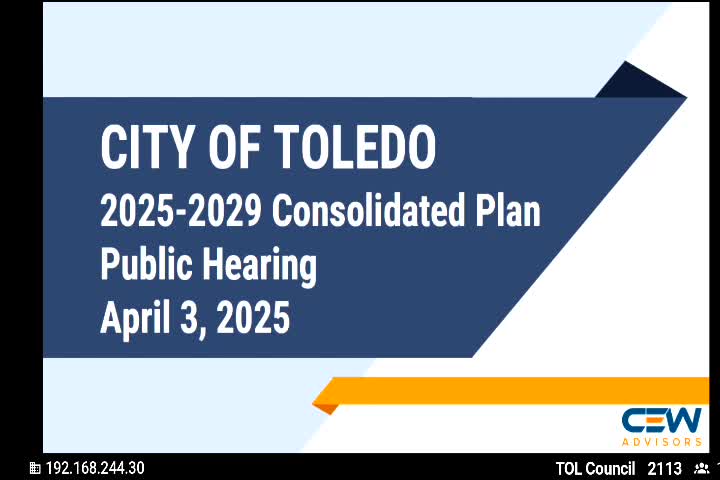
The City of Toledo’s Department of Housing and Community Development opened the first public hearing on the city’s 2025–2029 Consolidated Plan and the accompanying Analysis of Impediments to Fair Housing Choice.
The City of Toledo’s Department of Housing and Community Development opened the first public hearing on the city’s 2025–2029 Consolidated Plan and the accompanying Analysis of Impediments to Fair Housing Choice. Rosalind Clements, director of the Department of Housing and Community Development, introduced the hearing and said the consolidated plan “is a process that we have to go through as an entitlement community that receives HUD’s housing and community development fund.”
Brian Hull, president of CEW Advisors, presented the plan’s preliminary needs assessment and funding outlook. He said the plan will guide how the city uses federal Community Development Block Grant (CDBG), HOME Investment Partnerships Program (HOME) and Emergency Solutions Grant (ESG) funds over the five-year period. Hull said the city expects approximately $47.3 million across those three HUD funding streams over the next five years and gave the following annual and five‑year estimates cited in the presentation: roughly $7.1 million in CDBG next year, about $1.9 million in HOME next year (approximately $9.2 million over five years) and roughly $650,000 a year in ESG (about $3.3 million over five years).
The needs assessment presented by CEW and summarized to attendees draws on U.S. Census sources, HMIS homelessness data, the American Community Survey and other federal and local data sets, together with focus groups, neighborhood meetings and an online needs survey. Key findings described at the hearing included:
- Population and housing stock: the city population was described as about 260,000 and has declined for decades; presenters said Toledo has about 18,000 households and about 33,000 housing units. Presenters said the city’s vacancy rate is roughly 11.6 percent.
- Demographics and age: the 65–74 age cohort grew about 50 percent from 2010–2023, while youth populations have declined, which has implications for housing demand and school enrollments.
- Cost burden and housing problems: presenters said nearly 11,000 renter households and about 6,500 owner households are cost-burdened (paying more than 30 percent of income for housing). They said a little over 11,000 renters and more than 5,000 owners are severely cost-burdened (paying more than 50 percent). Overcrowding and severe overcrowding affect about 1,200 households; about 1,400 households lack complete plumbing or kitchen facilities; and just over 3,000 households reported zero or negative income.
- Homelessness: the presenters said homelessness has grown substantially in recent years, estimating roughly a 30–33 percent increase over the past four years and about 3,400 people experiencing homelessness in 2024.
- Lead hazard and housing condition risks: the presentation identified pre‑1980 housing as a lead-hazard risk and noted nearly 15,000 housing units occupied by children under age 6 as a particular concern. Presenters also described widespread blight and a sizeable portion of vacant units that may be dilapidated.
- Other needs: community respondents and focus groups prioritized affordable housing (rental and owner), homeowner rehabilitation, supportive housing for seniors and people with disabilities, services for people experiencing or at risk of homelessness, additional public services (childcare, workforce training, health and mental‑health services), and infrastructure improvements including sidewalks, stormwater management and pedestrian accessibility.
George Thomas, CEO and general counsel of the Fair Housing Center, presented the center’s Analysis of Impediments (AI). Thomas said the AI is separate from but concurrent with the consolidated plan and is intended to identify barriers that prevent residents from accessing housing opportunities protected under the federal Fair Housing Act. “Housing, where you live, powerfully impacts every aspect of your life,” Thomas said, and described the AI’s focus on historical and ongoing barriers to fair housing choice.
Thomas reviewed historical redlining and presented local data linking past disinvestment to contemporary outcomes such as fewer loan originations in central-city tracts, higher rates of child lead poisoning and other health and environmental disparities. The AI identified 14 barrier categories and proposed an action plan. Among the impediments and recommended responses Thomas highlighted were:
- Criminal-history screening: study and promote the state’s new certificate program to reduce blanket denials based on criminal records and organize clinics to help eligible residents secure certificates once the state establishes application procedures.
- Access to homeownership: encourage banks to market home-loan products locally, hold home-ownership fairs, create programs to resolve tangled-title issues and study lending data more deeply to target interventions.
- Accessibility and disability: enforce state and local building-code provisions that require accessible features when significant renovations are performed; apply Toledo’s local visitability requirement to single-family homes built with public funds; build more accessible affordable housing and supportive housing with services for people experiencing chronic homelessness.
- Source of income and voucher mobility: Thomas noted Toledo has enacted a local law prohibiting source-of-income discrimination and said enforcement systems are the next step. The AI recommends programs to increase mobility for Housing Choice Voucher holders so they can access neighborhoods of their choice.
- Zoning and food access: the AI recommends rezoning actions to remove barriers to group homes and to reduce concentrations of small “low‑access” retail that contribute to food deserts, and to incentivize healthy food providers.
- Transportation and utilities: the presenters described the recent transition to a countywide transit system and recommended additional study to ensure the system serves low-income riders and people with disabilities. Thomas highlighted local policy changes on water terminations and recommended enforcement and further measures to prevent landlords from reselling water service to tenants in ways that block access to assistance.
Public participation next steps announced at the hearing included a 30‑day public comment period from April 23 to May 23, a draft consolidated plan to be posted for review, and two additional public hearings scheduled in the council chambers on April 24 and May 1 at 5:30 p.m. Clements and Hull invited written comments to neighborhoods@toledo.oh.gov or mailed letters to the Department of Housing and Community Development. The presenters said all public comments will be reviewed, responded to and incorporated as appropriate before the plan is submitted to the U.S. Department of Housing and Urban Development.
The hearing contained no formal council vote; presenters described the planning process, data findings and next steps for public engagement. A single audience member offered an unsolicited comment during the Q&A referencing green stormwater infrastructure and received a clarification that the speaker’s slides were not presented in priority order.
The Fair Housing Center’s Analysis of Impediments and the draft consolidated plan were described as available for public review online; Thomas said the center has posted its AI on its website and welcomes public comment.
Reporting at the hearing relied on presentations by the Department of Housing and Community Development, CEW Advisors and the Fair Housing Center and on the city’s published opportunities for public comment. The consolidated plan and the AI will determine how federal HUD resources are prioritized in Toledo over the coming five years.