Get Full Government Meeting Transcripts, Videos, & Alerts Forever!
Get email alerts on the Institutional Funding Benefits topic
No spam. Unsubscribe anytime.
HEC details funding formula changes, one‑time grants to regional universities and benefit navigator impact
Summary
HEC told the Education Subcommittee April 3 that it has shifted parts of university and community college funding to reward completion and equity, awarded one‑time sustainability grants to regional and technical universities and reported postsecondary benefit navigators served more than 15,000 students last year.
The Education Subcommittee received an overview April 3 of how the Higher Education Coordinating Commission allocates state support to institutions and the use of one‑time funds to support regional and technical universities. The commission also reported early results from postsecondary benefit navigator positions funded in the current biennium.
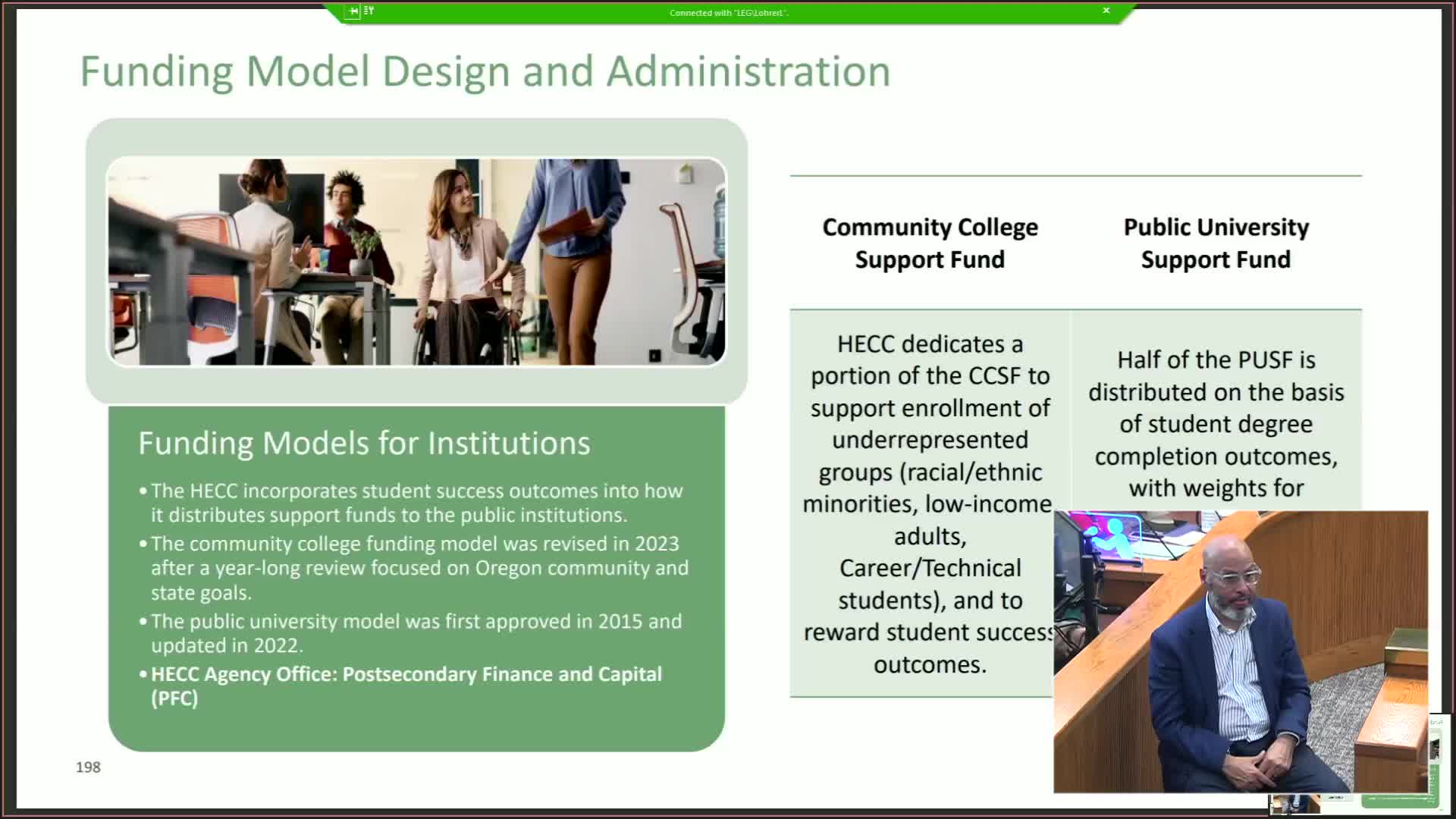
Ben Cannon and Jim Pinkard, director of the HEC’s Office of Postsecondary Finance and Capital, described recent changes to how public university support fund (PUSF) and community college support fund (CCSF) dollars are distributed. Cannon said the commission, acting under state law, moved portions of university funding toward degree completion outcomes (a model phased in beginning in 2015) and more recently adjusted the community college distribution to include progress and completion measures and weights for underrepresented students. The changes were described as efforts to balance seat‑based funding with incentives for student success and equity.
One‑time grants for regional and technical universities: Cannon said the legislature appropriated a one‑time package (described in the presentation as $24,900,000 general fund) for projects to promote the long‑term financial sustainability of Oregon’s technical and regional universities. HEC awarded grants to the five institutions and requested reappropriation of about $11,500,000 that will not be spent in the current biennium. Cannon gave examples of funded projects: Eastern Oregon University expanding high‑demand graduate healthcare programs; Oregon Institute of Technology pursuing digital transformation and student retention projects; Portland State University supporting academic program revitalization and administrative data analytics; Southern Oregon University replacing a core information system; and Western Oregon University upgrading financial systems.
Benefit navigators: The commission described the postsecondary benefit navigator program, funded in 2023–25 with a $5,200,000 appropriation. HEC said institutions distributed the funds to employ navigators who connect students with state, federal and local benefits and basic‑needs resources. Cannon told the committee the program served more than 15,000 students in the last year and produced more than 21,000 referrals for basic‑needs resources on campus. He noted that the governor’s recommended budget does not include continued funding for the navigator positions; the commission provided a written follow‑up letter with additional performance information.
Why it matters: Changes to distribution formulas and strategic one‑time investments affect institutional incentives and operations. The benefit navigator program aims to reduce nonacademic barriers to retention and completion by linking students to food, housing, health and financial supports.
HEC said it will continue to monitor outcomes and return with further analysis if the committee requests more detail.