Get Full Government Meeting Transcripts, Videos, & Alerts Forever!
Get email alerts on the Perinatal Housing Hrsn Benefit topic
No spam. Unsubscribe anytime.
Committee holds public hearing on housing measures tied to perinatal care; Medicaid housing benefit described
Summary
At an April 3 public hearing, Senator Lisa Reynolds and health-care stakeholders described a proposed approach to keep pregnant people and infants housed, including braiding Medicaid HRSN housing benefits that can pay up to six months of rent under the state's 1115 waiver funding.
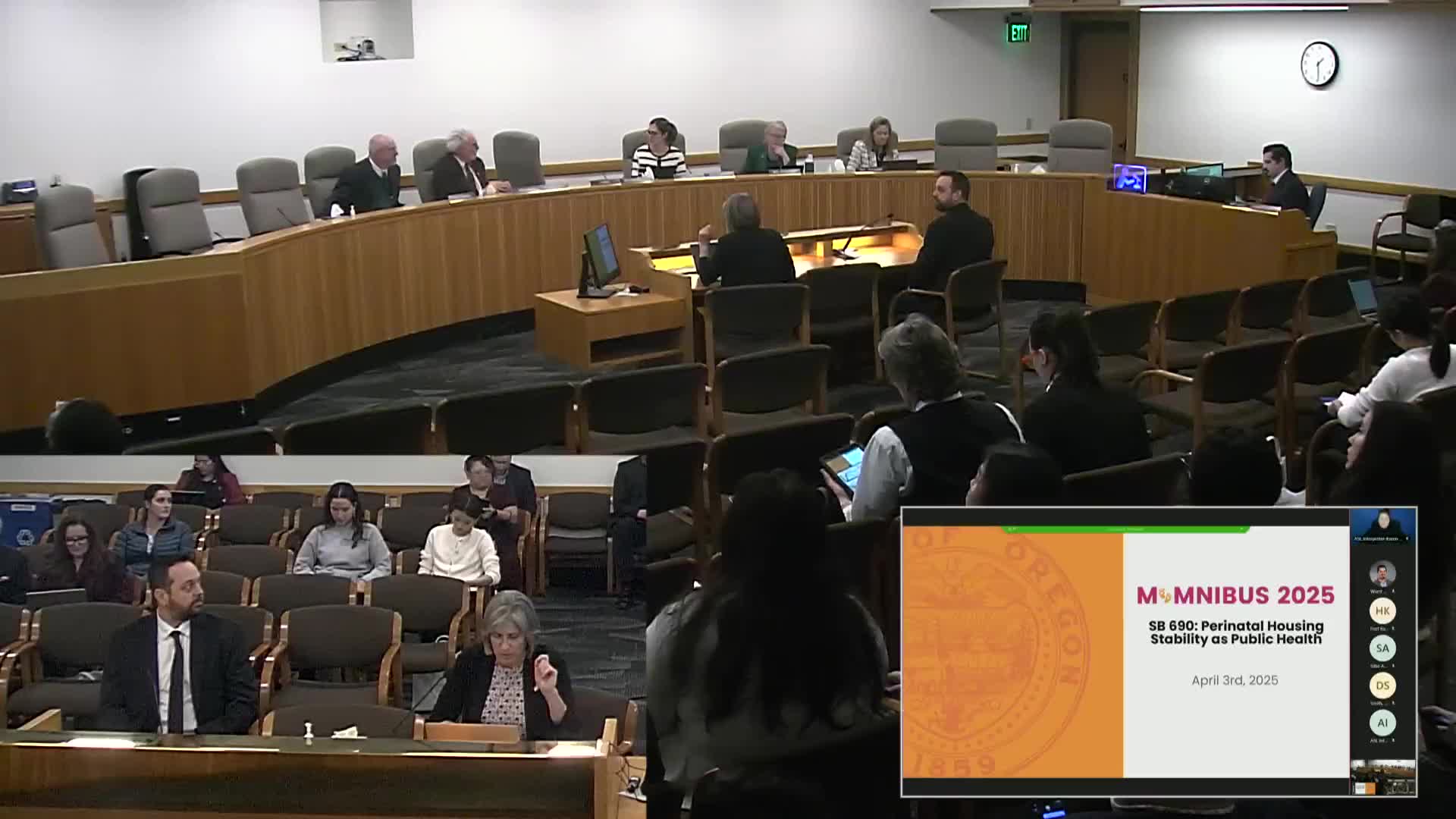
Senator Lisa Reynolds opened a public hearing on Senate Bill 690 on April 3, describing a proposed package of housing tools intended to prioritize housing stability for pregnant people and infants as part of broader perinatal policy work in the chamber.
Reynolds, chair of the Senate Committee on Early Childhood and Behavioral Health, said the bill’s forthcoming amendment would focus on keeping babies housed through three mechanisms: braiding Medicaid health-related social needs (HRSN) housing funding, preventing nonpayment evictions for families accessing services, and directing Oregon Housing and Community Services to prioritize the perinatal population for existing long-term rental assistance.
"Our coming gut and stuff amendment for Senate Bill 6 90 is all with the goal of keeping babies housed," Reynolds said on the record. She argued that housing instability during the first year of life interrupts early relational health and infant brain development and said the proposed measures aim to give families the time and supports needed to secure longer-term housing.
Josh Balak, vice president of government affairs and health policy for AllCare Health, described local CCO experience implementing the HRSN housing benefit. He said the benefit can pay rent for up to six months and is reimbursed by federal Medicaid funding in the first year. He told the committee that total funding available under Oregon’s Section 1115 waiver for HRSN purposes is up to $1.1 billion, with roughly $200 million set aside for infrastructure and the remaining funds available for housing, food and climate-related supports.
"If you are pregnant or you have or you're postpartum, that effectively does qualify you" for the benefit, Balak said, describing the two eligibility checks: an income eligibility similar to HUD’s poverty thresholds and a qualifying medical condition. He explained that the HRSN housing benefit can be used retroactively or prospectively for up to six months, and some CCOs have pursued additional HRS funding to extend assistance by roughly two months in certain cases.
Balak also described implementation limits: the HRSN housing benefit is intended as a time-limited support rather than a guaranteed bridge into long-term housing, and successful use generally requires local coordination with care coordinators, landlords and housing partners.
Vice Chair Anderson and other committee members asked implementation questions. Anderson asked whether the federal funding could be cut and if the state would have to backfill; Balak and other speakers said the federal 1115 waiver contract runs through Sept. 28, 2027, and said they did not currently expect an immediate federal withdrawal but could not predict long-term federal decisions.
The committee closed the public hearing and carried over a work session on the bill to Tuesday, April 8, 2025, for continued consideration and amendment drafting.
Ending: The hearing clarified how the Medicaid HRSN housing benefit is being used locally and signaled the committee’s intent to continue work on a housing amendment to prioritize perinatal households. The bill’s next committee work session is scheduled for April 8, 2025.