Get Full Government Meeting Transcripts, Videos, & Alerts Forever!
Get email alerts on the Student Pathways Transfer topic
No spam. Unsubscribe anytime.
HEC updates committee on direct admissions, co‑requisites and transfer reform; lawmakers urge faster progress
Summary
The Higher Education Coordinating Commission reported work on direct admissions and co‑requisite models and outlined progress under Senate Bill 233 on transfer policy — but committee members pressed for faster, better‑funded implementation.
The Education Subcommittee heard April 3 that the Higher Education Coordinating Commission is advancing multiple initiatives to smooth students’ transitions from high school to college and between community colleges and universities, but it lacks dedicated funding for some initiatives and members expressed frustration at the pace of transfer reform.
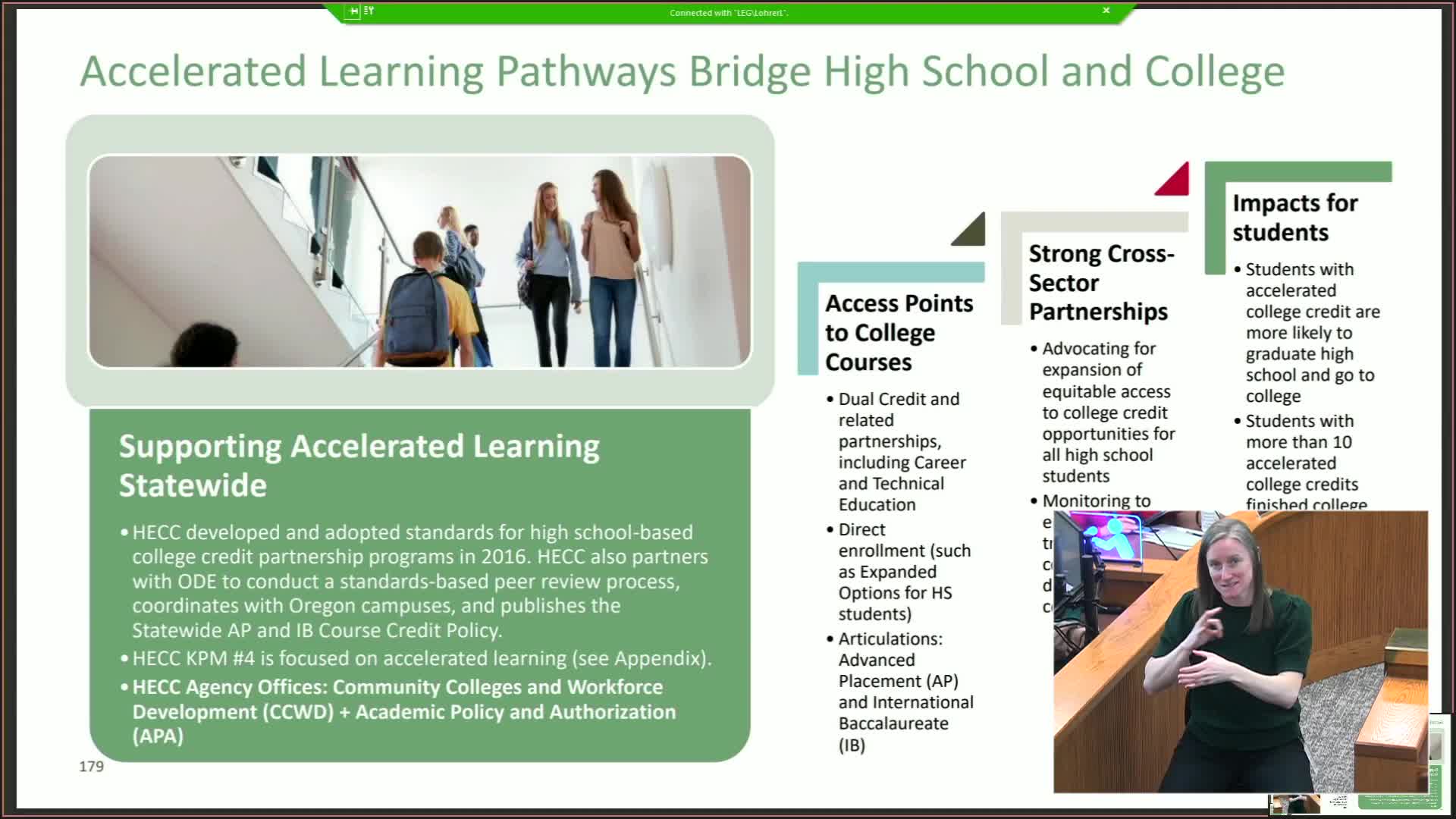
Ben Cannon, executive director of the commission, briefed the panel on several pathway initiatives the commission is leading or overseeing. He described direct admissions, a program required by Senate Bill 1552 that aims to provide automatic admission offers to qualifying Oregon high‑school graduates at public colleges and universities without a separate application. Cannon said pilots are underway and that expansion “within the next several years” is the commission’s goal, but he noted that SB 1552 included no dedicated funding in the 2025–27 governor’s recommended budget, which “limits the speed … with which we are able to achieve the goals that this program envisions.”
Cannon described co‑requisite models intended to replace remedial placement: under co‑requisites, students take college‑level courses while receiving additional, concurrent supports to address skill gaps. He said community colleges and the commission have convened a workgroup and produced recommendations to accelerate adoption.
Transfer policy and pace of reform drew sustained comment from committee members. Cannon summarized the commission’s work under Senate Bill 233 (2021), which established a transfer council and set authorities and timelines for common course numbering, core transfer maps and major transfer maps. He reported that, to date, the system has 37 commonly numbered courses that are fully transferable and six major transfer maps.
Representative McLean urged faster progress and asked the commission to return with a legislative proposal if additional authority or resources are needed. “I still care and I still really believe that this will make a big difference in the life of some,” McLean said, criticizing the slow pace and urging more resources to expand transfer maps and common course numbering.
Cannon responded that the commission is meeting the legislative timelines set in SB 233 and that much of the work has been intentionally collaborative and faculty‑driven. He told the committee that accelerating the work further would likely require legislative direction and additional staff or more centralized authority, and that the commission would treat the request for a legislative proposal seriously.
Why it matters: Transfer alignment, direct admissions and co‑requisite instruction are central to state efforts to shorten time‑to‑degree and reduce costs for students who begin at community colleges. Committee members framed the issue as both a student success and a fiscal priority.
The commission offered to follow up with additional data and with a plan if the legislature asks for accelerated timelines or resources.