Get Full Government Meeting Transcripts, Videos, & Alerts Forever!
Get email alerts on the Outreach Aspire Fafsa topic
No spam. Unsubscribe anytime.
HEC tells education committee Aspire, FAFSA outreach reach thousands but faces funding cliff
Summary
Higher Education Coordinating Commission staff told the Education Subcommittee that outreach programs including Aspire and FAFSA/ORSAA partnerships served tens of thousands of Oregon students, but expansions funded with one-time dollars face sustainability risks in the 2025–27 budget.
The Education Subcommittee heard April 3 from Ben Cannon, executive director of the Higher Education Coordinating Commission, that the agency’s outreach programs have broad reach but face budget uncertainty.
Cannon told the committee that programs run out of the commission’s Office of Student Access and Completion focus on increasing college and career readiness and financial aid access for high school students. “Aspire is a kind of linchpin,” he said, describing the program’s role in mentoring and college‑readiness work.
Why it matters: Aspire and the commission’s FAFSA/ORSAA partnerships are intended to increase postsecondary enrollment and reduce barriers to aid for students who are low‑income, rural or from communities underrepresented in higher education. Several expansions were funded with one‑time investments that expire in the coming biennium, which the commission said could limit future capacity.
Cannon and staff described three main outreach efforts:
- FAFSA and ORSAA outreach. The commission shares federal completion data back with participating high schools to help counselors target students who have not completed the Free Application for Federal Student Aid (FAFSA) or Oregon’s equivalent, the ORSAA. Cannon said the outreach partnership covers 32 counties and 279 high schools and uses training, webinars, social media and individualized texting and calling. Despite a problematic federal rollout of FAFSA, Cannon said overall completion rose year‑over‑year in Oregon and that the commission expects an improved year ahead.
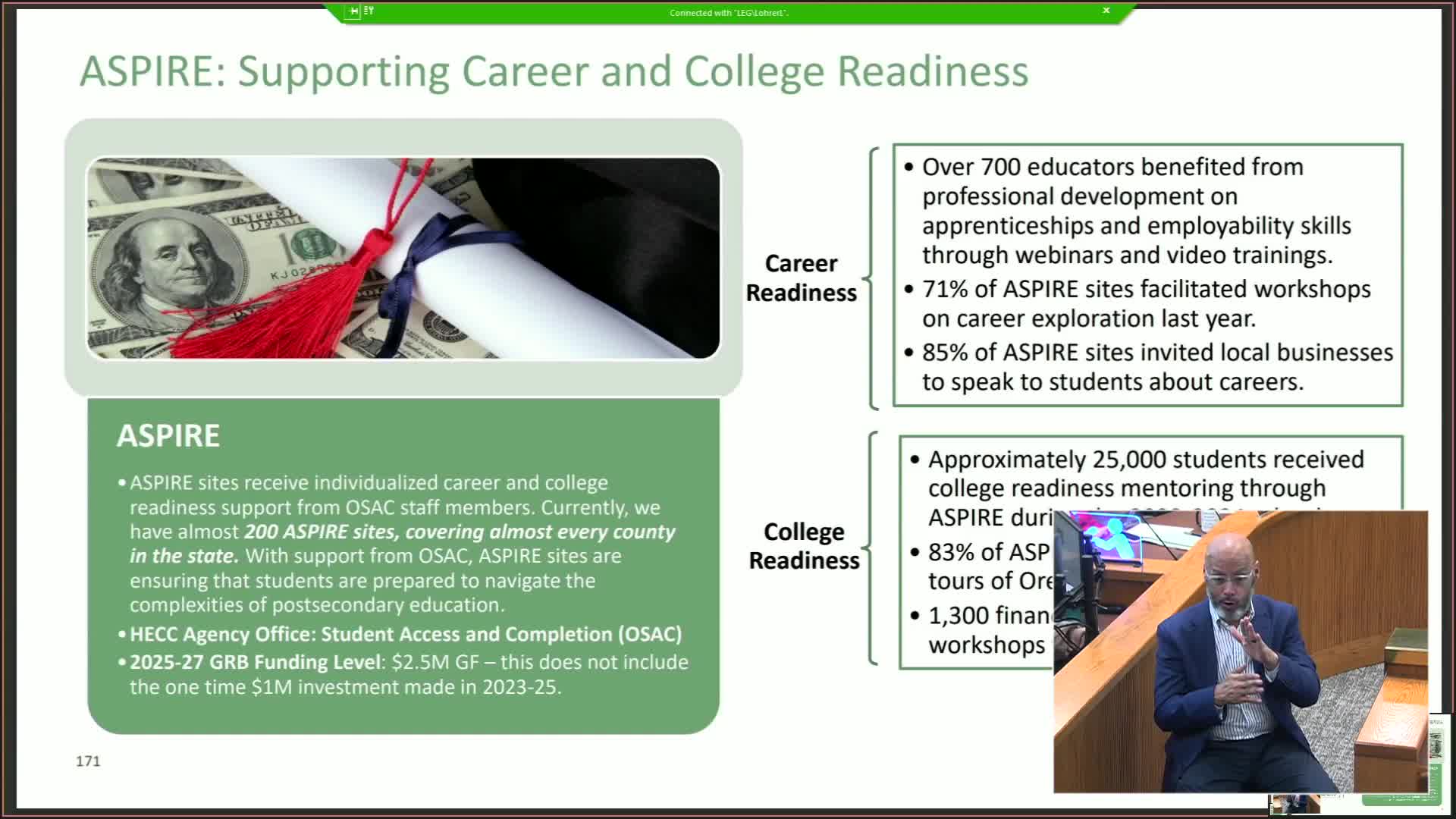
- Aspire mentoring and readiness. Cannon said approximately 25,000 students received college‑readiness mentoring through Aspire during the 2023–24 school year. He said 83% of Aspire sites facilitated student campus visits and that Aspire sites hosted more than 1,300 financial‑aid and scholarship workshops. The program now includes about 200 sites, including 149 high schools; 56 new sites were added in the 2023–25 biennium, 35% in rural communities and 18% in frontier communities, Cannon said.
- Funding and sustainability. Cannon said Aspire is supported by a small number of HEC staff and a recurring general‑fund appropriation (described in the presentation as $2,500,000 ongoing) plus grants to participating schools. He noted a $1,000,000 one‑time appropriation in the 2023–25 biennium that supported expansion; that one‑time funding is phased out in the 2025–27 budget and the commission warned the phase‑out is “likely to have an impact on our ability to sustain that expansion into future biennia.”
Committee members asked clarifying questions about definitions (for example, how the state defines “frontier communities”) and the limits of the commission’s staffing and funding. Cannon said the commission would follow up with exact statutory language for the frontier definition.
The commission provided the committee with a letter of follow‑up materials during the hearing and offered to return for additional briefings on specific outreach topics.
The presentation placed FAFSA/ORSAA outreach and Aspire as central tools to connect students to financial aid and postsecondary options, while flagging that growth achieved with one‑time funds may not be sustained without additional appropriations.