Get Full Government Meeting Transcripts, Videos, & Alerts Forever!
Get email alerts on the Permit Cost Shifting topic
No spam. Unsubscribe anytime.
Testimony in Salem highlights costly permit dispute that prompted proposed limits on shifting publicly funded improvements to property owners
Summary
House Bill 2658 would bar cities and counties with populations of 15,000 or more from conditioning permits or zone changes on applicants completing public improvements already planned or funded by a public body.
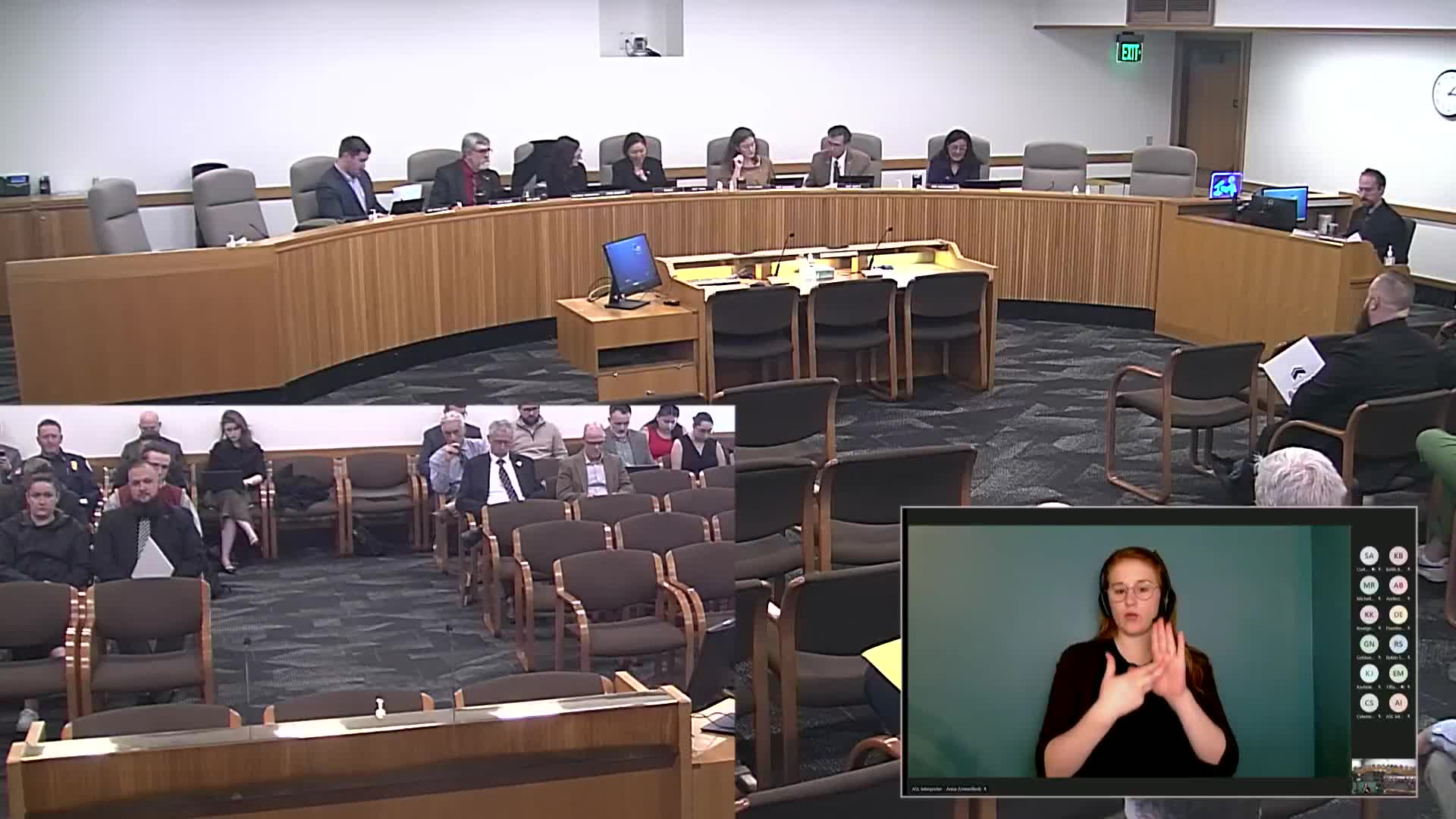
House Bill 2658 would prohibit cities or counties with populations of 15,000 or more from conditioning a permit or zone change on the applicant completing a public improvement project that a public body had already planned or financed. The bill drew extended public testimony April 3 in the House Committee on Emergency Management, General Government, and Veterans.
The hearing centered on the case of Cammie Price, a Portland small-business owner who said the City of Portland required her to pay for curb, sidewalk and ADA-ramp work tied to a multimillion-dollar Oregon Department of Transportation project that had been planned for the same corners of North Lombard Avenue.
Price said she began interior renovation of a 1,300-square-foot storefront in January 2019 and was told by the city her permits were being held because of sidewalk and ADA requirements. She testified that initial city estimates for the sidewalk work ranged from about $2,900 up to $8,000–$10,000, but later the city required civil engineering plans and a performance bond. After months of coordination among Price’s contractor, Portland and ODOT, she said bids for the corner work ballooned; the contractor she ultimately hired charged about $90,000 and with engineering fees, permit fees, performance bond and inspection costs Price said she spent roughly $132,000 in total.
Price said the corner was originally included in ODOT’s Lombard multimodal safety project, a program she said cost about $16.5 million and included 77 corner ramps, 91 crosswalks, five traffic signals and 1.3 miles of new pavement. She told the committee she learned by mailed notice from ODOT that her corner had been removed from the state project, and that she was not told earlier the city had removed the corner from ODOT’s scope.
City of Portland engineering manager Kurt Krueger told the committee the case was unusual and complex because it involved city development review on a state highway and coordination across jurisdictions. Krueger said it was "probably the first time" in nearly two decades he had seen this situation; he told members the city supports the underlying principle of avoiding duplicate cost-shifting, and that the city had proposed amendments to provide local flexibility for applicants in some cases.
Stakeholder testimony was divided. The Oregon Association of Realtors, represented by Thomas Cuomo, and several individual small-business owners and realtors urged passage, saying the bill would prevent small business owners from bearing the cost of projects already planned and funded by public agencies. The League of Oregon Cities and the Port of Portland expressed concerns that the bill is overly broad and could limit local governments’ ability to require proportional shares of infrastructure or to negotiate mitigation and construction timing with developers.
Neighbors for Clean Air and other community groups supported the narrow dash-3 amendment offered during committee discussions; proponents said the amendment focuses the measure on cases like the Parkrose/Portland example and uses existing assessment tools to guide mitigation.
No committee vote was taken on April 3; the hearing closed after extensive testimony.
Key details and clarifications
- Cammie Price’s reported out-of-pocket costs related to the corner improvement: about $90,000 construction; $10,000 engineering; $10,000 initial permit estimates noted earlier; $13,000 performance bond payments; $9,000 final inspection/closing fees; total cited: approximately $132,000.
- ODOT Lombard multimodal safety project: cited total spending about $16,500,000; included 77 corner ramps, 91 crosswalks, five traffic signals and 1.3 miles of pavement in testimony.
Why it matters
Supporters described the bill as a fairness measure that would protect small businesses and homeowners from unexpected, large infrastructure costs when the public sector has already planned and budgeted the same work. Opponents worry statewide legislation could create uncertainty for local land-use decision-making and impede negotiated solutions and necessary infrastructure financing.
Quotes
"This process was unnecessarily costly, exhausting, and duplicative. No small business owner should have to endure such an ordeal just to bring back life to their community," Cammie Price testified.
"We think where there's a capital project that's funded and ready to go, we would love to see those opportunities to take that requirement off the development community," Kurt Krueger said, adding the city sought amendments to allow flexibility in some cases.
Ending
Committee members heard substantial, split testimony and did not act on HB 2658 on April 3. The committee record now includes a range of amendment proposals and stakeholder offers to continue negotiations on a narrower remedy.