Get Full Government Meeting Transcripts, Videos, & Alerts Forever!
Get email alerts on the Veterans Services topic
No spam. Unsubscribe anytime.
Senate bill seeks $300,000 for veterans suicide-prevention grants; broad support from veterans groups
Summary
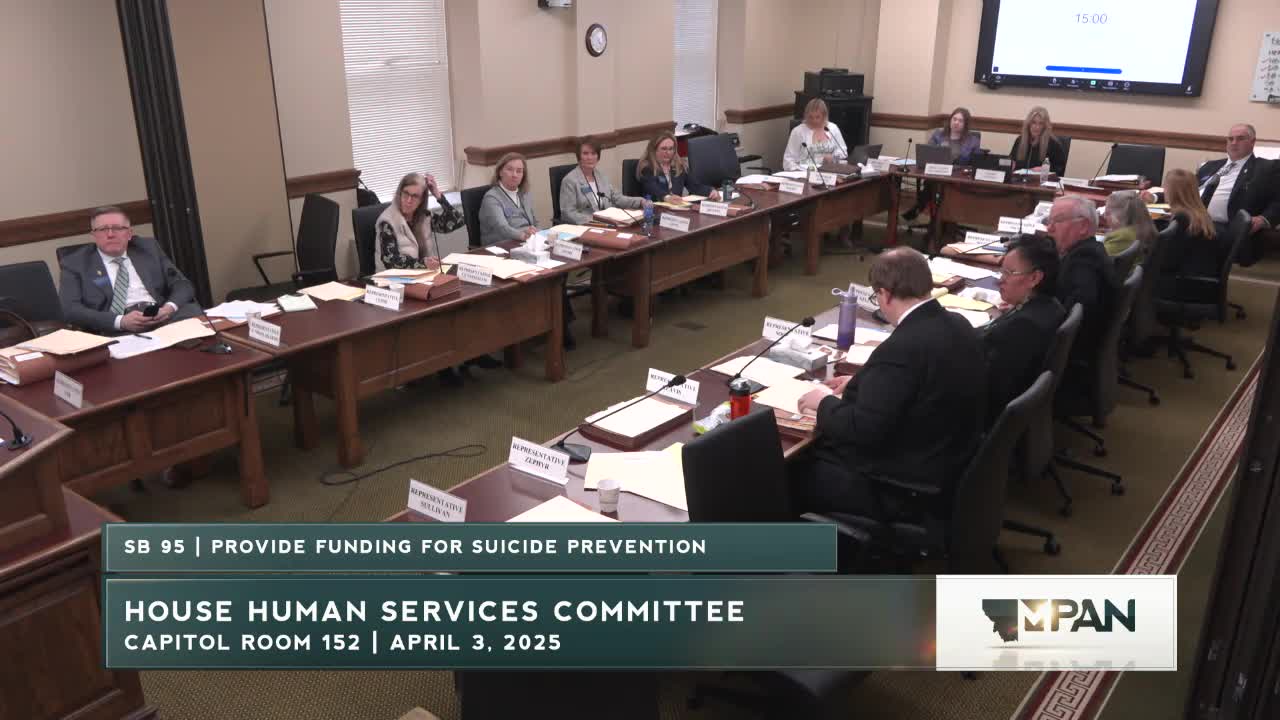
Senate Bill 95 would provide a one-time $300,000 appropriation to fund community-based veteran suicide-prevention activities, including peer support and outreach, proponents told the House Human Services Committee during a hearing.
Senator Mike Yakawich opened Senate Bill 95 and described the legislation as a one-time request of $300,000 to fund veteran-focused suicide-prevention activities. "We're asking $300,000 one-time," he said, and invited community groups and veterans organizations to describe how the funds would be used.
Multiple proponents testified in favor. Justin Dupree, a Fort Peck tribal council member and veterans committee chair, described personal difficulties with VA behavioral-health encounters and urged more local resources and culturally competent care. Major General J. Peter Ronek, adjutant general and director of the Department of Military Affairs, said the Montana National Guard will collaborate with DPHHS and Montana Veterans Affairs Division to share resources and risk-reduction programs if the bill passes. Montana Veterans Affairs Division leadership and organizations including the American Legion and NAMI Montana urged passage, stressing the state’s high veteran suicide rate and the need for peer support and community outreach. John Tabb, DPHHS suicide-prevention program manager, said DPHHS supports SB 95 and called it a way to increase protective factors for veterans.
Supporters described grant-funded activities such as veteran peer support, gun-lock distribution and education, local navigation networks and alignment with federal programs. Proponents said Montana has one of the highest per-capita veteran populations and a persistently high veteran suicide rate; they argued targeted state funding would support community organizations and connect veterans to services. DPHHS staff and program managers said the funding would be distributed through grants to organizations that work with veterans and service members.
One opponent, Kathryn Wedemeyer of the Citizens Commission on Human Rights, urged the committee to prioritize non-drug, non-coercive treatments and expressed concern about reliance on psychotropic medication in existing treatment models; she asked the committee to amend the bill to emphasize non-drug modalities. Committee members pressed sponsors for details about how grant recipients would be chosen, how programs would be measured and how the new funding would align with federal resources. The sponsor and proponents said the money would be allocated to community organizations with reporting requirements and that it is intended to complement, not replace, federal programs.
Senate Bill 95 drew broadly bipartisan and cross-sector support from veterans’ organizations, tribal representatives and state military leadership during the hearing; no committee vote was recorded in the transcript for SB 95.