Get Full Government Meeting Transcripts, Videos, & Alerts Forever!
Get email alerts on the Federal Energy Policy topic
No spam. Unsubscribe anytime.
Opponents urge committee to reject House resolution that calls for loosening federal environmental laws
Summary
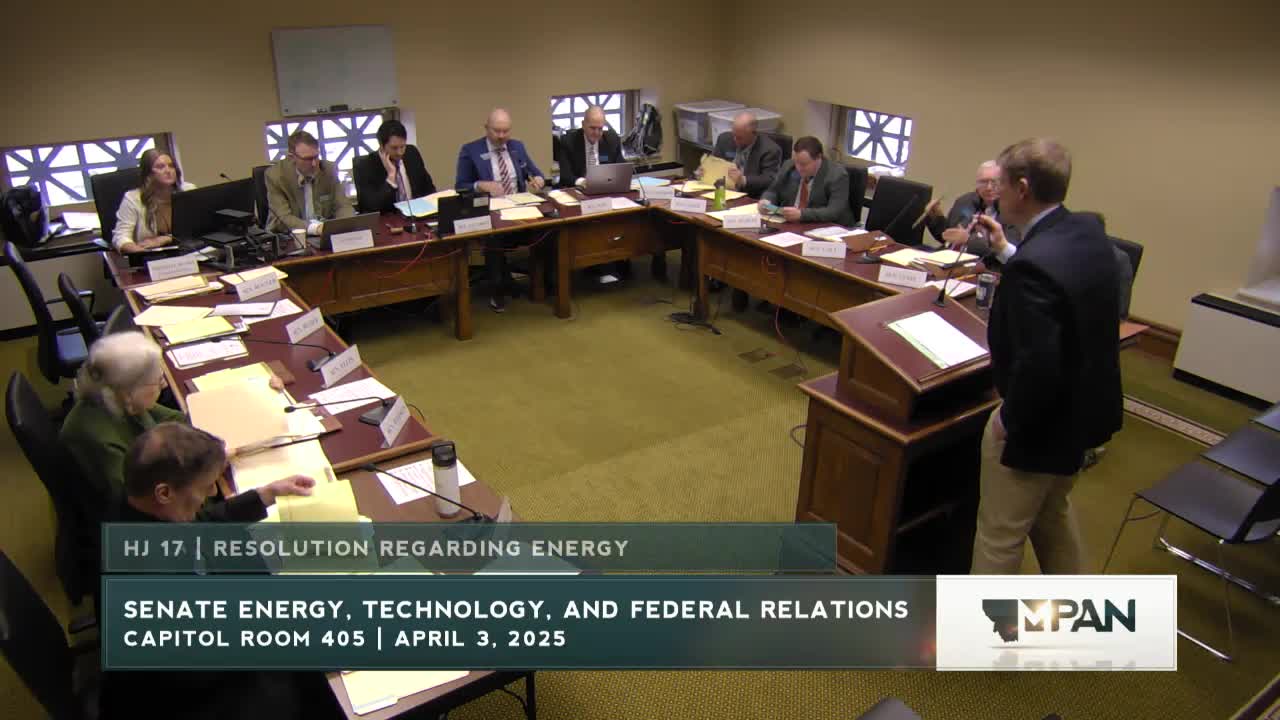
House Joint Resolution 17, which asks Congress and the President to take steps to increase domestic energy production including via permitting reform and expanded executive waivers, drew strong opposition from conservation and environmental groups at a committee hearing.
The committee heard divided testimony on House Joint Resolution 17, a measure asking Congress and the President to pursue steps to ‘‘improve energy production in the United States’’ including permitting reform, support for critical minerals, and broader use of executive tools to speed projects.
Sponsor Representative Steve Fitzpatrick described the resolution as a request that federal authorities prioritize energy production and permitting reforms. Opponents characterized the resolution as an effort to undermine longstanding environmental protections. Shannon James of the Montana Environmental Information Center said HJ 17 calls for weakening laws that protect public health and safety and specifically cited the Mercury and Air Toxics Standards (MATS) as a rule the resolution encourages Congress to reconsider. Derek Goldman of the Northwest Energy Coalition agreed that the resolution’s framing is a ‘‘red herring’’ that misattributes permitting and interconnection problems to environmental laws rather than to transmission and interconnection processes.
Natalie Wright of Montana Conservation Voters Education Fund and Peter Dudley of Montana Audubon testified in opposition, warning that the resolution advocates for using emergency or executive powers to bypass the legislative branch and could increase pollution and litigation risk. Wright submitted data on Clean Air Act trends and urged senators to correct citations in the resolution.
Representative Fitzpatrick closed by thanking the committee and said typos could be fixed in drafting. The transcript does not record a committee vote in the excerpt provided.