Get Full Government Meeting Transcripts, Videos, & Alerts Forever!
Get email alerts on the State Grant Funding topic
No spam. Unsubscribe anytime.
Senate panel hears hours of testimony as lawmakers weigh changes to Minnesota State Grant amid $200M+ shortfall
Summary
The Minnesota Senate Higher Education Committee met in a lengthy hearing to consider proposals to address a projected shortfall in the Minnesota State Grant program, hearing testimony from students, system officials, unions and state analysts about how changes would affect low‑income, first‑generation and student‑parent borrowers.
The Minnesota Senate Higher Education Committee met in a lengthy hearing to consider proposals to address a projected shortfall in the Minnesota State Grant program, hearing testimony from students, system officials, unions and state analysts about how changes would affect low‑income, first‑generation and student‑parent borrowers.
Committee members and witnesses gave varying estimates of the shortfall, with figures cited in committee materials and testimony ranging from roughly $211 million to about $240 million for the upcoming biennium. Lawmakers discussed a mix of permanent parameter changes and temporary rationing measures to close the gap.
Why it matters: The State Grant is a primary need‑based aid program for Minnesota students; changes to its formulas determine which students qualify and how much they receive. Witnesses warned that certain technical changes could disproportionately reduce awards for independent students and student parents while others argued the largest savings come from addressing tuition and fee drivers.
Committee discussion and proposals
Legislators debated several amendment packages (identified in committee as A‑9, A‑1, A‑2, A‑7, A‑10 and A‑4) that aimed to reduce program spending or raise revenue. Common proposals included lowering the Living and Miscellaneous Expense (LME) allowance from 115% to 110%, reducing lifetime eligibility from 180 to 120 credits, adjusting assigned family responsibility (AFR) modifiers, restoring earlier treatment of the student aid index (SAI), and changing the application deadline to 30 days after the start of term.
Senators pressed the Office of Higher Education (OHE) and university systems for clearer estimates and impacts on subgroups. OHE staff and campus financial aid directors urged caution in making permanent changes until additional data is available and recommended relying in part on the program's existing rationing statute as a temporary tool.
What witnesses told the committee
Students and student advocates described how the programs operate in real lives and urged lawmakers to avoid measures that would cut aid for those with the greatest need.
Student Australia Ford of Metropolitan State testified about balancing parenting and college costs and urged the committee to oppose measures that would "disproportionately harm student parents and low income students across the state." Ford warned that "treating negative SAI as 0 would result in a 35% decrease to the average state grant award" for some independent students with children, language she and others used to stress the consequences of recoding negative SAI values.
Shay Horning, director of state affairs for the University of Minnesota Undergraduate Student Government, told the committee the grant program is "at a crossroads facing a $211,000,000 shortfall" and cautioned that across‑the‑board cuts would hurt the lowest‑income students and widen equity gaps. Horning summarized disparities in average awards by sector and said private nonprofit students receive substantially larger institutional and state aid on average than public college students.
Representatives of the University of Minnesota and Minnesota State (the public systems) presented a joint proposal that combined a small number of permanent parameter changes with greater use of the statute’s rationing provisions as temporary reductions. Meredith Burgess, scholarship and financial aid analyst at the University of Minnesota, said permanent reductions proposed by systems totaled about $77 million and recommended that the remainder of deficit reduction be done temporarily so the program could be adjusted with better data.
Carrie Schneider, research director at the Office of Higher Education, provided data on recent award distributions, noting private nonprofit four‑year institutions accounted for a substantial share of grant dollars to four‑year students in FY2024.
Public college faculty and student groups — including Minnesota State faculty representatives and Students United — urged protecting public institutions and students with greatest need. Mark Grant, a Dakota County Technical College instructor, emphasized that 43% of State Grant participants attend two‑year colleges yet receive a smaller share of total grant dollars.
Tuition caps, endowment fees and other revenue options
Several lawmakers and witnesses proposed rethinking the statutory tuition cap used in the grant formula. Some proposals would tie the tuition cap for private institutions to the highest Minnesota State university rate rather than the University of Minnesota rate in order to reduce how much the formula rewards higher‑tuition campuses.
Senator proposals also included an optional institutional ‘‘participation fee’’ tied to endowment growth for schools with large endowments (an amendment described in committee as A‑4). Proponents framed it as a way to create a dedicated revenue stream to make the State Grant perennial and "whole." Opponents called the idea a tax on institutions and warned it could create unintended consequences.
Distinguishing discussion from decisions
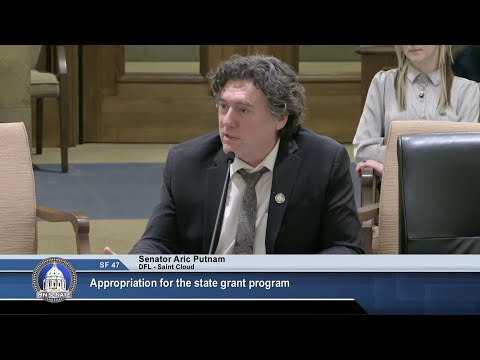
No final policy changes were enacted during the hearing. Several amendments were offered and later withdrawn by their sponsors (committee record shows multiple amendments — including A‑9, A‑1, A‑2, A‑10 and A‑4 — were withdrawn). Committee members said they would continue work on the bill as part of a broader budget package and requested additional data from OHE. The committee laid over Senate File 47 for further consideration.
Key technical details discussed
- Rationing statute: multiple witnesses urged using the statutory rationing mechanism as a temporary means of award reductions so cuts could be proportional by cost and assets and protect lowest‑income students. - Student Aid Index (SAI): witnesses opposed recoding negative SAI values to zero, saying negative SAI identifies the most financially vulnerable students and that changing it would reduce awards for independent parents most sharply. - Assigned family responsibility (AFR) and assigned student responsibility: raising these parameters would reduce awards; witnesses cautioned about unequal impacts across sectors. - Living & Miscellaneous Expense (LME): several proposals suggested reducing the LME allowance from 115% to 110% (or similar small rollbacks) to save funds without targeting a narrow population. - Application deadline: changing the application deadline to 30 days after the start of term was proposed to limit late filers; university and state system staff warned an earlier deadline would especially affect two‑year and spring start students.
What comes next
Committee members asked OHE and campus financial aid officers for more detailed impact modeling and indicated they would continue negotiating changes as part of the broader budget process. No final votes were recorded in the hearing; the committee laid Senate File 47 over for future action.
Sources: testimony and data presented to the Minnesota Senate Higher Education Committee (transcript).