Get Full Government Meeting Transcripts, Videos, & Alerts Forever!
Get email alerts on the Elections Policy topic
No spam. Unsubscribe anytime.
Senate Elections Committee hears extensive testimony on omnibus elections policy bill SF2384; markup set for next week
Summary
Senate File 2384, an omnibus elections policy bill combining provisions on campaign finance, disclosure, election administration, absentee voting, and local filing rules, received detailed walk-throughs and mixed testimony from election administrators and advocacy groups. The committee laid the bill over for markup next week.
Senate File 2384, the 2025 elections policy omnibus bill, received a detailed read-through and broad public testimony at the April 3 meeting of the Minnesota Senate Elections Committee.
Senator Westlund, who introduced the policy portion of the bill, said the measure "includes a wide range of pro democracy reforms that will help improve transparency, prevent corruption and fraud, close loopholes in our campaign finance laws, and strengthen election administration across the state." Counsel Kim Stangley (referred to as Miss Stangley in the transcript) then walked members section-by-section through the nearly 82-page amendment, identifying sources for each provision.
The bill incorporates numerous earlier proposals and committee recommendations. Article 1 includes campaign finance and disclosure changes adopted from multiple bills (including provisions from Senator Marty, Senator Swadzinski, Senator Westlund, Senator Gustafson and others) such as: adjustments to definitions ("expressly advocates," "independent expenditure," and "lobbyist"); new registration and reporting requirements for designated lobbyists and expert witnesses; expanded coverage of statements of economic interest (including reporting virtual currency, stocks and stock options); and updated disclaimer language and digital-ad disclosure rules. Article 1 also contains a default effective date provision (section 47) stating a default effective date of January 1, 2026 unless otherwise provided.
Article 2 focuses on election administration and absentee/mail voting procedures and includes items drawn from the Office of the Secretary of State (OSS) and bills by Senator Kuran (the Mako bill) among others. Provisions described by committee counsel and testifiers include removing the permanent absentee application from the voter registration form and placing it on the absentee ballot application; timeline changes for public voter records requests (shortening from 10 to 5 days); expanded access and procedures for absentee voting in health care and residential facilities; requirements for chain-of-custody plans; changes to e-poll books and combined polling places; expanded testing and public notice requirements for voting-system testing; and a requirement in mail-ballot jurisdictions that mail ballots be sent at least 20 days before election day. Article 2 also contains a default effective date (for some provisions) of July 1, 2025, with various sections carrying different effective dates as noted in the amendment.
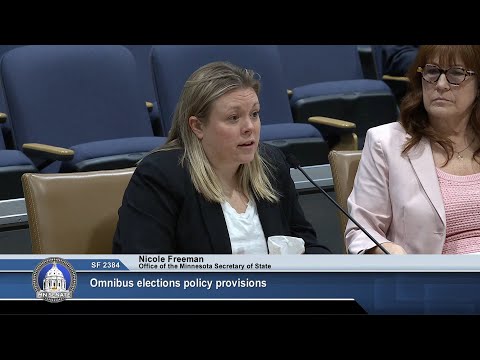
Office of the Secretary of State: Nicole Freeman, policy staff at the Office of the Minnesota Secretary of State, testified in support and emphasized administrative and security improvements. "The bill, I think, really brings forward some great ideas that support local election administrators and, the work that they do," Freeman said. She highlighted removing the permanent absentee application from the voter registration form and placing it on the absentee ballot application to improve clarity and capture required identification numbers.
Local election administrators and organizations expressed general support with technical caveats. Matt Hilgert of the Association of Minnesota Counties said the bill contains "a lot of great sensible, reasonable, and bipartisan proposals" and urged careful consideration of expanding economic interest statement requirements so they apply to officials who make budgetary or policy decisions. Michael Stahlberger, representing Blue Earth County and the Minnesota Association of County Officers, praised chain-of-custody formalization, e-poll books and the errors-and-omissions remedy for correcting ballot problems to avoid court time.
Advocacy groups took different positions on campaign finance provisions. Kathy Blazer, co-executive director of Minnesota Citizens Concerned for Life, warned that expanding the definitions of independent or coordinated expenditures beyond express advocacy could run afoul of free-speech protections and cited precedent. "To limit that right by adding a definition of independent or coordinated expenditures that includes expression outside of express advocacy would gut that protection and so would quickly be found unconstitutional," she said.
By contrast, Elizabeth Schimmick, senior legal counsel at Campaign Legal Center, urged expanded disclosure to cover paid communications that "promote, attack, support, or oppose a candidate" (often called PASO communications), arguing such updates would align Minnesota with other states and reduce "dark money" influence. Clean Elections Minnesota (Mary Hartnett) similarly supported transparency measures, digital disclaimers and anti-coordination language, and urged additional campaign finance reforms in future sessions.
Committee process and next steps: Senator Westlund said she looks forward to the bill markup next week. The chair confirmed the committee will meet again to consider amendments and continue work on the omnibus bill.
Key provisions highlighted in testimony
- Removal of permanent absentee application from voter registration form; placement of permanent absentee on absentee ballot application (OSS). - Chain-of-custody plans for ballots and election materials (OSS and county administrators). - Requirement that mail ballots be sent at least 20 days before election day in mail-ballot jurisdictions. - Expanded statement of economic interests to include virtual currency and stock holdings, and timeline changes for filing. - Expanded campaign finance definitions and digital-ad disclaimer requirements to increase transparency and address independent spending and coordination concerns.
What the committee decided
- Senate File 2384 was laid over for further consideration and markup at the committee's next meeting; no final votes on SF2384 were taken at the April 3 hearing.
Participants and roles quoted in this report reflect how they identified themselves in committee testimony or the hearing record.