Get Full Government Meeting Transcripts, Videos, & Alerts Forever!
Get email alerts on the Country Of Origin Labeling topic
No spam. Unsubscribe anytime.
Montana Legislature backs federal country-of-origin labeling for beef and pork
Summary
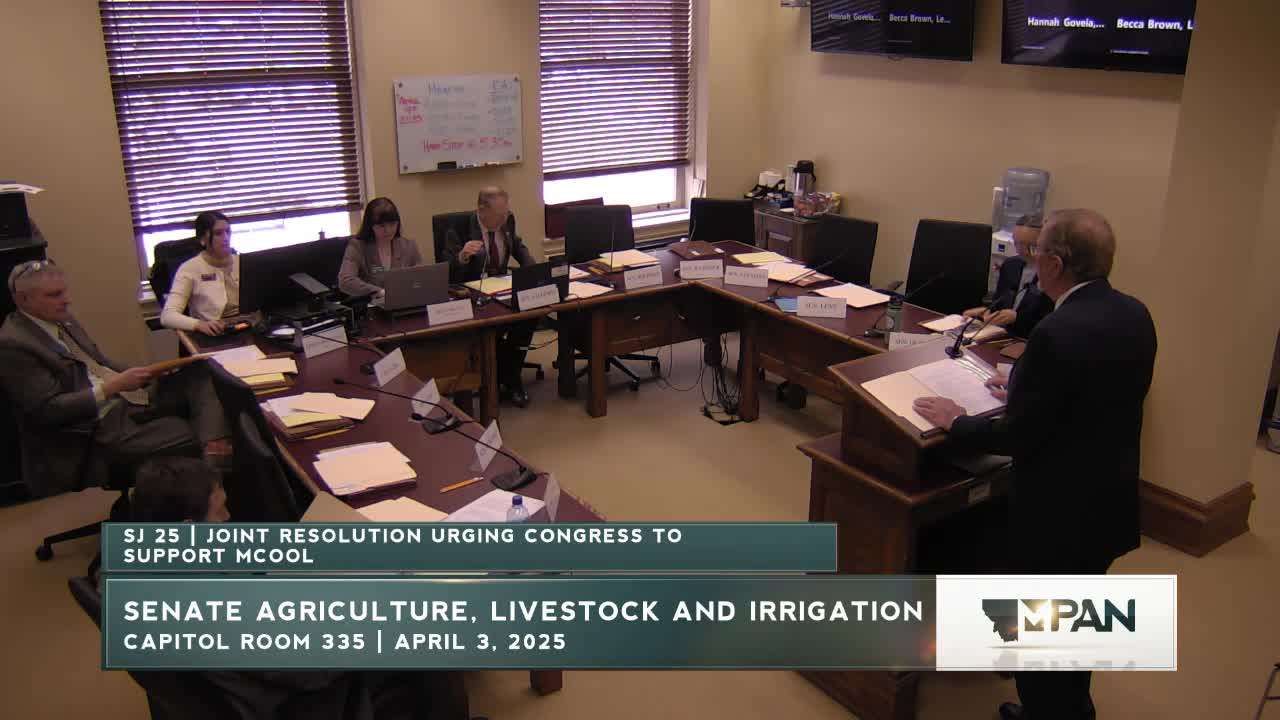
The Senate Agriculture Committee voted 6-5 to urge Congress to require country-of-origin labeling for beef and pork, after hearing largely pro-COOL testimony from ranchers and producer groups and a call for voluntary labeling from the Montana Farm Bureau.
The Montana Senate Agriculture Committee voted 6-5 to approve Senate Joint Resolution 25, a measure urging the U.S. Congress to adopt mandatory country-of-origin labeling for beef and pork.
Sponsor Sen. Willis Curti, Senate District 49, told the committee the resolution is a consumer-protection and market-transparency measure and cited a recent U.S. House and Senate reintroduction of federal legislation on the topic, saying mandatory labeling would allow U.S. ranchers to get full value for higher-quality meat.
The resolution drew broad support from Montana ranchers and agricultural groups. Caroline Canarios of the Northern Plains Resource Council said the measure would give consumers “the opportunity to confidently choose products raised by American ranchers.” Rachel Prevost of Montana Farmers Union told the committee that Montana once required COOL for beef and pork and urged the state to again press Congress to restore nationwide mandatory labeling.
Producer witnesses told the committee they want transparency and the ability to market Montana-raised beef as born, raised and processed in the U.S. Richard Liebert, president of the Montana Cattlemen’s Association, said past COOL rules helped producers and that packers opposed the rules because they benefit from mixing imported, lower-cost product into the U.S. supply.
The Montana Farm Bureau, represented by Casey Mott, opposed mandatory federal COOL and urged a voluntary approach. Mott said a federal mandatory program in 2015 prompted trade threats from the World Trade Organization and argued voluntary labeling would avoid potential retaliatory tariffs.
Committee members discussed those trade risks and market effects. Sen. Dunwell asked whether the sponsor believed the measure was timely amid current tariff and trade uncertainty; Curti cited past examples of Montana producers losing markets after contamination events and said the study could inform policy responses. The committee approved the resolution on a roll call: Chair Gillespie, Vice Chair Boldtman, Sen. Curti, Sen. Dunwell and others voted aye; Vice Chair Casmeier, Sen. Glim, Sen. Lenz, Sen. McKinney and Sen. Tzcziak voted no.
Votes at a glance
- SJ 25 — Motion: “Do pass on senate joint resolution number 25.” Mover: Sen. Glenn. Outcome: approved on roll call, 6–5.
The sponsor asked that the committee advance the resolution to send Montana’s support for mandatory COOL to Congress.