Get Full Government Meeting Transcripts, Videos, & Alerts Forever!
Human Services finance panel advances DHS omnibus and lays over housing, homelessness, dementia and trafficking bills
Summary
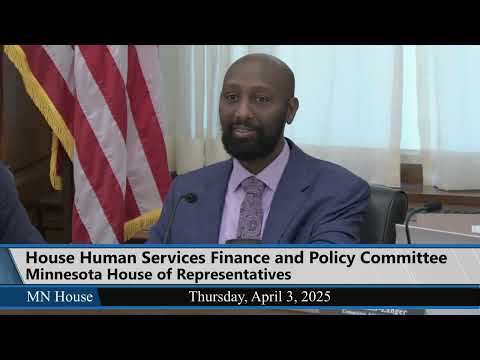
The Minnesota House Human Services Finance Committee on April advanced a Department of Human Services policy omnibus (House File 2,115) to the General Register and laid over several homelessness, supportive-housing and human-services bills for possible inclusion in omnibus or budget bills.
The House Human Services Finance Committee moved the Department of Human Services policy omnibus (House File 2,115, as amended) to the General Register and laid over a package of bills addressing homelessness, supportive housing, assessments, dementia grants and services for victims of sex trafficking.
Representative Erik Schumacher, the author and floor sponsor, moved the omnibus and won voice approval from the committee after the body adopted two amendments (DE2 and A2) that the author said put the bill “in the shape of the author.” House Research staff walked members through each article of the measure, which bundles provisions affecting aging and disability services, the new Direct Care and Treatment agency, behavioral health, the Office of Inspector General, licensing and background studies, concordant rulemaking changes and various technical edits.
The committee also heard and laid over standalone bills and funding requests for the Minnesota Homeless Study (Wilder Research), a Family Supportive Housing grant program, expanded supportive housing for people with serious mental illness (the HASAMI program), restoration of housing-support service rates and improved processing timelines, reforms to MN Choices reassessments, expanded dementia grants, additional shelter capital and youth homelessness investments, Safe Harbor services for trafficking victims, and supplemental rates for the Avivo Village shelter model.
Why it matters: HF 2,115 is an omnibus vehicle that collects many policy changes stakeholders and the agency have negotiated across the year; the other measures address acute gaps in homelessness response, family and youth supportive housing, and targeted services for people with serious mental illness or trauma from sex trafficking. Several testifiers told the committee that data and ongoing state investments inform operations and federal funding applications, while providers said current gaps threaten capacity or force long waits for services.
DHS omnibus highlights Representative Schumacher and House Research staff described the omnibus as a yearlong, bipartisan consolidation of measures heard by the committee. House Research summarized the bill into discrete articles: Article I (aging and disability services) pulls together multiple authors' proposals; Article II covers Department of Health items including case-mix and assisted-living changes; Article III updates statutes for the new Direct Care and Treatment (DCT) agency and related rulemaking; Article IV contains behavioral-health reforms including children's mental health terminology updates and SUD assessment changes; Articles V–VI cover OIG, licensing, background checks, and recodification of ACT/IRTS; Article VIII revises children's mental-health terminology; and Article IX contains a single technical reviser instruction.
Representative…
Already have an account? Log in
Subscribe to keep reading
Unlock the rest of this article — and every article on Citizen Portal.
- Unlimited articles
- AI-powered breakdowns of topics, speakers, decisions, and budgets
- Instant alerts when your location has a new meeting
- Follow topics and more locations
- 1,000 AI Insights / month, plus AI Chat