Get Full Government Meeting Transcripts, Videos, & Alerts Forever!
Get email alerts on the Human Services Omnibus topic
No spam. Unsubscribe anytime.
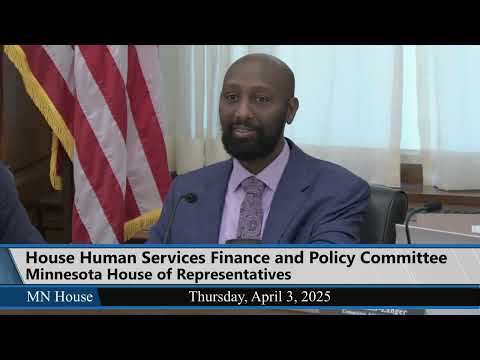
Human Services finance panel advances DHS omnibus and lays over housing, homelessness, dementia and trafficking bills
Summary
The Minnesota House Human Services Finance Committee on April advanced a Department of Human Services policy omnibus (House File 2,115) to the General Register and laid over several homelessness, supportive-housing and human-services bills for possible inclusion in omnibus or budget bills.
The House Human Services Finance Committee moved the Department of Human Services policy omnibus (House File 2,115, as amended) to the General Register and laid over a package of bills addressing homelessness, supportive housing, assessments, dementia grants and services for victims of sex trafficking.
Representative Erik Schumacher, the author and floor sponsor, moved the omnibus and won voice approval from the committee after the body adopted two amendments (DE2 and A2) that the author said put the bill “in the shape of the author.” House Research staff walked members through each article of the measure, which bundles provisions affecting aging and disability services, the new Direct Care and Treatment agency, behavioral health, the Office of Inspector General, licensing and background studies, concordant rulemaking changes and various technical edits.
The committee also heard and laid over standalone bills and funding requests for the Minnesota Homeless Study (Wilder Research), a Family Supportive Housing grant program, expanded supportive housing for people with serious mental illness (the HASAMI program), restoration of housing-support service rates and improved processing timelines, reforms to MN Choices reassessments, expanded dementia grants, additional shelter capital and youth homelessness investments, Safe Harbor services for trafficking victims, and supplemental rates for the Avivo Village shelter model.
Why it matters: HF 2,115 is an omnibus vehicle that collects many policy changes stakeholders and the agency have negotiated across the year; the other measures address acute gaps in homelessness response, family and youth supportive housing, and targeted services for people with serious mental illness or trauma from sex trafficking. Several testifiers told the committee that data and ongoing state investments inform operations and federal funding applications, while providers said current gaps threaten capacity or force long waits for services.
DHS omnibus highlights Representative Schumacher and House Research staff described the omnibus as a yearlong, bipartisan consolidation of measures heard by the committee. House Research summarized the bill into discrete articles: Article I (aging and disability services) pulls together multiple authors' proposals; Article II covers Department of Health items including case-mix and assisted-living changes; Article III updates statutes for the new Direct Care and Treatment (DCT) agency and related rulemaking; Article IV contains behavioral-health reforms including children's mental health terminology updates and SUD assessment changes; Articles V–VI cover OIG, licensing, background checks, and recodification of ACT/IRTS; Article VIII revises children's mental-health terminology; and Article IX contains a single technical reviser instruction.
Representative Schumacher told the committee the omnibus “is a culmination of the work of this committee throughout the year,” noting the measure incorporates provisions the committee vetted and, according to him, “pulled out the pieces that did not have costs.” House Research and DHS staff provided the detailed article-by-article walkthrough requested by members.
Homelessness, supportive housing and related measures - Wilder Research / Minnesota Homeless Study (House File 2,276, as introduced): Michelle Decker Gerard, senior research manager at Wilder Research, told the committee the study counted “over 10,500 people who are homeless in our state” on a single night in October 2023 and described the study’s face-to-face interviews, tribal partnerships and the study’s use by courts, state agencies and local governments. Decker Gerard said funding fragmentation threatens the continuation of the study and warned the program may need to be sunset without streamlined state support.
- Family Supportive Housing Grant Program (House File 16,44): Ben Helvick Anderson of Beacon Interfaith Housing Collaborative described plans to create more family-focused supportive units and said existing supportive housing stock is limited for families; resident testimony from Alice Johnson (Vista 44) illustrated the claim’s practical impact: “For the first time in a long time, I felt relief,” she said, describing how a family-focused supportive building allowed her children to be reunited and stabilized her daughter’s health.
- Supportive housing for people with serious mental illness (House File 99): Testimony from providers (Guild, Touchstone Mental Health) emphasized that current HASAMI funding requests outpaced available dollars in 2024 — requests totaled about $7.6 million while new funding available was roughly $2.1 million — and asked the committee to add $2 million to the base to expand capacity.
- Housing support rate restoration and process changes (House File 2,704): Shelter and supportive-housing providers including Simpson Housing Services urged restoration of service rates reduced in 2020 and faster approvals for housing-stabilization services. Providers said rate reductions and delays limit capacity to help people with high-acuity needs. One provider said the 50% reduction in one program’s rate forced organizations to serve fewer households.
- MN Choices assessment efficiencies (House File 2,406): Ramsey County Deputy Director Katie Molinaire and MACSA supported shorter, less-frequent full reassessments in limited circumstances (abbreviated reassessments for two consecutive years, then a full reassessment in year three) and allowing remote reassessments in some cases. The bill would limit abbreviated reassessments to people ages 22–64 on disability waivers and require informed choice and the ability to request a full reassessment at any time. Representative Hicks voiced concerns about allowing verbal attestation in place of signatures for remote assessments and asked the author and staff to tighten language.
- Dementia grants (House File 16,74): The Alzheimer’s Association Minnesota-North Dakota chapter asked the committee to double the Board on Aging’s dementia grant appropriation from $750,000 to $1.5 million to expand memory screening and caregiver consultation programs statewide.
- Youth homelessness and shelter capital (House File 2,068 and related shelter grants): Multiple nonprofit leaders and people with lived experience urged continued and expanded investments in youth shelters and shelter capital. Testifiers described the Youth Homeless Act’s role in prevention and the need for capital to upgrade or replace outdated congregate shelters. Project examples included a proposed $14.1 million replacement shelter for domestic-violence survivors (3Sixty Communities). Providers and advocates also noted that targeted investments produce long-term returns: early intervention and supports can reduce downstream public costs.
- Safe Harbor (House File 2,707): The Link and other Safe Harbor grantees asked for increased funding to serve youth and adult survivors of sex trafficking, including requests for $20 million over two years for outreach, emergency shelter beds, housing, and support services and $2 million to expand regional navigator programs. The Link’s program manager cited state evaluations and a University of Minnesota study that estimated a substantial return on investment for supportive services to trafficking victims.
- Avivo Village supplemental rate (House File 15,79): Avivo requested a supplemental housing-support service rate for its Avivo Village low-barrier, high-impact shelter model (Minneapolis, St. Cloud) to underwrite 24/7 staffing, health partnerships and wraparound services. Avivo reported that since 2020 its Village model moved more than 270 people into long-term housing and reduced public-system contacts.
Votes at a glance: - House File 2,115 (DHS omnibus, as amended, DE2 + A2 adopted): Motion to re-refer to the General Register moved by Representative Schumacher; approved by voice vote (committee adopted amendments and referred the bill). (Action: re-refer to General Register; outcome: approved — voice vote.) - House File 2,276 (Minnesota Homeless Study): Author moved to lay over for possible inclusion; committee laid over (voice vote). (Action: laid over; outcome: approved — voice vote.) - House File 16,44 (Family Supportive Housing): A-one amendment adopted; bill laid over. (Action: laid over; outcome: approved — voice vote.) - House File 99 (HASAMI supportive housing): Laid over after testimony and requests for funding increases. (Action: laid over; outcome: approved — voice vote.) - House File 2,704 (housing supports / rate restoration): A1/A2 amendments adopted; bill laid over. (Action: laid over; outcome: approved — voice vote.) - House File 2,406 (MN Choices efficiencies): DE2 adopted; bill laid over (members asked for follow-up on attestation/signature language). (Action: laid over; outcome: approved — voice vote.) - House File 16,74 (dementia grants): Laid over after testimony asking to double the appropriation. (Action: laid over; outcome: approved — voice vote.) - House File 2,068 (Youth Homeless Act / shelter capital and grants): A1/A2 adopted; bill laid over. (Action: laid over; outcome: approved — voice vote.) - House File 2,707 (Safe Harbor / anti-trafficking supports): DE1 adopted; bill laid over (testimony requested $20M over two years + $2M regional navigators). (Action: laid over; outcome: approved — voice vote.) - House File 15,79 (Avivo supplemental rate): A1 adopted; bill laid over. (Action: laid over; outcome: approved — voice vote.)
What’s next: Committee chairs said written testimony was compiled for members and reiterated that many measures will proceed to finance or omnibus negotiations. Several members asked agency staff for follow-up data (number of current grantees and average grant amounts for youth programs, shelter capital pipeline details, and specifics on rates and implementation timelines). The committee adjourned after scheduling the next meeting.
Selected direct testimony excerpts (verbatim): - Michelle Decker Gerard, Wilder Research: “On a single night in October 2023, we counted over 10,500 people who are homeless in our state.” - Alice Johnson, Vista 44 resident: “For the first time in a long time, I felt relief.” - Steve Horsfield, Simpson Housing Services: “We are participating with DHS and our community of providers on rate study efforts to come up with responsible long term solutions as a state but this temporary rate restoration is necessary right now.”
Committee process notes and limits on authority: Members repeatedly distinguished discussion from formal action; most items were laid over or referred for possible inclusion rather than finally enacted. Several members emphasized the committee was not taking oral public testimony on the omnibus (written testimony was placed in members’ packets). Representative or staff statements about federal approvals, interagency partnerships, or use of the homeless study to support FEMA or HUD applications were labeled as uses described by testifiers; the committee did not itself adopt new federal authorities.
Ending: The committee advanced the agency omnibus to the General Register and collected a wide set of homelessness and human-services funding proposals for further negotiation in finance and omnibus processes. Members asked DHS and agency staff to return with numbers on grantees, average grant sizes and rate calculations ahead of final budget decisions.