Get Full Government Meeting Transcripts, Videos, & Alerts Forever!
Get email alerts on the Water Appropriations Data Centers topic
No spam. Unsubscribe anytime.
Committee adopts amendment and lays over bill tightening early review of large water uses including data centers
Summary
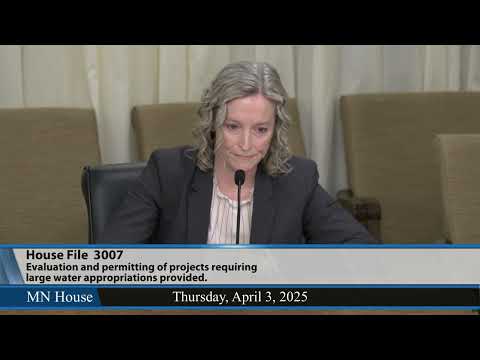
Co-chair Fisher moved House File 3,007, which would require earlier DNR engagement, create a statewide water-availability atlas and tighten pre-application review for large water users; an author's A2 amendment was adopted and the bill was laid over for possible inclusion in a later omnibus bill.
Co-chair Fisher, the bill's author, moved House File 3,007 as amended to be laid over for possible inclusion in a future bill; the committee adopted an A2 author's amendment before laying the bill over.
The measure would create a pre-application evaluation process for proposed large water users, encourage earlier coordination with the Minnesota Department of Natural Resources (DNR) and add a statewide "Water Availability Atlas" intended to guide siting for large water users such as hyperscale data centers. Co-chair Fisher told the committee the bill is intended to provide definitions and clarity, to help craft permit conditions for large water users and to reduce cases where project proposers select sites and later find sufficient water is not available.
The bill drew public testimony from business groups, environmental advocates, local governments and the DNR. Sarah Meridian, government relations and policy director for CURE, testified that Minnesota is seeing "sudden and intense interest from companies seeking to build hyperscale data centers" and said House File 3,007 is a starting point for "essential conversations" about how the state should handle that growth. Darren Broton, executive director of Minnesota Agri Growth, said a 100,000,000-gallon threshold mentioned in testimony would also affect large agricultural users and some proposed sustainable aviation fuel facilities; he urged clearer standards and warned that a provision giving the DNR authority to deny permits "because it's not in the public's interest" is ambiguous.
Representatives of the Minnesota Chamber raised concerns that some language in the bill is vague and could increase permitting uncertainty, citing risks such as repeated requests for supplemental information and challenging notification and enforcement obligations. Michelle Benson, energy policy director for the Minnesota Chamber, said increased regulatory burdens could deter investment and urged further debate on balancing economic growth and environmental protection.
Advocacy groups including Minnesota Interfaith Power & Light, Vote Solar and the Minnesota Center for Environmental Advocacy supported the bill's goals while urging stronger, mandatory protections in some areas. Patty O'Keefe of Vote Solar cited large water demands by some data centers and urged prohibitions on groundwater use, mandatory aquifer testing and public transparency for siting data; the Minnesota Center for Environmental Advocacy supported enhanced review and accountability for water and electricity consumption.
Katie Smith, director of the Ecological and Water Resources Division at the Minnesota DNR, said early coordination with the agency helps avoid late-stage design changes when water availability problems surface. Smith cautioned that a statewide atlas "would not be able to predict water availability at the scale of an individual site" and that county-scale geologic and groundwater atlases remain incomplete in many areas; she warned that a broad atlas could be misinterpreted as a site-specific guarantee of water availability.
The League of Minnesota Cities raised a separate concern about proposed notification language in the bill that would require every city and county employee to report potential project contacts to the DNR within 10 days. Craig Johnson of the League said the duty as written is vague and could require routine municipal employees to determine whether casual inquiries trigger a reporting obligation; the League recommended the project proposer, not municipal employees, be responsible for contacting the DNR.
After public testimony and member questions, the committee adopted the A2 author's amendment, which the sponsor said included technical corrections from the DNR and the added provision creating the Water Availability Atlas. Co-chair Fisher then renewed his motion that House File 3,007 as amended be laid over for possible inclusion in a future bill; the motion was agreed to and the bill was laid over.
The record shows further drafting and stakeholder discussions are expected if the bill advances. Committee members asked the author to work with cities, counties and the DNR to clarify notification requirements and other broad language before the measure moves further.