Get Full Government Meeting Transcripts, Videos, & Alerts Forever!
Get email alerts on the Medicaid Funding topic
No spam. Unsubscribe anytime.
Minn. proposal would add top tax tier to backfill possible federal Medicaid cuts; bill laid over
Summary
Chair Gomez presented House File 2591 to add a fifth income-tax tier aimed at offsetting potential federal Medicaid funding cuts; bill drew testimony from health workers, public-health experts and advocates and was laid over for possible inclusion in the 2025 tax bill.
Chair Gomez introduced House File 2591, the Protect Medicaid and Not Millionaires Act, proposing a fifth individual income-tax tier intended to offset any reduction in federal Medicaid funding that would otherwise flow to Minnesota. The committee heard roughly an hour of testimony from public-health workers, union representatives and mental-health providers before the bill was laid over for possible inclusion in the 2025 taxes bill.
The bill would create a contingent top marginal rate that, according to Chair Gomez, would be set “at a rate sufficient to offset any cuts in federal Medicaid funding that flow to the state of Minnesota.” Gomez said analysts estimate the state share of a broad federal Medicaid reduction could be about $1.4 billion to $1.6 billion in fiscal year 2027. Gomez also noted that 42% of Minnesota children rely on Medicaid for health coverage.
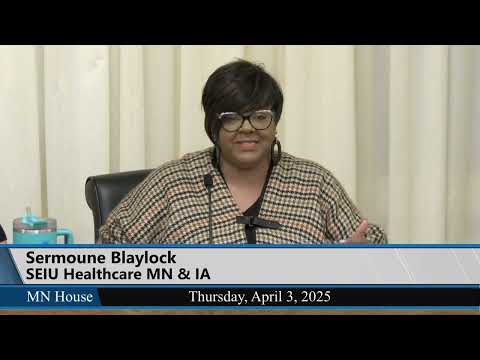
Supporters told the committee that Medicaid is a lifeline for many Minnesotans and that federal budget changes could force the state to backfill a large funding gap. Simone Blaylock of SEIU Healthcare Minnesota and Iowa said, “Medicaid is a lifeline for me, my family, and the people I care for,” and described the program’s role in enabling daily home care and keeping hospitals and nursing homes open. Marika Dekir, an epidemiologist at the Minnesota Department of Health speaking as a member of the Minnesota Association of Professional Employees (MAPE), said recent cuts to the department had already removed roughly $226 million and resulted in about 170 layoffs, including specialists in infectious disease and data modernization. Dekir testified those workforce losses have reduced the state’s capacity to investigate outbreaks and monitor public-health threats.
Other witnesses framed the proposal as a preemptive step. Pahua Yang of the Wilder Foundation described how Medicaid underpins community mental-health clinics and school-based therapists, saying loss of Medicaid funding could “decimate our clinics and our fragile mental health system.” Eric Bernstein of the coalition We Make Minnesota urged lawmakers to consider revenue options and to weigh public-health outcomes against competitiveness concerns in tax policy.
Committee staff explained the bill’s implementation mechanics. Nonpartisan staff member Mr. Williams summarized that the commissioner of Minnesota Management and Budget (MMB) must certify any estimated federal funding loss by Dec. 31; if MMB certifies a loss, the Commissioner of Revenue would apply the additional rate beginning with tax year 2026 (returns filed in 2027). Williams said if no federal change is certified by year’s end, the contingent rate would not take effect.
Members questioned details and raised concerns. Representative Anderson asked whether Medicaid dollars go to undocumented immigrants; Christie Grama of the Department of Human Services clarified the committee’s distinction between Medicaid and MinnesotaCare and said MinnesotaCare does not receive the same federal matching funds as Medicaid. Representative Johnson and others asked what would happen if federal changes occur after the Dec. 31 certification deadline; Mr. Williams reiterated the certification-based timeline. Representative Weiner warned of potential tax flight and unintended consequences if high earners relocate. Representative Elkins noted that most Medicaid fraud, where it exists, is perpetrated by providers and that preventing fraud will require investment in modernizing DHS systems. Several members pointed out the bill text did not specify the actual fifth-tier tax rate—Chair Davids read a portion of the bill that left the rate line blank and described it as “dot dot dot,” prompting questions about how the contingent rate would be set.
The bill sponsors and supporters emphasized they were seeking tools to protect healthcare access for children, seniors and people with behavioral-health needs in the event of federal funding cuts. After debate and public testimony, Chair Gomez renewed her motion and the committee laid House File 2591 over for possible inclusion in the 2025 taxes omnibus bill.
Next steps: MMB would be expected to produce the certification described in the bill text if federal policy changes occur; inclusion in the taxes omnibus would require future committee and floor action.