Get Full Government Meeting Transcripts, Videos, & Alerts Forever!
Get email alerts on the Agriculture Nutrient Management topic
No spam. Unsubscribe anytime.
Committee lays over bill to fund ‘4R’ nutrient stewardship training after privacy concerns
Summary
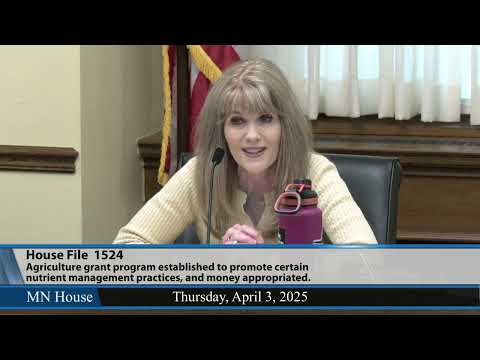
House File 15‑24 would provide grants to ag retailers and co‑ops to cover costs of 4R nutrient stewardship certification. Committee members raised concerns about data privacy classifications for grantee information and laid the bill over.
The committee heard House File 15‑24 on April 3, a measure to provide grants to agricultural retailers and co‑ops to offset the cost and staff time required for 4R nutrient stewardship certification. Testimony emphasized the agricultural practice known as the 4Rs — right source, right rate, right time, right place — and framed the grant as supporting best management practices to reduce nutrient runoff.
Ashley Runholt, identified as the executive chair of the Legislative Committee with MCPR and an agronomy sales manager at Cottonwood Co‑op Oil Company, said ag retailers typically do not bill growers for advisory services and that the grants would cover staff time and training costs to implement 4R stewardship. “If a client comes to me and says or if we initiate with a client that we want them to be part of doing the correct thing … we don’t charge for those services. So this bill would help us cover our cost for staff and time needed,” Runholt testified.
Members focused on Section 5 of the A1 amendment, which changes how grantee information is classified under Minnesota data practices law. House Research explained the A1 modifies classifications to include “private data on individuals” and clarifies that the general grant data classification at Minn. Stat. §13.599 would not automatically apply; instead, the bill’s specific classification provisions would control. Representative Rearick and others expressed concern that shifting much grantee information to private classification could reduce public oversight of grant distribution.
Representative Harter and the testifier said the grants would be administered by the Minnesota Department of Health and directed toward producers and ag retailers to promote nutrient management practices aimed at reducing nitrates.
Given the privacy concerns and the committee’s request for clarity about who would receive grants and what data would be protected, members laid House File 15‑24 over for additional work on data‑classification language and stakeholder input.