Get Full Government Meeting Transcripts, Videos, & Alerts Forever!
Get email alerts on the Land Use Development topic
No spam. Unsubscribe anytime.
Staff recommends approval of Teal Club Specific Plan for 150-acre site north of Oxnard Airport
Summary
City planning staff recommended that the Oxnard City Council approve a package of actions to adopt the Teal Club Specific Plan and certify a final EIR, a move that would allow future development of roughly 150 acres north of Oxnard Airport with up to 990 homes and mixed commercial and office space, though no construction is proposed at this time.
City planning staff recommended that the Oxnard City Council approve a set of actions to adopt the Teal Club Specific Plan, including a general plan amendment, annexation, pre-zoning, a development agreement for Phase 1 and certification of a final environmental impact report (EIR). The specific plan would guide future development of roughly 150 acres north of Oxnard Airport and would allow up to 990 residential units, up to 55,000 square feet of commercial space, up to 132,000 square feet of business/research office space and about 17.76 acres of park and open space. No construction is proposed at this time.
The specific plan would convert mostly county farmland into an urban village-style, walkable neighborhood bounded generally by Ventura Road, Patterson Road and Doris Avenue, and would bring the site into the city through annexation and connection to city utilities, including the Calleguas Municipal Water District. Staff told the council that the planning commission reviewed the project in November 2024 and recommended five revisions; staff supports three of those revisions (expanded bike lanes, allowance of water fountains and promotion of electric energy), but does not support raising the affordable housing requirement to 20% or imposing a prevailing-wage requirement beyond state law.
Staff said the specific plan area is organized into 14 planning areas across approximately 150 acres and is proposed to be developed in two phases. Phase 1 covers about 92 acres and is under a single owner; Phase 2 comprises the remaining roughly 58 acres and involves three owners. Staff’s presentation said grading and improvements for Phase 1 could begin in 2026 and home construction could start in 2027. The proposed development agreement would apply to Phase 1 only and, among other commitments, would require the developer to construct a 6.5-acre park in Phase 1, provide 15% of residential units deed-restricted for very low- and low-income households, pay an in-lieu fee to support farmworker housing, and pay fees to offset proportional police and fire staffing costs. The agreement would include local buyer and local-hire preferences.
The City prepared a final EIR that, according to staff, includes mitigation and a monitoring program designed to reduce most impacts to less-than-significant levels. Two categories of impacts could not be mitigated to less-than-significant levels: conversion of approximately 150 acres of farmland to nonagricultural uses and certain daily air quality emissions (including NOx) largely related to project traffic. To address the permanent loss of farmland the EIR and staff recommended an agricultural conservation in-lieu fee; mitigation for air quality impacts includes payment into a transportation demand management fund and energy-saving construction measures, though staff said not all operational emissions are fully mitigable. Because of those unavoidable impacts, staff presented findings and a statement of overriding considerations explaining why the benefits of the project—housing supply, an urban-village design, transit proximity and buffers between residences and airport/agricultural uses—outweigh the unavoidable environmental harms.
Staff summarized project outreach and review: a Cabrillo neighborhood meeting in March 2022, a community workshop in April 2022, the planning commission hearing in November 2024, a virtual town hall in March 2025 and 15 comment letters received since the planning commission hearing. Notices of the City Council hearing were published in a newspaper, posted on the site and mailed to surrounding property owners. Staff said the information in public comments does not change the recommendation to approve the actions listed in the staff report.
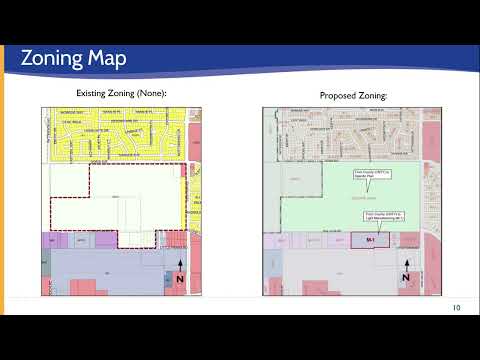
The council packet lists the following recommended actions for the council’s consideration: (1) certify the final EIR and adopt related findings and the statement of overriding considerations, (2) approve a general plan amendment to reconfigure land-use designations within the specific plan area (parcels south of Teal Club Road would remain designated airport-compatible), (3) approve annexation of approximately 143 acres within the specific plan area plus about 11 acres south of Teal Club Road and connection to city utilities, (4) adopt pre-zoning for the specific plan area and light industrial zoning for parcels south of Teal Club Road, (5) adopt the Teal Club Specific Plan, and (6) approve a development agreement applicable to Phase 1 setting affordability, infrastructure and fee obligations. Staff recommended approval of these actions subject to findings included in the staff report. No City Council vote is recorded in the staff presentation portion of the transcript.
Planning commission recommendations and staff responses were described in detail. The planning commission recommended (a) expanded bike lanes, (b) allowance of water fountains, (c) promotion of electric energy, (d) increased affordable housing to 20%, and (e) a prevailing-wage requirement for all future development in Phase 1. Staff recommends adopting the bike-lane, water-fountain and electric-energy suggestions as specific-plan improvements. Staff does not support the 20% affordable-housing recommendation because city practice and the urban-village designation call for 15% affordability with deeper affordability levels; staff also recommended removing local prevailing-wage language from the development agreement so prevailing-wage requirements default to state law, noting that an added prevailing-wage condition on private development could increase costs and affect the project’s feasibility.
Staff noted that parcels south of Teal Club Road would remain airport-compatible to avoid uses that interfere with airport operations or expose large numbers of people to aircraft hazards. The staff presentation concluded with an invitation for questions; both the applicant team and city staff were available for the council hearing.