Get Full Government Meeting Transcripts, Videos, & Alerts Forever!
Get email alerts on the Animal Cruelty Law topic
No spam. Unsubscribe anytime.
Committee approves SB 80 to create intermediate felony for animal cruelty resulting in death; debate centers on veterinary second-opinion and rural access
Summary
Senate Bill 80, sponsored by Sen. Kramer, creates an enhanced penalty when violations of the animal-cruelty statute result in the death or euthanasia of an animal; the measure was moved favorably with an emergency designation. Members questioned how the bill would work in rural areas and how second-veterinarian validation would apply.
The House Judiciary Committee voted favorably on Senate Bill 80, a measure from Sen. Kramer that creates a higher penalty when a violation of the animal-cruelty statute results in the death of a domestic animal or livestock or requires euthanasia.
Under current law (Criminal Law Article §10-604), prohibited acts include overdriving or overloading an animal, depriving an animal of necessary sustenance, inflicting unnecessary suffering, and failing to provide care when a person has charge of the animal. SB 80 would make it a separate offense if such conduct results in the animal's death or the need to euthanize it; the bill raises the maximum penalty to up to one year in jail and a $5,000 fine and includes conditions of sentencing.
Committee members asked about the bill’s impetus and scope. A sponsor representative said the bill creates an intermediate offense for cases where prolonged neglect or abuse results in death but might not meet the statutory elements of the higher-level animal-abuse offense. Members asked whether livestock are included (the bill covers domestic animals and livestock) and whether the requirement in the bill that euthanasia be validated by a second licensed veterinarian would be practical in rural areas with limited veterinary availability.
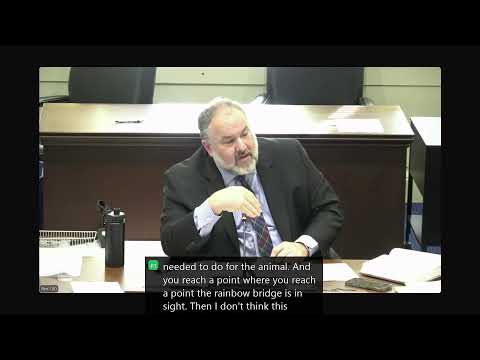
One member raised the concern that rural owners facing an animal in acute distress may not be able to obtain a second-veterinarian validation quickly and that requiring a second opinion could prolong suffering. Committee discussion included an interpretation from a member that the second-veterinarian reference is intended to support prosecution — that a second opinion would be used to validate that euthanasia was necessary when pursuing criminal charges — rather than to delay emergency euthanasia.
The committee approved a motion for a favorable report with emergency status; members recorded their votes in favor by voice/hand vote and the motion passed. Committee members emphasized the need to clarify implementation details about second-opinion validation and how the provision would apply with large animals and in rural settings before final enactment.