Get Full Government Meeting Transcripts, Videos, & Alerts Forever!
Get email alerts on the Data Centers Hydropower topic
No spam. Unsubscribe anytime.
Maine committee hears proposal to limit data centers’ access to hydropower at Millinocket redevelopment site
Summary
Sponsors and local advocates urged limiting how much behind-the‑meter power a single data center can buy at the former Great Northern Paper Mill site in Millinocket so renewable hydropower benefits a range of industrial reuses and local jobs. Regulators and consumer advocates urged caution about statewide precedents and grid impacts.
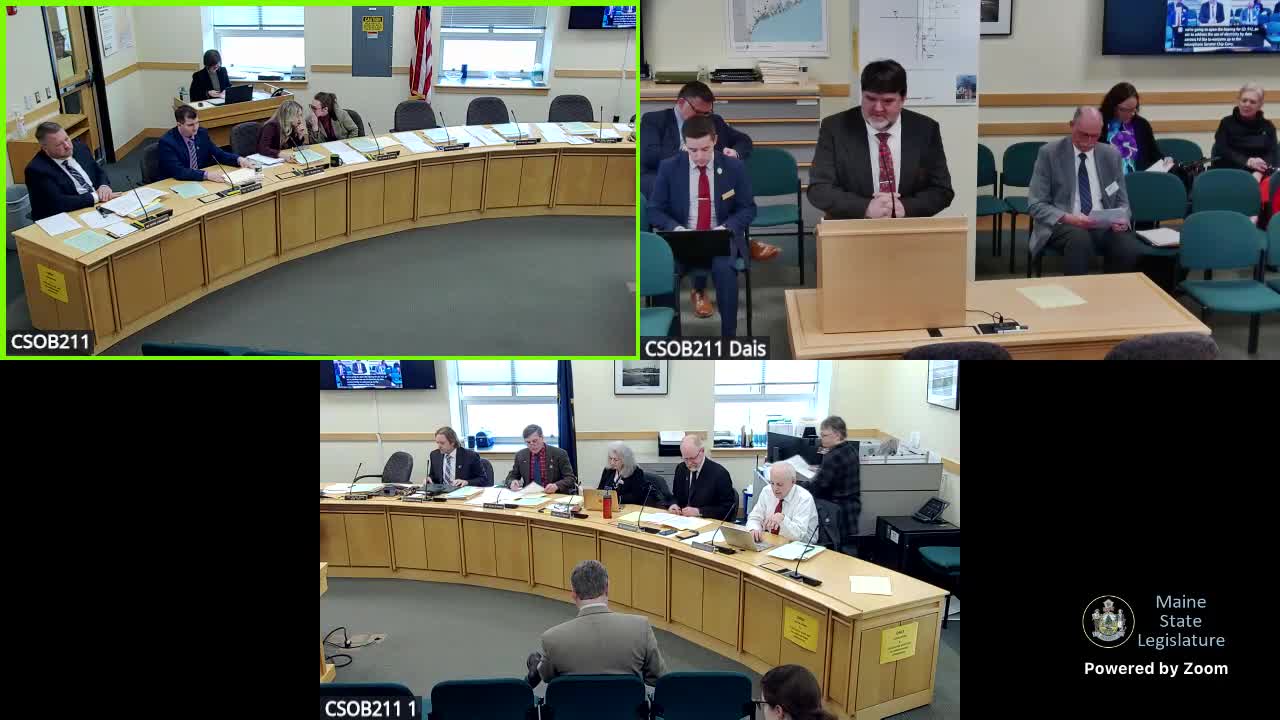
Chair Pro Tem Chris Kessler convened the Energy, Utilities and Technology Committee public hearing on LD 912, an act addressing the use of electricity by data centers, with sponsor Senator Chip Curry urging a site‑specific amendment focused on the former Great Northern Paper Mill site in Millinocket.
Curry said the amended bill would “limit the amount of power that can be promised to data centers,” arguing the change would preserve power for the broader economic‑development goals of the site and region. He told the committee behind‑the‑meter agreements can be “an important economic development tool” but warned that if a single deep‑pocketed buyer “gobbles up” capacity, other job‑creating projects could be excluded.
Why this matters: Millinocket’s redevelopment proponents and the local developer 1 North say on‑site renewable hydropower is a key asset that could attract higher‑value industrial uses (salmon farming, biofuels) and help revive a region that lost large employers. But state agencies, the public advocate and utility stakeholders cautioned that data centers present distinct power, reliability and cost allocation issues that could affect ratepayers and the regional grid if treated as a general precedent.
What sponsors and proponents said
Senator Chip Curry said the amendment was intended to be narrowly focused on the Millinocket site and to prevent a single purchaser from taking the bulk of a limited resource. Shane Flynn, representing 1 North (the redevelopment entity for the former mill), told the committee the site is being marketed to companies that would employ local workers and invest hundreds of millions of dollars. Flynn described two potential industrial prospects that would each use megawatts of on‑site renewable power and said recent interest from data center brokers threatens to “purchase all power available on‑site to the exclusion of those companies employing a wider array of the local workforce.”
Bill Ferdinand, counsel to 1 North, told the committee the statutory language being amended was originally written to preserve a narrow, site‑specific regulatory accommodation so that the site’s generator would not be classified as a transmission and distribution utility; he urged the committee to keep the change narrow to the Millinocket fact pattern.
Public interest and regulatory concerns
Caroline Cohn, Legislative Liaison for the Governor’s Energy Office, said GEO were “neither for nor against” the amendment but urged caution about creating a statewide precedent. She flagged potential reliability and wholesale price impacts noted by New England grid analyses and recommended more study of cost allocation, transmission upgrades and how new load interacts with clean‑energy accounting.
Heather Sanborn, the state’s Public Advocate, also testified neither for nor against and recommended a broader approach to protect customers. She cited national reports urging states to require tariffs rather than special contracts for large new loads, to require commitments to incremental clean generation, and to consider tariff classes that reflect the unique risks data centers pose to other customers.
Industry and local government input
Woody Bartley of the Midcoast Regional Redevelopment Authority described other redevelopment examples and noted the varied load profiles utilities already serve; he said the Millinocket amendment may not affect other systems if it remains site‑specific. Stephen Hudson, attorney for the Industrial Energy Consumer Group, urged caution about statutory changes that could constrain flexible arrangements historically used by large industrial generators to serve on‑site tenants.
Technical questions from the committee
Members pressed proponents on generator capacity and operational detail: Flynn said the site’s hydro nameplate is 26 megawatts with operating constraints (minimum flow) and discussed typical user consumption: the salmon farm might consume about 13.5 MW and an initial biofuel phase about 3–4 MW. Committee members also asked whether battery storage or other grid assets would pose similar risks; witnesses said storage tends to be more flexible than a single nonstop data‑center load because batteries both charge and discharge.
What the bill would do next
The committee did not take a final vote in the hearing. Members indicated an interest in holding a work session with technical follow‑up — including analysis of grid impacts, potential stranded‑cost exposure for ratepayers, and whether the amendment should remain narrowly site‑specific. No formal action (pass/fail) was recorded in the transcript excerpt; the hearing was closed and the item referred to committee follow‑up and work session consideration.
Ending
Committee members and witnesses agreed the Millinocket redevelopment faces a time‑sensitive market; proponents asked the committee to move carefully but deliberately so that economic development can proceed without creating statewide rules that would have unintended system‑wide consequences.