Get Full Government Meeting Transcripts, Videos, & Alerts Forever!
Get email alerts on the Dairy Policy topic
No spam. Unsubscribe anytime.
Dairy Task Force urges consistent funding for Maine’s dairy stabilization program, and a package of supports
Summary
A legislative dairy task force recommended fully funding Maine’s dairy stabilization (TIER) program, baseline allocations to reduce volatility, expanded processing capacity and technical assistance, and other measures to support farm transfers, feed access and on‑farm modernization.
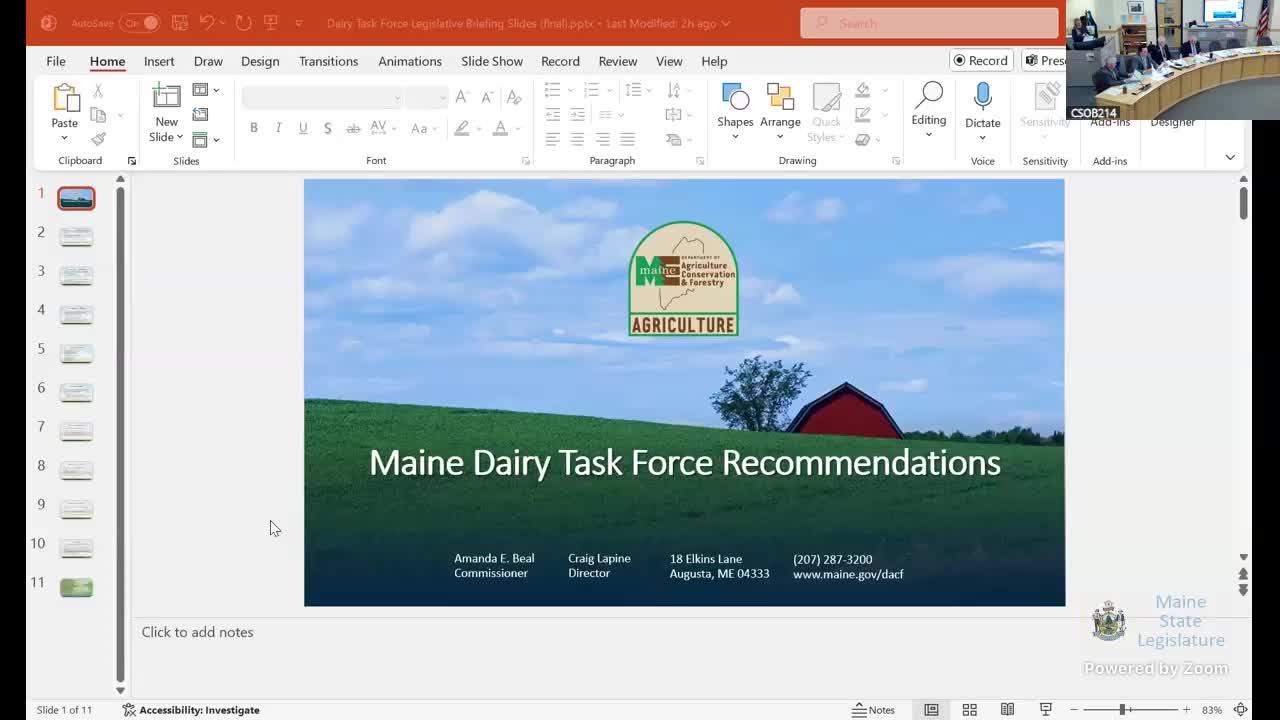
The Joint Standing Committee on Agriculture, Conservation and Forestry received the final report of the Legislature’s Dairy Task Force, which recommends a series of actions to support farm viability, expand processing capacity and increase technical assistance for Maine dairy farms.
The task force’s central recommendation is that the Maine dairy stabilization program (commonly referred to as the TIER program) be funded at the current cost‑of‑production level and funded consistently. Task force members told the committee that the TIER program works most effectively when it is fully funded; partial funding undermines the program’s stabilizing intent. The task force also recommended establishing a baseline funding allocation to reduce year‑to‑year volatility and improve predictability for farmers and the Legislature.
Other recommendations in the task force report include: - Increased on‑farm and regional technical assistance (business planning, infrastructure modernization, value‑added processing expertise, succession planning). - Support for expansion and retention of in‑state dairy processing capacity, including study of current processing gaps and infrastructure needs. - Creation of a centralized Maine dairy resource hub that lists technical service providers, funding opportunities and regulatory guidance. - Support for farmer learning networks and programs to facilitate farm transfers and succession. - Measures to improve availability and storage of dairy feed in Maine and consideration of tax incentives or credits to support agricultural building investment.
Representatives of Maine’s dairy sector explained the context and urgency: task force presenters said Maine had 141 dairy farms in June 2024 and 137 at the time of the task force’s final meetings. Annie Watson of the Maine Dairy Industry Association, an organic dairy farmer who participated on the task force, told the committee that an economic impact study by Camoin Associates is underway and will report additional data to the Legislature within weeks.
Task force presenters and committee members highlighted structural challenges for Maine producers, including high grain costs (organic and conventional), logistical limits being at the end of rail lines, aging farmer demographics and the multi‑year production cycle that complicates short‑term responses to price shocks. The task force advised that investments in processing and technical assistance will take time to reduce farms’ long‑run reliance on stabilization payments; until then, the TIER program remains an important safety net.
The task force report grew from LD 1274 in the prior session; the committee discussed the option of preparing a committee bill to enact baseline funding and other recommendations but did not take a final legislative vote. Task force materials, drafts and staff work were made publicly available during the group’s monthly meetings from June to December 2024.
Why it matters: Dairy farms steward roughly 700,000 acres in Maine and support veterinarians, feed suppliers, equipment dealers and other year‑round services in rural communities. The task force framed its recommendations as measures to stabilize a sector that supports jobs, open space and other public benefits.
Committee next steps: Committee members discussed the possibility of developing a committee bill to establish baseline funding for the TIER program and other measures. Staff and task force members offered to provide follow‑up materials, including the pending economic impact study.