Get Full Government Meeting Transcripts, Videos, & Alerts Forever!
Get email alerts on the Property Taxes topic
No spam. Unsubscribe anytime.
Norwalk City Council approves fiscal 2026 property tax levies after public hearing
Summary
The Norwalk City Council voted 5-0 on April 3, 2025, to approve the city’s proposed property tax levies for fiscal year 2026 after holding a required standalone public hearing on the proposal.
The Norwalk City Council voted 5-0 on April 3, 2025, to approve the city’s proposed property tax levies for fiscal year 2026 after holding a required standalone public hearing on the proposal.
City staff presented the levies under the state law referenced in the hearing, House File 718, explaining that the city’s taxable value rose from $781,000,000 to $831,000,000 and that the city is requesting roughly 3.23% in new levy-funded dollars under the state formula. Staff said the tax-supported levies would increase total property-tax revenue from about $11,800,000 to $12,600,000 — an increase in tax-supported dollars the presentation summarized as approximately $824,000.
The hearing mattered because, while the city’s overall levy rate is expected to remain roughly the same, state formula changes and growth in taxable value affect how much new revenue the city may collect and when property owners feel changes on their bills. City staff said the average Norwalk homeowner, using a $375,000 example, would see the city portion of property taxes rise from about $2,586 to $2,647 — a $61.70 increase, or roughly 2.39% — noting that assessments and tax timing create an 18-month lag between assessed values and when owners pay the taxes.
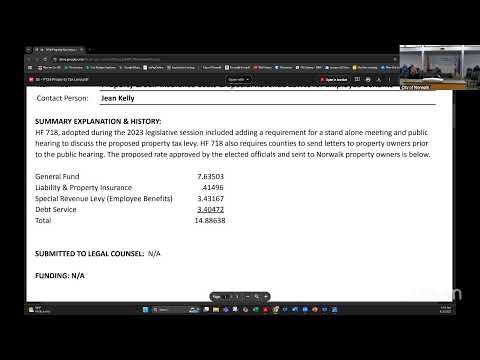
Jean (staff member) opened the presentation by saying, "This public hearing is a requirement under house file 7 18," and walked the council through the state-provided notice form with three columns: current year figures, a no-new-dollars scenario, and the city’s proposed levy request. Jean said the city’s proposal reflected a 6.33% growth in taxable value and the state’s ratcheting formula that limits how much of that growth the city may capture, allowing about a 3% increase in levy-funded dollars under the new formula. The presentation listed changes across levies, including higher insurance and benefits costs tied to the Field House and increases in debt service to cover infrastructure and equipment needs.
During public comment, resident Steve Hill asked whether taxes were going to increase; staff answered that, for the average $375,000 home, the city portion would rise by roughly $60 a year and emphasized the difference between the high-percentage example on the state notice (a hypothetical 10% assessment increase producing a 12.6% tax increase in that scenario) and the actual city proposal. Resident Jeff Altman asked why his land value rose substantially; staff advised property owners to contact the county assessor and explained that assessor procedures, vacant-lot sales and comparable-sale adjustments can change land values.
Council members thanked staff for limiting the levy-funded increase to under 3%. Council member Livingston moved to adopt the resolution approving the proposed fiscal 2026 property tax levies; Council member Brown seconded. Lindsay (city clerk) called the roll: Council member Baker — yes; Council member Brown — yes; Council member Cool — yes; Council member Livingston — yes; Council member Meineke — yes. The motion carried 5-0 and the council closed the public hearing and approved the levies.
City staff reiterated timing and next steps: assessment dates and payment timing mean that recently received assessment notices reflect an earlier assessment date and that changes in assessed value typically show up on tax bills with a lag; staff also noted continued work on future budgets and that the city expects to address fiscal 2027 during next winter’s budget process.
The resolution approved the levies for the general fund, liability and property/self-insurance, special revenue for employee benefits, and debt service. The council did not specify a resolution number during the recorded discussion; no oral or written comments were received in advance of the hearing, according to the clerk.