Get Full Government Meeting Transcripts, Videos, & Alerts Forever!
Get email alerts on the Child Welfare topic
No spam. Unsubscribe anytime.
Maine DHHS and partners roll out five-year Child Safety and Family Well‑being Plan
Summary
Department of Health and Human Services and the Maine Child Welfare Action Network presented a five‑year Child Safety and Family Well‑being Plan to the legislaturecommittee, emphasizing upstream prevention, family partnership, and pilot initiatives including a public campaign and community spaces work.
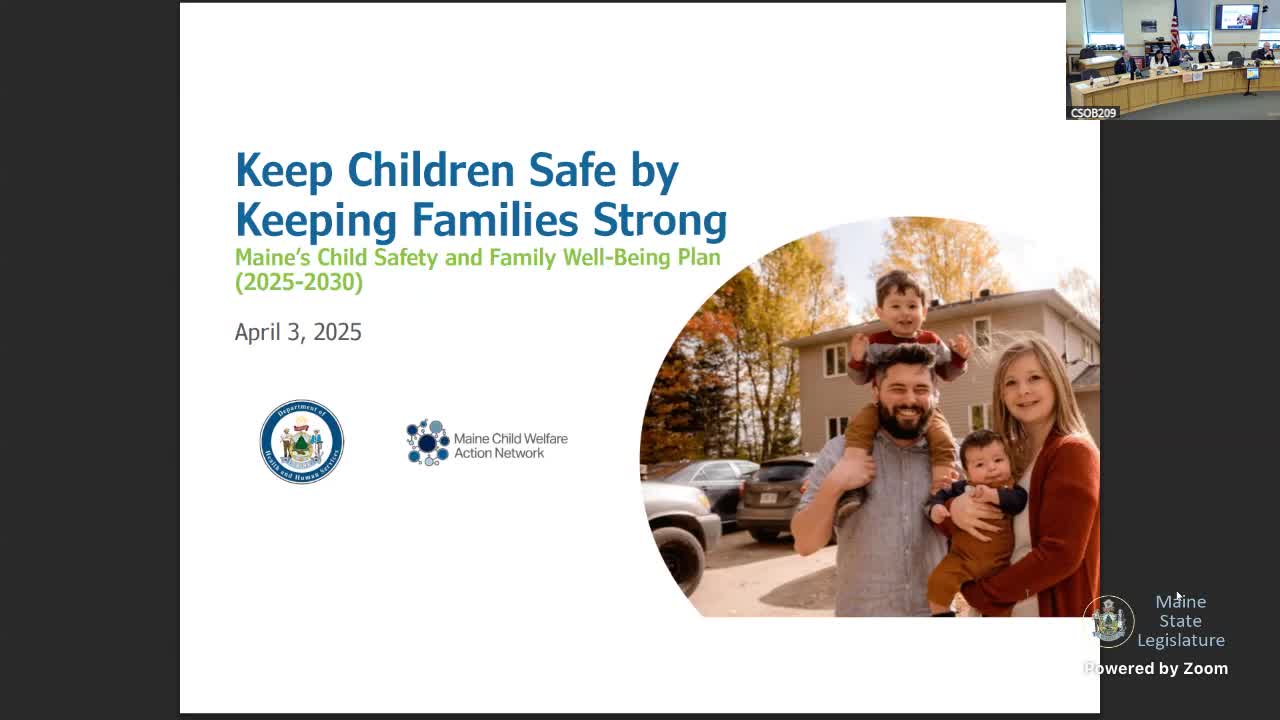
A five‑year Child Safety and Family Well‑being Plan intended to "keep children safe by keeping families strong" was presented Wednesday to the Legislature—s Joint Standing Committee on Health and Human Services by the Department of Health and Human Services and the Maine Child Welfare Action Network.
Mariette Aylborn, Special Projects Manager for Child and Family Well‑being at DHHS, described the plan as "a comprehensive and collaborative effort to keep children safe by keeping families strong," saying the strategy focuses on working "further upstream" to prevent child welfare involvement by strengthening families and communities.
The plan sets two goals and five strategies that center parents, caregivers and families. Presenters said the plan emphasizes economic and concrete supports such as food, housing, child care and transportation; low‑barrier access to services; family partnership and leadership; supportive community spaces; and improved coordination between state and community partners.
Maine Child Welfare Action Network coordinator Melissa Hackett and Christine Theriault, program manager for Family First Prevention Services, joined Aylborn in detailing the plan—s development. Presenters said the effort incorporated statewide data, literature reviews and extensive input from parents, caregivers and local partners. The plan builds on an initial version the state released in May 2023 and seeks to move policy and practice toward primary prevention and community capacity.
Officials cited three pilot initiatives already in action: (1) the Be There For Me public awareness campaign to reduce stigma around help‑seeking (supported by a one‑time $750,000 legislative appropriation plus $100,000 in preschool development grant funds to target parents of young children); (2) a Maine Children—s Trust and Prevention Councils initiative to identify and strengthen community spaces for families funded with $335,000 one‑time; and (3) a mandated‑reporting review and community supports effort launched in July 2024.
Aylborn reported early engagement metrics for the Be There For Me campaign, noting "approximately 19,000 visits to the website since its launch" and an average website engagement rate of roughly 35 percent; digital promotion, she said, produced tens of millions of impressions. The presenters said campaign materials are available in 12 languages and that more than 18,000 rack cards in multiple languages had been distributed by partners.
On mandated reporting, presenters said DHHS reviewed calendar year 2023 intake data and other sources and found that roughly 33 percent of calls to child protection intake were screened in for assignment while about 65 percent were screened out. Of the reports assigned, presenters said roughly 25 percent resulted in findings of abuse or neglect; of those screened out, they reported fewer than 1 percent later had findings. Presenters characterized the data as evidence that many families who come to the attention of callers need community supports rather than child welfare intervention.
Presenters described next steps including work to clarify statutory definitions of abuse and neglect to avoid conflating poverty with neglect, to redesign mandated‑reporter training, and to develop community pathways that would direct families in need to local supports instead of defaulting to child welfare intake. They said the Prevention Councils network and local community collaboratives may be logical components of those pathways.
Committee members asked for additional detail on the mandated‑reporting work and whether more reports reflect appropriate vigilance or risk‑averse reporting; presenters said many states see spikes after high‑profile child deaths and that their goal is "appropriate reporting" supported by decision tools, improved training and local supports.
Presenters said the plan will be tracked using a set of community and outcome indicators and that an annual report on implementation is planned, with the first annual report targeted for early 2026. They asked the committee to view the plan as a state‑community partnership rather than a DHHS‑only program.
Ending: The committee did not take formal action on the plan at the hearing; presenters answered members— questions and asked for opportunities to return with additional implementation and evaluation details.