Get Full Government Meeting Transcripts, Videos, & Alerts Forever!
Get email alerts on the Expanded Learning topic
No spam. Unsubscribe anytime.
Panel Debates Expansion of After‑School Funding; Administration Seeks $435 million to Lower Threshold to 55% Unduplicated Pupils
Summary
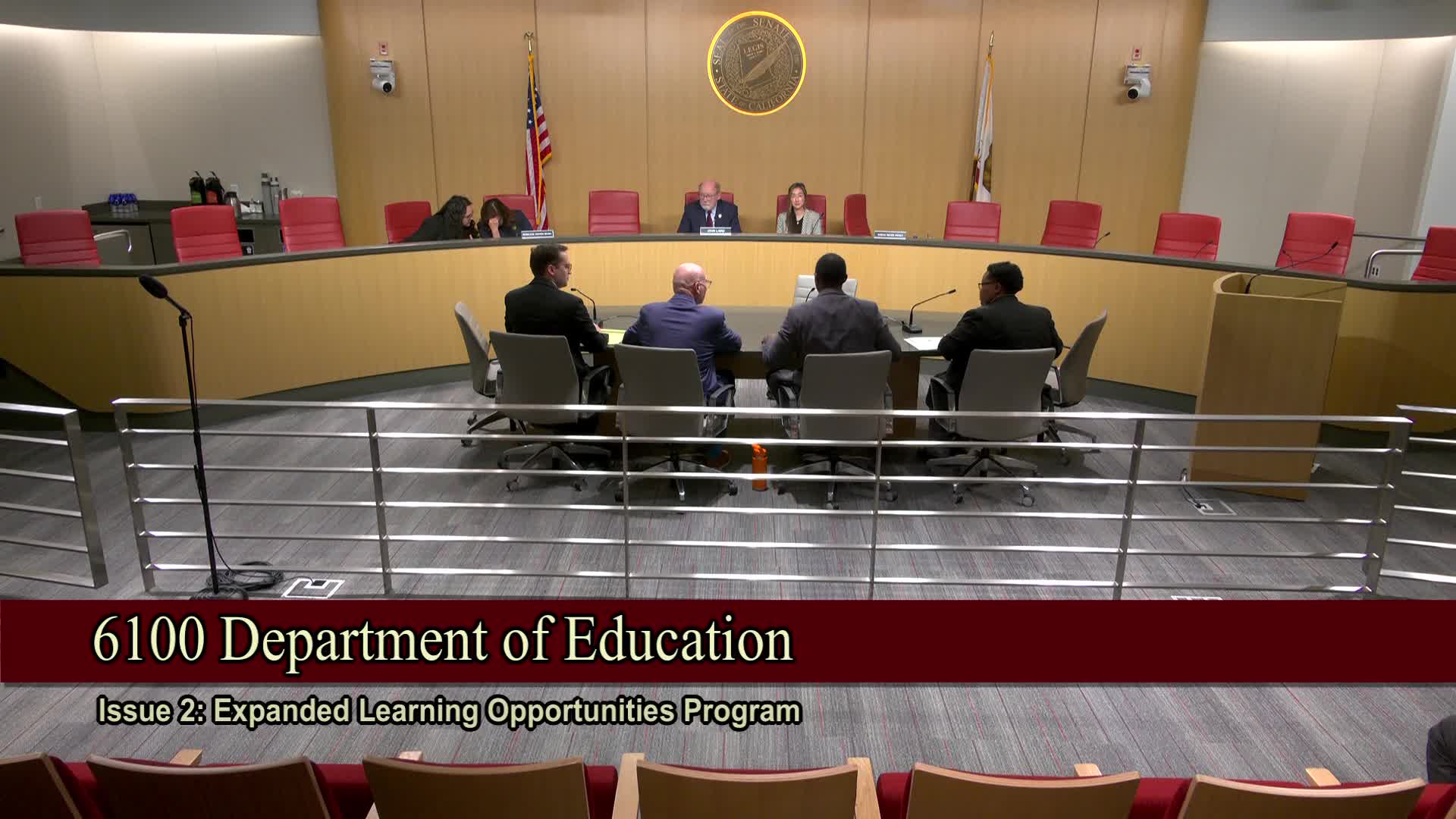
Senate Budget Subcommittee No. 1 on Education reviewed the governor's plan to expand the Expanded Learning Opportunities Program by lowering the Tier 1 eligibility threshold from 75% to 55% unduplicated pupils, an action financed by a proposed $435 million ongoing increase.
Senate Budget Subcommittee No. 1 on Education members reviewed the governor's proposal to expand the Expanded Learning Opportunities Program (ELOP), which funds before‑, after‑ and summer‑school enrichment for TK–6 students. The administration proposed an ongoing increase of $435,000,000 in 2025-26 to lower the threshold for Tier 1 eligibility from an unduplicated pupil percentage of 75% to 55%, bringing total ongoing ELOP funding to $4,400,000,000 (Proposition 98).
George Harris of the Department of Finance told the panel the change would increase the number of local educational agencies eligible for the higher Tier 1 funding rate. Michael Funk of the California Department of Education, representing the State Superintendent, said many districts welcome the change but cautioned that staffing shortages and facilities constraints could make immediate, full implementation challenging in some remote and rural areas. "More money doesn't create more humans," Funk said, summarizing a common concern that expanding program obligation without workforce supply can be difficult for some LEAs.
The Legislative Analyst's Office urged caution. Dylan Ocasio of the LAO recommended delaying the change at least one year to give districts time to prepare and to avoid unintended burdens. The LAO also recommended revisiting ELOP's structure now that implementation is maturing: suggestions included aligning ELOP and the After School Education and Safety (ASES) program to avoid funding overlap, transitioning long-term funding to be participation-driven (rather than purely enrollment-based), and fixing the Tier 2 per‑pupil rate to improve predictability.
CDE officials and district representatives told the panel the funding increase could markedly expand access. CDE said it is preparing to collect more detailed participation data in CALPADS starting July 2025, which will enable future funding and planning improvements. Local district speakers and advocates stressed that small districts face a particular burden under current rules and urged an increase in the minimum base grant (currently $50,000) to a figure closer to $100,000 so small programs can operate with basic staffing and safety needs.
Committee members asked whether the shift from 75% to 55% would dilute resources for the highest‑need districts; the administration and CDE said no current Tier 1 district would lose funding and that the $435,000,000 increase is intended to cover the change. LAO and CDE witnesses also noted continuing uncertainty about the Tier 2 rate and urged a plan to stabilize funding for Tier 2 districts.
Several districts requested transition flexibility and penalty relief during the initial year of an eligibility change, urging the state to allow ramping up services rather than imposing immediate penalties for not serving all students in a district after eligibility shifts. The panel signaled support for the expansion but asked for additional detail on rate stabilization, minimum grant impacts and operational support for districts that must scale up services.
Next steps: the subcommittee expects additional technical conversations and data analysis before May revise decisions and indicated interest in statutory or trailer‑bill adjustments to clarify minimum grants, rate stabilization and data collection requirements.