Get Full Government Meeting Transcripts, Videos, & Alerts Forever!
Get email alerts on the Literacy topic
No spam. Unsubscribe anytime.
Senate Budget Panel Reviews Governor's Literacy Package: $500 million for Coaches, $25 million for Statewide Network
Summary
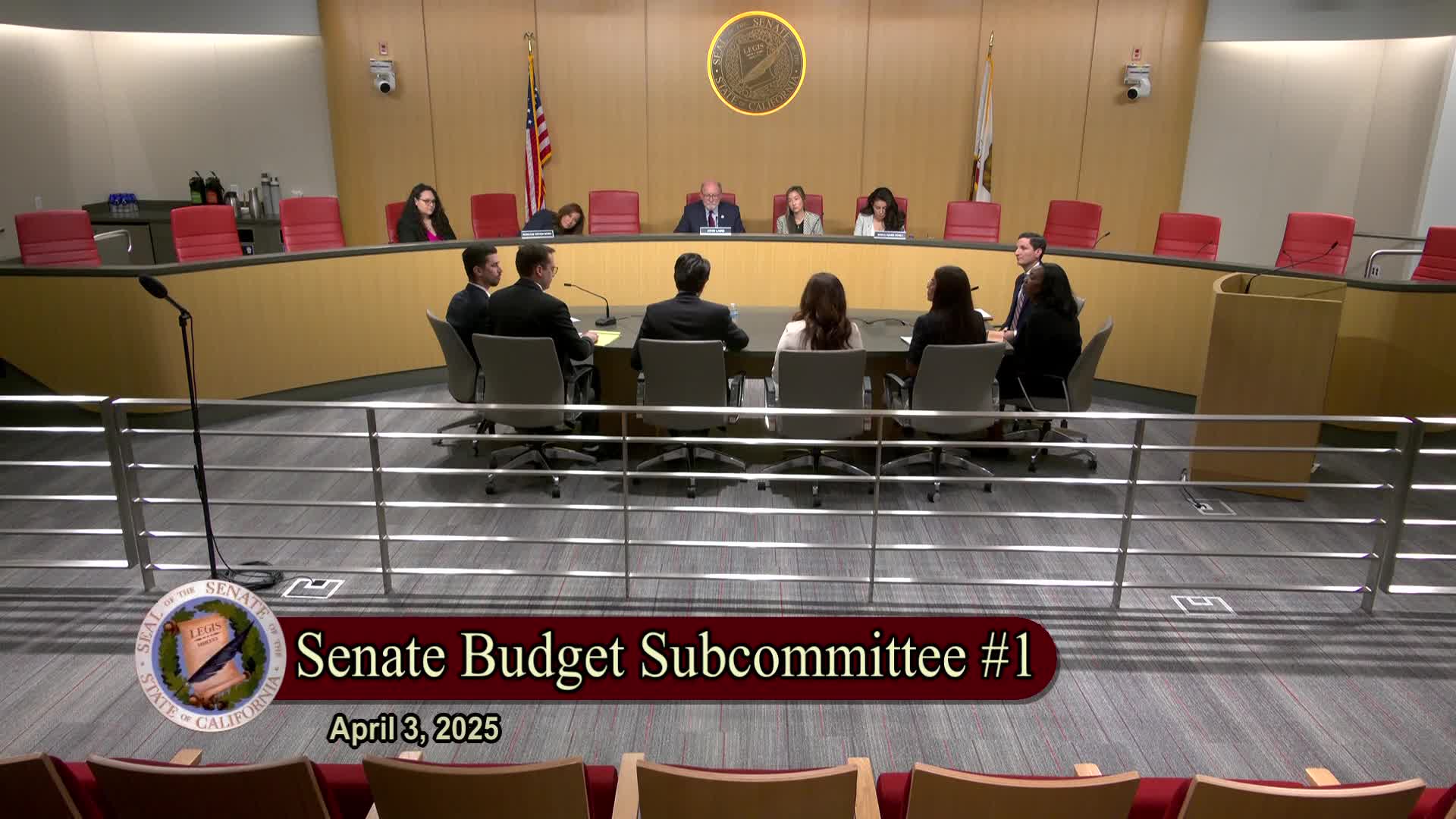
Senate Budget Subcommittee No. 1 on Education members heard detailed presentations on the governor's literacy proposals, which combine a statewide coordination effort, expanded coaching programs, screening tools for early grades and supplemental guidance for ELA/ELD materials.
Senate Budget Subcommittee No. 1 on Education members heard detailed presentations on the governor's literacy proposals, which combine a statewide coordination effort, expanded coaching programs, screening tools for early grades and supplemental guidance for English language arts and English language development materials. The administration told the panel it expects the measures to align existing initiatives and improve early reading outcomes.
The nut of the governor's package, as laid out by Hugo Solis Galiana of the Department of Finance, includes a $25,000,000 one-time Proposition 98 General Fund appropriation to the California Collaborative for Educational Excellence (CCEE) to convene a statewide literacy network, plus $500,000,000 one-time Proposition 98 General Fund to expand the literacy coaches and reading specialists program and to establish a new math coaches program. Solis Galiana said the network would "convene literacy leads to support statewide implementation of evidence based practices aligned to the English language arts slash English language development framework, the English learner roadmap, the literacy roadmap, and the use of data to support effective instruction." He also described a $40,000,000 one-time Proposition 98 General Fund proposal to support locally administered K–2 literacy screeners.
The Department of Finance outlined the coaches funding as a roughly $235,000,000 allocation for expanded literacy coaches and specialists, $15,000,000 for training and credentialing for literacy coaches, and $250,000,000 proposed for math coaching and specialist supports aligned to the new math framework. The administration also proposed raising the reading and literacy supplementary authorization incentive grant award from $2,500 to $6,000 and lowering the local match from one-to-one to one-third of the grant award.
The Legislative Analyst's Office (LAO) raised several implementation concerns and recommended changes. Dylan Hawksworth Lutsko of the LAO said the $40,000,000 estimate for K'2 screeners appears reasonable but urged that prior-year training funds could cover some start-up costs; the LAO recommended stricter targeting and design changes for the coaches proposal. "We recommend adopting this proposal with modifications," Lutsko said, urging that math coach grants be limited to elementary schools, that grants require a minimum award to ensure adequacy, that funding be spent at eligible school sites (rather than being routed to districts generally), and that automatic eligibility be considered to reduce administrative burden for small districts.
California Department of Education (CDE) officials framed the network and coach investments as efforts to create coherence across existing state-supported literacy initiatives. Cheryl Cotton, deputy superintendent for instruction, said local education agencies use a mix of screenings, diagnostic and progress-monitoring assessments in the K'12 year and that those local data sources are central to determining whether interventions are working. Bonnie Garcia, co-director of state literacy at CDE, urged a sustained approach: "the field needs this additional funding," she said, arguing that one-time support has helped districts prepare but that ongoing investments will be required to maintain progress toward third-grade reading goals.
Panel members pressed administration and LAO staff on eligibility and targeting questions, how the proposals would be measured and evaluated, and whether the many separate literacy investments could be consolidated. CDE and the California Collaborative for Educational Excellence (represented by Dr. Stephanie Gregson) described the statewide literacy network as a vehicle to compile and disseminate best practices and to coordinate the multiple initiatives already operating across the state. Gregson told senators the network would provide a "North Star around high quality literacy instruction" and help identify high-performing local education agencies and practices that could be scaled.
The panel also heard a separate administration proposal to select a developmentally appropriate screening instrument for multilingual learners in transitional kindergarten (TK). Nate Williams of the Department of Finance described a $10,000,000 one-time Proposition 98 General Fund for selection and statewide use of a TK multilingual screener; the administration said local agencies could begin optional screening as soon as 2026-27 with a requirement to start statewide screening in 2027-28, pending State Board of Education approval.
Where the proposals diverge is in the implementation details. The LAO urged limiting the math coaching funding to elementary schools and setting minimum grant levels; it also warned that the mix of additional math funding and continued investment in literacy represents trade-offs in how the state expands supports. CDE said it is already working to coordinate local initiatives through a "Move the Needle" effort and to use existing local assessments and interim Smarter Balanced tools to track progress while state summative data are available only from third grade onward.
The subcommittee requested additional data runs and refinements ahead of the May revision. Committee members repeatedly asked that the proposals include clearer metrics for outcomes, explicit service requirements tied to new screening tools, and ways to reduce administrative barriers for small and rural districts. The administration said it is considering LAO suggestions and will use additional data analysis to inform the May revise.
Next steps: subcommittee members indicated they expect continued negotiations and technical refinements for the May revise, including clarifications of eligibility criteria, minimum grant amounts, and how the statewide network would coordinate and measure the effect of multiple literacy investments.