Get Full Government Meeting Transcripts, Videos, & Alerts Forever!
Get email alerts on the Childcare Funding topic
No spam. Unsubscribe anytime.
State officials outline childcare funding, federal enrollment rule and large estimated unspent contract funds
Summary
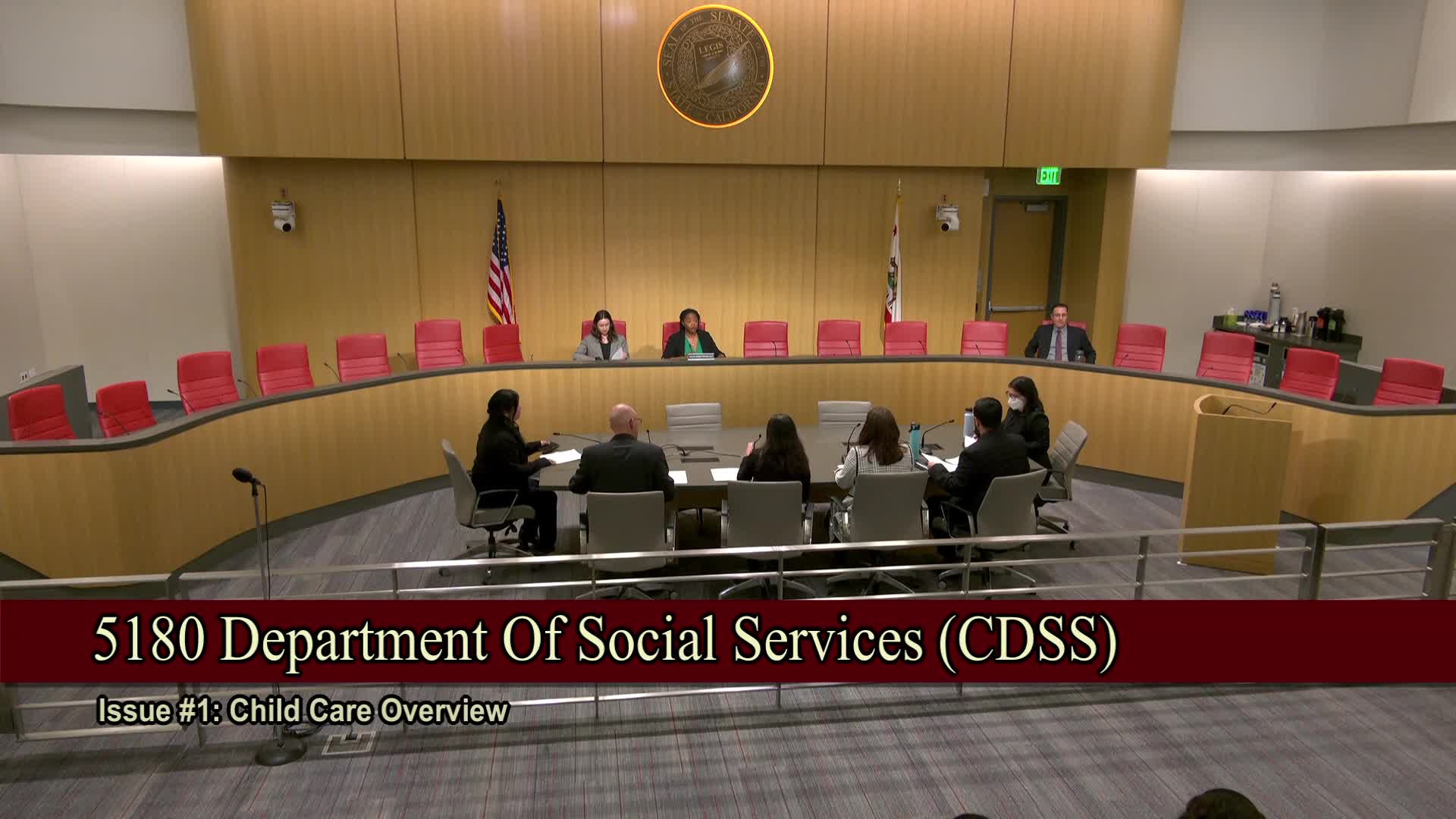
Department of Social Services and Department of Finance described California's childcare budget totals, upcoming federal rules requiring payments based on enrollment, and an estimated $1.1'billion to $1.3'billion in unspent childcare contract funds for 2023'24.
Jennifer Troia, director of the California Department of Social Services, told Senate Budget Subcommittee No. 3 that the governor's budget proposes about $6.4 billion (including $4.6 billion General Fund) for state-administered childcare and development programs and that the state has nearly doubled childcare funding in the last five years.
Troia said the department administers vouchers and direct contracts, negotiated memorandums with childcare providers and has worked to unify reimbursement-rate structures. She said more than 129,000 additional childcare slots were added since 2021 and that approximately 11,000 of those slots were for California Childcare and Technical Resources (CCTR) awarded in the 2024 budget act.
The federal government finalized a 2024 rule requiring states to make timely payments based on enrollment rather than attendance and to provide prospective payments at the start of service. Troia said California enacted enrollment-based reimbursement flexibilities during the COVID-19 pandemic (the "hold harmless" policy) but that the current state policy that reimburses on enrollment is scheduled to expire on June 30, 2025. She said the governor's budget does not currently include a proposal to continue that policy but that the state requested and received a federal waiver allowing prospective payments to be implemented effective Aug. 1, 2026.
Christian Malhotra of the Department of Finance told the committee the supplemental reporting language submitted by CDSS estimated unspent childcare contract funds as a point-in-time projection (January 2025) and that the department's year-end reconciliation may reduce that amount. Malhotra said the governor's 2025'26 budget assumes $1.1 billion in General Fund savings from fiscal year 2023'24 under the childcare appropriation item; later in the hearing Senator Menjivar referenced an estimate of $1.3 billion unspent for 2023'24 reported by Department of Finance staff in committee discussion.
Why this matters: The committee was focused on two near-term issues: how to align state policy and the budget with the federal enrollment rule and understanding the size and nature of unspent contract funds that the administration counts as savings in the 2025'26 governor's budget.
Department of Finance and CDSS cautioned the committee that the unspent amount is preliminary and may shrink as contractors submit final audits and invoices. Malhotra said the SRL-based figure reflects only contract expenditures and not other childcare appropriations such as child and adult care food program allocations or supplemental rate payments.
Public commenters and provider representatives at the hearing urged the committee to maintain enrollment-based reimbursement and to avoid a policy gap after June 30, 2025. Several provider speakers and union representatives said enrollment-based payments and prospective payments are necessary to stabilize providers and avoid closures; union witnesses also said many proposals remain under negotiation at the bargaining table.
Looking ahead: Troia said represented family childcare providers' payment practices are within the scope of collective bargaining and that the administration is currently bargaining with the union representing family providers. For contractors that provide direct, center-based services, prospective payments are currently made to some degree (initial apportionments for projected services). Malhotra said the administration is aware of the federal rule and is developing its approach but could not commit in committee to a specific May revision item before the May revision is released.