Get Full Government Meeting Transcripts, Videos, & Alerts Forever!
Get email alerts on the Water Conservation And Rates topic
No spam. Unsubscribe anytime.
Bend reviews three-year conservation pilot, weighs budget-based water rates
Summary
City staff reported results from the 2024 water conservation programs, outlined next steps to analyze participation and equity, and presented options for budget-based (water-budget) rates as part of a broader rate research effort.
City of Bend water conservation staff on the WAG meeting recapped 2024 program results, said the city is wrapping a three‑year pilot of incentive measures and will run updated demand projections, and asked the advisory group for input on exploring budget‑based rate structures.
Dan Denning, Water Conservation Manager, told the Water Advisory Group that 2024 was “a big year” for the program and that the city added a turf‑replacement incentive to indoor/outdoor device rebates introduced after adoption of the Water Management Conservation Plan (WMCP). Denning said staff are now analyzing who participates and who they miss, working with the Office of Performance Management and GIS to assess participation by census tracts and other customer characteristics.
The city intends to re‑run earlier demand modeling used in the WMCP to see how actual savings compared to prior projections and to identify program adaptations. “We’re going to rerun that model and see how close we were,” Denning said, noting the consultant engagement that will handle modeling and a separate effort to research conservation‑oriented rate options.
Carlos Bustos, senior water resources manager with Madaus Water Management, presented the scope of a research task focused on water‑budget (budget‑based) rates. Bustos said the firm is not performing a full rate study but will compile best practices, examine case studies, and select about 10 utilities for comparative research before doing deeper interviews with 3–5 utilities. He described water budgets as a customer‑specific allocation that can separate indoor and outdoor needs, incorporate household size and landscape area, and be paired with tiered pricing or variably priced blocks to protect basic needs while discouraging excessive outdoor irrigation.
Bustos and Dan Denning described how budget approaches vary: some utilities apply budgets only to irrigation‑only accounts (parks, medians, large commercial landscapes); others apply indoor/outdoor budgets to single‑family and multifamily meters. Bustos said Albuquerque’s irrigation‑only program is an example—about 3,000 meters on roughly 400 properties—and reported a 6% demand drop in that sector over eight years after targeted programs and budgets were used.
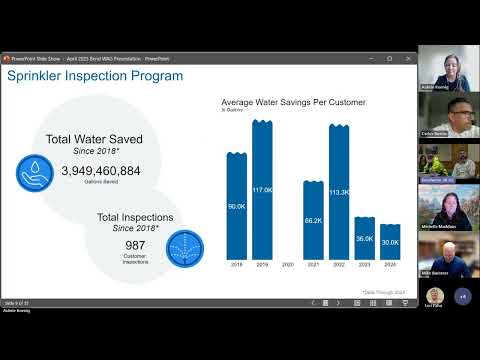
Program metrics presented by Denning included: the sprinkler‑inspection technical assistance program that the city targets to the top 2% of single‑family users and that still yields roughly 4,000,000 gallons saved per year; proactive enforcement outreach that produced about 1,900 voluntary corrections after an email batch of roughly 2,000 notices; and an average days‑to‑resolve trend that fell to about 23 days in 2024. Denning also noted an increase in measured gallons‑per‑capita per day partly caused by Portland State population revisions that lowered the city population baseline and by an extended run of peak temperature days last summer.
Staff emphasized tradeoffs. Bustos warned that designing and implementing a water‑budget billing program can be materially more expensive than other policy options, citing a typical implementation range of about $160,000–$260,000 for utilities he has studied. He also stressed the need for customer data, a strong education and outreach campaign, and operational capacity to manage budgets, variances and appeals. Denning said the city will use research to inform a future formal rate study and has not decided to adopt a budget‑based rate yet.
WAG members asked about equity, seasonal and second‑home impacts, the role of contractors vs. customer‑driven applications for rebates, and staff capacity. Denning said single‑family residential rebate applications are largely customer‑driven, while some multifamily and commercial projects come through property managers or contractors. A WAG member asked whether utilities that adopt budgets need additional staffing; Bustos said answers vary by jurisdiction and that the forthcoming interviews with other utilities will probe implementation burden and staffing lessons.
No formal action or vote occurred at the meeting. Staff said slides and a follow‑up email would be circulated so WAG members can comment offline and identify specific utilities the group wants included in the comparative research.
Ending: Bend staff framed the next steps as (1) re‑running demand models to compare pilot savings to earlier WMCP projections and (2) continuing the consultant’s rate‑research work to identify and interview utilities with budget‑based approaches. Staff reiterated that a policy decision on rate design would follow further analysis and public engagement.