Get Full Government Meeting Transcripts, Videos, & Alerts Forever!
Get email alerts on the Criminal Justice Grants topic
No spam. Unsubscribe anytime.
Multnomah County approves notice of intent to apply for Justice Reinvestment funding from Oregon CJC
Summary
The Board approved a notice of intent to apply for Justice Reinvestment Program funding from the Oregon Criminal Justice Commission. County staff said the application includes formula and competitive components, and a required 10% set‑aside for victim services.
Multnomah County commissioners unanimously approved a notice of intent on April 2 to apply to the Oregon Criminal Justice Commission (CJC) for Justice Reinvestment Program (JRP) funds intended to reduce prison use and reinvest avoided costs in local community‑based sanctions and services.
Commissioner Jones Dixon moved approval of the notice of intent; Commissioner Bridal Edwards seconded and the motion passed on a roll‑call vote with Commissioners Moyer, Singleton, Bridal Edwards, Jones Dixon and Chair Vega Peterson recorded as voting in the affirmative.
Denise Pena, director of the county’s Department of Community Justice (DCJ), and Jay Scrogg of DCJ briefed the board. Pena said JRP funds include a formula allocation tied to a statewide community corrections formula (Multnomah County’s share is roughly 15.77 percent of the state allocation) and a competitive pool counties may apply to for programs that provide certain services, including downward departure programs. Pena said statute requires 10 percent of any JRP award be allocated to victim services and the JRSC (Justice Reinvestment Steering Committee) will build program budgets and priorities for the application.
Pena described a timeline: a preliminary application was due April 18 to allow CJC feedback on program plans; the final submission is due in June 2025; awards are expected in the fall and will require later board actions to accept intergovernmental agreements and to modify the county budget if revenue differs from assumptions.
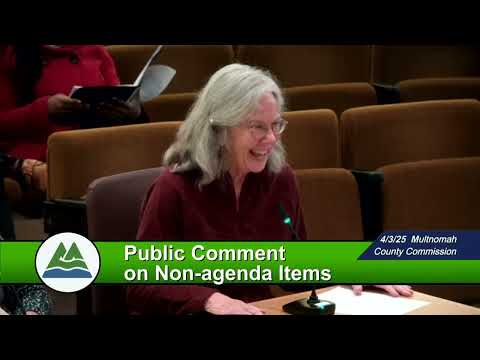
Public testimony included Charles Simcoe Johnson, who urged clearer outcome reporting and attention to impacts on disproportionately affected communities, and a speaker identifying as Lightning who asked whether the victim‑services set‑aside could be increased from 10 percent to 25 percent and recommended data analysis on jail capacity in nearby counties to assist planning.
The board asked staff follow‑ups about culturally specific victim‑service subgrantees; Pena said historically the county has partnered with ERCO (pass‑through), Lutheran Community Services and the Oregon Crime Victims Law Center, and promised a follow‑up list for commissioners. Commissioners also asked about outcome reporting; Pena and DCJ staff said reporting requirements and later board items on the IGA and budget modification would show final program details and outcomes.
Ending: The board approved the notice of intent; staff said further budget and intergovernmental agreement items will return to the board after the CJC awards funds.