Get Full Government Meeting Transcripts, Videos, & Alerts Forever!
Get email alerts on the Wastewater Sewage Management topic
No spam. Unsubscribe anytime.
Custer County approves $40,000 from contingency to help Round Mountain remove lagoon sludge
Summary
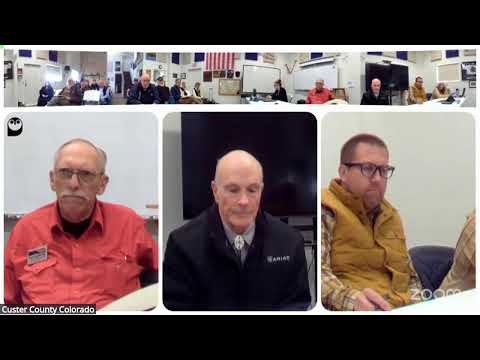
The Custer County Board of Commissioners voted unanimously on April 3 to approve Resolution 25‑25, authorizing a $40,000 appropriation from the county contingency (LATCF) fund to Round Mountain Water and Sanitation District to offset sludge disposal costs.
The Custer County Board of Commissioners voted unanimously on April 3 to approve Resolution 25‑25, authorizing a $40,000 appropriation from the county contingency (LATCF) fund to Round Mountain Water and Sanitation District to offset sludge disposal costs.
County officials said the appropriation is intended to allow the district to sign a contract and begin immediate removal of accumulated biosolids from treatment lagoons that district staff described as an operational crisis.
At the meeting David Niquette, representing Round Mountain Water and Sanitation District, described the bidding and contracting process with a contractor identified as Denali. "The original contract price was $238,000," Niquette said, citing a breakdown he provided: $4,000 for testing, $5,000 for mobilization and $229,000 for sludge removal. He said the district had added a $62,000 contingency and initially estimated a $300,000 project total. After asking Denali to provide a price to haul material out of county, Niquette said Denali proposed additional costs that he characterized as $98,600 in extra charges and a removal figure discussed in the meeting as $327,600 for out‑of‑county disposal; he presented the updated figures as the contractor reported them to the district.
Officials and residents raised several technical and regulatory constraints during public comment. County staff and district representatives said Colorado Department of Public Health and Environment (CDPHE) rules had previously limited options for on‑site discharge and that several potential in‑valley disposal cells were not approved or not lined. Niquette said earlier attempts to secure a long‑term treatment site had been hindered by soil composition (volcanic silt and clay) and the stream’s impaired listing, which constrained discharge options and lengthened the district’s compliance timeline.
Residents and municipal officials asked about trucking logistics and environmental safeguards. Niquette said Denali planned to move material in 6,000‑gallon loads and that, based on the contractor’s estimate, the work would require about 202 truck trips. He said Denali has approved land application sites along the Front Range, including fields near Yoder, Colorado, but did not provide a single fixed destination; he also said the contractor could potentially free up additional trucks to meet schedule needs if an agreement were executed quickly.
Public commenters also raised concerns about per‑ and polyfluoroalkyl substances (PFAS/PFOS) in the sludge. One attendee asked about a PFAS lab report and a letter from a state official (Luke Bond) that, according to the speaker, indicated state rules would preclude land application if PFOS levels exceeded 50 parts per billion. Meeting participants said the version of the lab report discussed during earlier meetings was not yet in the county’s hands at the time of the special meeting; during questioning a participant said the report had recorded 61 parts per billion, a point district staff acknowledged while also saying sampling and reporting issues were under review.
The county’s funding plan and process were discussed at length. Commissioners and staff proposed seeking contributions from nearby taxing districts, the town of Silver Cliff, the school district and taxing entities as goodwill contributions to replenish county funds. Several residents also suggested soliciting grants or community donations; county staff and others noted typical grant timelines would be months and could not meet the immediate need. County officials said the $40,000 would be taken from a reserved LATCF contingency balance earmarked for emergency or community needs and that the county intended to pursue reimbursement or backfill from other entities where possible.
The board appointed a process to seek commitments from other local taxing districts and proposed forming a citizen committee to help raise or funnel reimbursements; commissioners said they would follow up at their next meeting to set committee parameters. The resolution language approved by the board appropriated $40,000 from the contingency fund to assist in waste remediation and disposal in conjunction with Round Mountain Water and Sanitation District.
The decision followed more than an hour of public comment in which residents, district staff and officials outlined both a long‑term plan for a nutrient treatment plant and the immediate, reactive need for accelerated removal and disposal to avoid a potential spill. Board members said the county’s action is intended to enable the district to finalize a contract and begin work while local partners pursue additional funding and regulatory approvals.
Resolution and voting record: the board passed Resolution 25‑25 (appropriating $40,000 from the contingency fund). The vote was announced as unanimous (three ayes).