Get Full Government Meeting Transcripts, Videos, & Alerts Forever!
Get email alerts on the Resilient Economies Housing topic
No spam. Unsubscribe anytime.
Coconino County planners, residents review draft ‘Resilient Economies and Housing’ chapter; comments focus on tourism, forestry, housing and short‑term rentals
Summary
Coconino County staff and committee members reviewed the draft “Resilient Economies and Housing” chapter of the county comprehensive plan at a planning meeting, with participants urging clearer language and more data on tourism impacts, forestry and ranching industries, workforce retention and short‑term rentals.
Coconino County staff and committee members reviewed the draft “Resilient Economies and Housing” chapter of the county comprehensive plan at a planning meeting, with participants urging clearer language and more data on tourism impacts, forestry and ranching industries, workforce retention and short‑term rentals.
John Solstol, the county’s economic development director, and Zach Schwartz, a county planner who helped draft the chapter, presented the document and answered questions from committee members and public commenters. Solstol said the housing material is new to this plan and that staff will package the chapter into a full draft before beginning the statutorily required 60‑day public review; staff told the group they expect public hearings to start this summer.
The meeting drew a mix of technical comments and local concerns. Several participants said the chapter overemphasizes tourism and service jobs and underdescribes production sectors and working landscapes that residents consider central to the county economy. “We need to hit those industries that underpin it,” said Diane Kessler, arguing that ranching, timber and other production activities should be more prominent in the chapter’s analysis and policies.
Public commenters and committee members identified specific gaps and edits they wanted reflected in the draft. Jim Parks asked staff to add recommended text encouraging alternative/native building materials and proposed language: “Adobe, rammed earth, straw bale, traditional log, and native stone are encouraged.” Parks also said he would email data sources supporting agriculture and ranching economic figures for possible insertion into the chapter.
Staff and commenters discussed forestry and natural‑product figures that appear in the draft but lack local context. One reviewer asked whether the numbers shown were statewide or county‑specific; staff said some figures come from broader sources and that county‑specific data are limited. County planning staff agreed to try to clarify whether cited totals apply to Arizona, the region, or Coconino County.
Workforce and housing concerns drew repeated attention. Multiple speakers described workers leaving the area because they cannot afford housing. A planning staff member said the draft distinguishes between “affordable, attainable and workforce” housing but does not currently define those terms in the housing section; commenters recommended placing definitions near the start of the housing subsection and tightening links between goals, policies and implementation strategies.
Short‑term rentals were discussed at length. Melissa (staff) said the draft contains an inventory figure — “right around 970 or something” — for short‑term rentals in the county. Committee members noted statutory limits on local regulation: under current state law counties can require registration and permits but have limited authority to cap the number of short‑term rentals. Staff said state legislation is evolving and the county will track any changes.
Participants asked for more detail on rural planning areas (RPAs) and how they are used. Planning staff said the county currently has one rural plan area — the Diablo Canyon RPA — and several area plans; they said they would add clearer descriptions and examples of how an RPA functions and where landowners initiated prior RPA work.
The meeting also covered programmatic tools. A staff member noted that state statute allows transfer of development rights (TDR) to municipalities, but that implementing TDR would require intergovernmental agreements and ordinances. Committee members described TDR as a potential way to protect ranchlands while directing development to municipalities, but they cautioned it would take substantial planning and soft‑cost financing to succeed.
Other editorial and policy suggestions included expanding the chapter’s treatment of future trends (climate impacts, fire risk), adding more context about opportunity zones and Department of Commerce resources, and avoiding language that implies only extraction industries are important (one reviewer asked to change references to “extraction” and to include lumber products alongside biomass). Dark‑skies policy and outdoor‑lighting enforcement were raised; staff reminded attendees that the county zoning ordinance contains outdoor‑lighting standards and that code enforcement can investigate complaints.
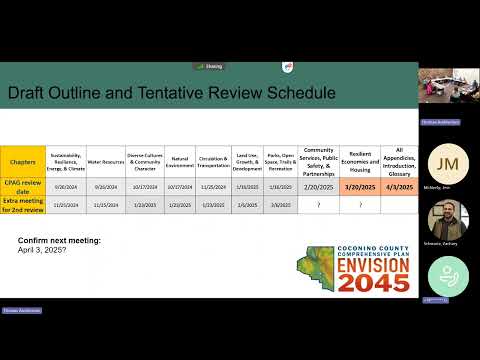
Staff concluded by reiterating the near‑term schedule: the committee agreed to move the next meeting to April 3 so staff can compile the chapter with appendices, a glossary and an implementation plan before launching the 60‑day public review period. Participants were invited to submit written edits and data; staff said they will incorporate feasible changes and return a packaged draft for review prior to public release.
For clarity, the meeting recorded many questions and suggestions but produced no formal ordinance or binding vote. Comments raised by residents and committee members will be captured in the plan’s public‑review package for potential incorporation into goals, policies and implementation actions.