Get Full Government Meeting Transcripts, Videos, & Alerts Forever!
Get email alerts on the Repatriation topic
No spam. Unsubscribe anytime.
OHA schedules April trip to repatriate three iwi kūpuna from Ulster Museum; will pursue shared stewardship in Germany
Summary
Office of Hawaiian Affairs staff will travel April 22–May 3 to recover three iwi kūpuna from Northern Ireland, attend repatriation events on the U.S. East Coast and continue negotiations with Germany’s Prussian Cultural Heritage Foundation over two contested kiʻi.
The Office of Hawaiian Affairs (OHA) said it will send staff to Europe and the U.S. East Coast from April 22 to May 3 to repatriate three iwi kūpuna from the Ulster Museum in Northern Ireland and to continue talks with the Prussian Cultural Heritage Foundation (Stiftung Preußischer Kulturbesitz, SPK) in Germany over two contested kiʻi.
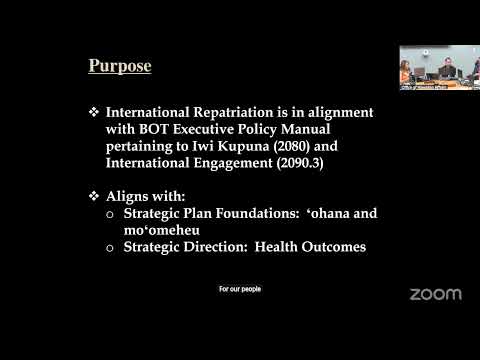
The briefing, presented to the OHA Committee on Beneficiary Advocacy and Empowerment on April 2, described the trip as both a continuation of earlier claims and an opportunity for in-person negotiations and cultural ceremonies. "I'm providing an informational briefing on an upcoming Office of Hawaiian Affairs repatriation mission ... April 22 to May 3," a staff presenter said during the committee meeting.
Why it matters: The work addresses claims started in 2021 and later, including human remains and funerary objects taken to overseas institutions during the 19th century. Repatriation is a culturally sensitive matter for beneficiaries and touches federal repatriation rules under the Native American Graves Protection and Repatriation Act (NAGPRA) and related state historic‑preservation processes.
Details of the Ulster Museum claim: OHA staff told trustees the Ulster Museum had been the subject of a claim begun in 2021. The museum had initially located two iwi kūpuna from a total claimed five and repatriated those in 2022. In November 2024 the museum reported it had located three additional iwi kūpuna; the institution’s board approved return in early January, and OHA plans to recover those three during the April trip.
Germany discussions and shared stewardship: OHA staff described ongoing negotiations with SPK over two kiʻi that OHA contends are funerary because they were recovered in the same sinkhole as an iwi poʻo (head). SPK maintains legal possession. Rather than pursue protracted legal action, staff said OHA has been negotiating a shared‑stewardship arrangement that would allow periods of residence in both Hawaii and Berlin and cooperative care. "This idea of shared stewardship ... offers the chance for institutions to work with native peoples on their holdings," a staff presenter said.
East Coast ceremonies and partnership work: The trip will include stops at the Peabody Essex Museum and the Smithsonian to attend or support repatriation ceremonies organized by partner claimants. OHA staff said they are supporting those events when asked and noted the Smithsonian has been moving toward broader ethical return policies beyond NAGPRA‑only claims.
Who will travel and budget: OHA said its delegation will include CEO Stacy Ferreira (introduced at the meeting), OHA’s cultural/implementation director Kuike (represented in the briefing by Elena Farden), and compliance staff. OHA will fund five travelers tied directly to OHA (two OHA staff plus three members of the partnering native‑Hawaiian organization named by partners), and staff told trustees OHA’s portion of the trip cost was about $30,000 for those five people. The presenters also said an earlier budget request submitted last year had been roughly $63,000 and was approved; the April trip’s outlay was reported lower.
Handling and disposition in Hawaiʻi: Repatriated sacred objects that are not OHA claims — for example, some items the Smithsonian planned to return to lineal descendants — were described as temporarily curated at the Hawaii Volcanoes National Park curatorial facility before lineal‑descendant disposition or reburial. OHA staff emphasized that when OHA has co‑managed returns in the past it has favored reburial or immediate disposition in consultation with burial councils and descendants.
Legal and institutional context: Presenters said OHA and partner organizations are recognized contacts under NAGPRA for repatriation from federally funded U.S. institutions. Internationally, different countries and institutions apply different rules; where NAGPRA does not directly apply, OHA said negotiation, ethical return policies and cooperative stewardship are the primary avenues for resolving claims.
Trustee questions and cultural role: Trustees asked about where remains and funerary items would be curated on return and about the formal relationship with partner organizations. Elena Farden, speaking for the cultural team while Kuike was on leave, described five reasons OHA should participate: cultural and spiritual stewardship, genealogical legitimacy, complementary legal/cultural roles, institutional representation, and accountability to future generations. "The return of iwi kūpuna and the mea kapu must be guided by those who hold this ʻike kūpuna," Farden said.
Next steps: Trustees did not take a formal vote on the informational briefing. Staff said they would proceed with logistics for the April travel, continue negotiations with SPK in Berlin, attend the East Coast ceremonies and coordinate curation and ceremonial plans with partner organizations and lineal descendants.
Ending note: Presenters described the mission as a mix of regulatory coordination, cultural protocol and diplomacy intended to recover iwi kūpuna and funerary objects and to strengthen OHA’s role in international repatriation work.