Get Full Government Meeting Transcripts, Videos, & Alerts Forever!
Get email alerts on the Capital Improvements topic
No spam. Unsubscribe anytime.
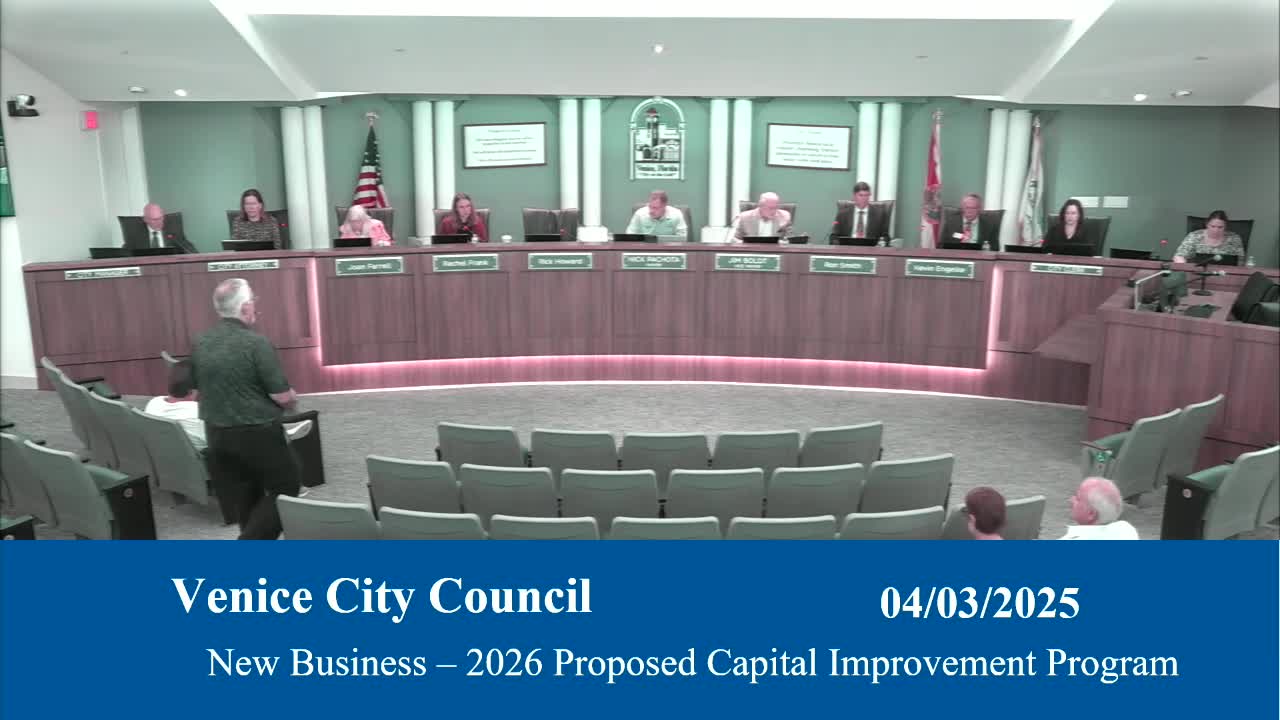
Venice council reviews five‑year CIP, weighs fast‑tracking beach parking and grants for jetty and renourishment
Summary
At a capital improvement plan workshop, Venice councilmembers and staff reviewed a five‑year CIP, debated accelerating a beach parking project, discussed a $5 million general‑fund payment toward Wellfield Park, and heard updates on beach renourishment and jetty restoration funding tied to the U.S. Army Corps of Engineers.
Venice City Council members on Wednesday reviewed the city’s draft five‑year Capital Improvement Plan and debated which new projects to accelerate into the fiscal 2026 budget and which to defer.
The workshop, led by City Manager John LaValley and Finance Director Linda Senney, covered dozens of proposed projects across funds, including a $5 million general‑fund payment toward Wellfield Park, a proposed $18 million beach renourishment effort tied to the U.S. Army Corps of Engineers, and a council discussion about moving forward sooner on additional beach parking at Broward Park.
Senney said the CIP is a working document that shows a five‑year projection and specifically identified fiscal 2026 items that would be incorporated into the next budget. “This is fluid,” Senney told the council. “If there’s a project council wants to start before Oct. 1, we would move that up with a budget amendment.”
Why it matters: The workshop grouped many small and large capital requests in one document, and council members said they will need to prioritize projects to keep the general fund healthy for staffing, union negotiations and other obligations. Several agenda items are tied to outside funding or to federal/state approvals, which affects timing and whether the city should commit local dollars now.
Key items and discussion
Wellfield Park: Senney explained an interlocal agreement that would require a $5 million payment in fiscal 2026, followed by annual payments planned out over the subsequent years. She said that the $5 million would be taken from general fund reserves and future payments from park impact fees. Council members repeatedly raised the need to reserve general‑fund capacity for foreseeable operating pressures.
Humphreys Park/South Jetty: John Kramer, acting city engineer, said hurricane damage has created a need to redesign and rebuild the saltwater jetty area at Humphreys Park. Kramer and several council members noted the city needs to coordinate with the U.S. Army Corps of Engineers (the Corps) because the Corps’ work will determine what the city can and should build. Council discussion produced a consensus to delay design/construction in the CIP by at least a year so work does not duplicate or get undone by the Corps’ restoration approach. Kramer cautioned that Corps timing and the scope of work are uncertain; he said two Corps models are under consideration (a phased restoration or a single large project) and that federal work could be years away.
Beach renourishment and funding mix: Senney presented a rough $18 million estimate for beach renourishment with multiple possible funding sources, including the Army Corps, the Florida Department of Environmental Protection grants, the city’s beach renourishment fund and the tourist development tax. Kramer said the Corps is finishing surveys to assess storm impacts and that the Corps’ schedule will determine the timing of construction. Council members encouraged continued state and federal outreach.
Broward Park additional beach parking: Councilmembers, led by Councilwoman Carol Frank and Councilman Paul Smith, favored accelerating a paved parking project at Broward Park so it would be completed before the next season. Senney said it could be funded from either the general fund or the 1¢ sales tax fund and that the city had been reserving sales tax proceeds for a new fire station and fleet facility. Councilmembers asked staff to explore Tourist Development Council contributions and other sources before making a final funding decision.
General fund new items and process questions: Council members noted that 16 of 46 general‑fund CIP items were new to the plan and that many of those appear in years one and two, creating pressure on the next budget. Councilmember Smith urged council colleagues to identify items that could be deferred and to use the CIP’s purple coding (items that can be moved back) to spread projects across the five years.
Smaller but notable items: Senney highlighted new general‑fund items including an estimate of $115,000 for an ADA‑compliant, citizen‑focused website update (federal accessibility regulations cited), $100,000 for mobile impact‑rated vehicle barriers for special events (see separate story on event vehicle mitigation), $10,000 for a Marine Patrol building awning, and an EMS inventory control “vending machine” the fire chief described as an electronically tracked, climate‑controlled medication cabinet intended to improve inventory accuracy and reduce waste. Fire Chief Archie Giddens and staff said the vending‑style inventory system would improve ordering accuracy and reduce expired medications; chief and council discussion placed the item in the context of the department’s five‑year EMS program growth.
Parks and playgrounds: Public Works Director Rick Simpson said the Legacy Park playground surfacing has failed its safety inspection and needs replacement for child safety; he described weather and repeated storm damage that accelerated deterioration. For Truck Bridal Field (Little League), assistant public works director Ashley Castle said the lighting infrastructure is aging and replacement parts are scarce; Castle said the city remains responsible for capital maintenance until Little League relocates under the county interlocal agreement, currently expected no later than 2029.
Fleet and apparatus procurement: Fire and fleet staff described long manufacturer lead times—roughly three years for a fire engine or ladder truck—and explained the city is appropriating funds in advance to lock a place in manufacturer queues. Council members asked about vehicle classification and the composition of the fleet; Chief Giddens said engines also respond to medical calls and described the rationale for maintaining a backup ladder truck while new apparatus arrive.
What the council directed
- Council signaled consensus to delay the Humphreys Park/South Jetty design and construction in the CIP until clearer Corps plans are available. (Council did not take a formal recorded vote in the workshop.) - Council requested staff explore alternative funding sources for Broward Park parking (including Tourist Development Council funds) and to present options for possibly accelerating the project into the current fiscal year.
Background and next steps
Senney reiterated the CIP is a fluid planning tool; the fiscal 2026 column becomes part of the budget book that will guide the formal budget workshops in June and adoption in September. Councilmembers asked staff to return with refined funding options, grant‑application timelines and additional detail on projects flagged as urgent.
Ending
Council set a June budget workshop date to continue refining priorities and encouraged staff to pursue federal and state funding opportunities for major shoreline and storm‑related projects while balancing general‑fund capacity for operations and negotiated personnel costs.