Get Full Government Meeting Transcripts, Videos, & Alerts Forever!
Get email alerts on the Medicaid Reimbursement topic
No spam. Unsubscribe anytime.
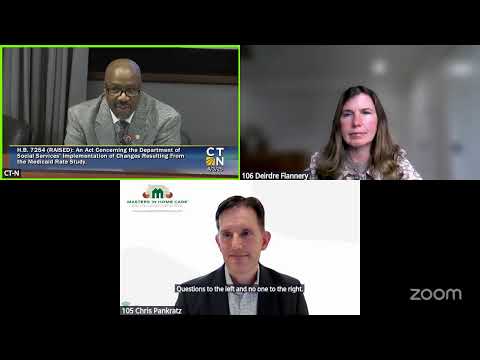
Connecticut providers warn Medicaid rates are untenable as bill would require regular rate reviews
Summary
For the record, my name is Deb Poland. I am the chief strategy officer at the Community Health Center Association of Connecticut, CHC Act, and we work with the state's 17 community health centers, who provide primary medical, dental, and behavioral health care to 440,000 people across our state, in every corner of the state, the big cities, rural areas, and small towns in Connecticut. We're here today to provide some comments on House Bill 72 54 regarding the, DSS implementation of changes resulting from Medicaid rate study. And we wanna thank you for bringing legislation forward that would actually implement, rate increases.
For the record, my name is Deb Poland. I am the chief strategy officer at the Community Health Center Association of Connecticut, CHC Act, and we work with the state's 17 community health centers, who provide primary medical, dental, and behavioral health care to 440,000 people across our state, in every corner of the state, the big cities, rural areas, and small towns in Connecticut. We're here today to provide some comments on House Bill 72 54 regarding the, DSS implementation of changes resulting from Medicaid rate study. And we wanna thank you for bringing legislation forward that would actually implement, rate increases.
Why it matters: dozens of nonprofit and hospital speakers told the Appropriations Committee that Connecticut’s Medicaid payment structure has not kept pace with costs and peer states. Witnesses said the DSS rate study documents substantial gaps — health centers told members they are paid roughly 20–25% less than comparable states; behavioral‑health rates were cited at about 62% of peer averages — and asked the legislature to translate the study’s recommendations into immediate funding and a durable update process.
Most urgent asks and evidence
- Community Health Centers: Deb Poland of the Community Health Center Association said the gap between health centers’ costs and Medicaid revenues is now about $74,000,000, after recent partial increases and service reductions. She told the committee that Medicaid dental visits at health centers declined about 23% in the prior year and that centers have closed or reduced services because of the shortfall.
- Behavioral health and youth crisis centers: Dr. Jeffrey Vander Ploeg of the Child Health and Development Institute said Connecticut’s Medicaid behavioral‑health rates average about 62% of peer states, and he urged raising rates to peer averages. He also said youth urgent crisis centers (UCCs) have strong results — 98% of youth discharged home — but that the current DSS plan to fund UCCs at $7,600,000 would leave a roughly $6,000,000 gap compared with ongoing ARPA support and would omit non‑Medicaid youth.
- Hospitals and specialty care: Mark Schaeffer of the Connecticut Hospital Association told the committee that hospitals face a $1.4 billion operating shortfall statewide in FY2023 and that Medicaid hospital reimbursement covers less than 60 cents on the dollar after hospital taxes. He urged including hospitals in any Medicaid rate increases and exploring a redesign that uses hospital tax revenue to reinvest in community health.
- Home and hospice care: Tracy Wodich of the Connecticut Association for Health Care at Home urged more frequent rate reviews (every two years rather than every five) and flagged key omissions in the DSS study: medication administration and continuous skilled nursing lines used by home health agencies were not adequately compared to other states, she said, and medication administration alone represents over 50% of Medicaid home health expenditures.
- Specialty physicians and allied providers: Physician groups and specialists testified for specialty‑specific rate fixes. Anesthesiologist John Satterfield said Medicaid has not had a physician rate increase for years and that Medicare underpays anesthesia; radiology and optometry representatives asked that periodic rebasing address long‑standing disparities for imaging and vision services in the Medicaid fee schedule.
What the bill would do and what witnesses asked
House Bill 72 54 would direct DSS to implement rate changes identified in the Medicaid rate study and require regular reviews and rebasing. Providers pressed the committee to turn the bill into action now — several witnesses urged a near‑term appropriation (community health centers quantified a $74 million gap; Optimus Healthcare asked for an $80 million rebase for federally qualified health centers) and recommended shortening the bill’s reporting deadlines so rates can be updated sooner rather than later.
Committee members pressed witnesses about implementation details and asked for written materials; several providers offered to share cost reports and charts. Witnesses also warned of federal policy risk: multiple witnesses cited analyses showing potential cuts to Medicaid financing at the federal level and urged the state to act now to shore up access.
Ending
Providers told the committee that the state’s Medicaid underpayment is already translating into lost services, reduced clinic hours, vacant positions and program closures. While the DSS rate study gives the legislature a starting point, witnesses asked the committee to pair the study’s recommendations with immediate appropriations and more frequent rebasing so Medicaid rates track costs and avoid further provider exits.