Get Full Government Meeting Transcripts, Videos, & Alerts Forever!
Get email alerts on the Public Safety topic
No spam. Unsubscribe anytime.
Prince George’s County committee backs higher fire-inspection fees, raises top civil fine to $10,000
Summary
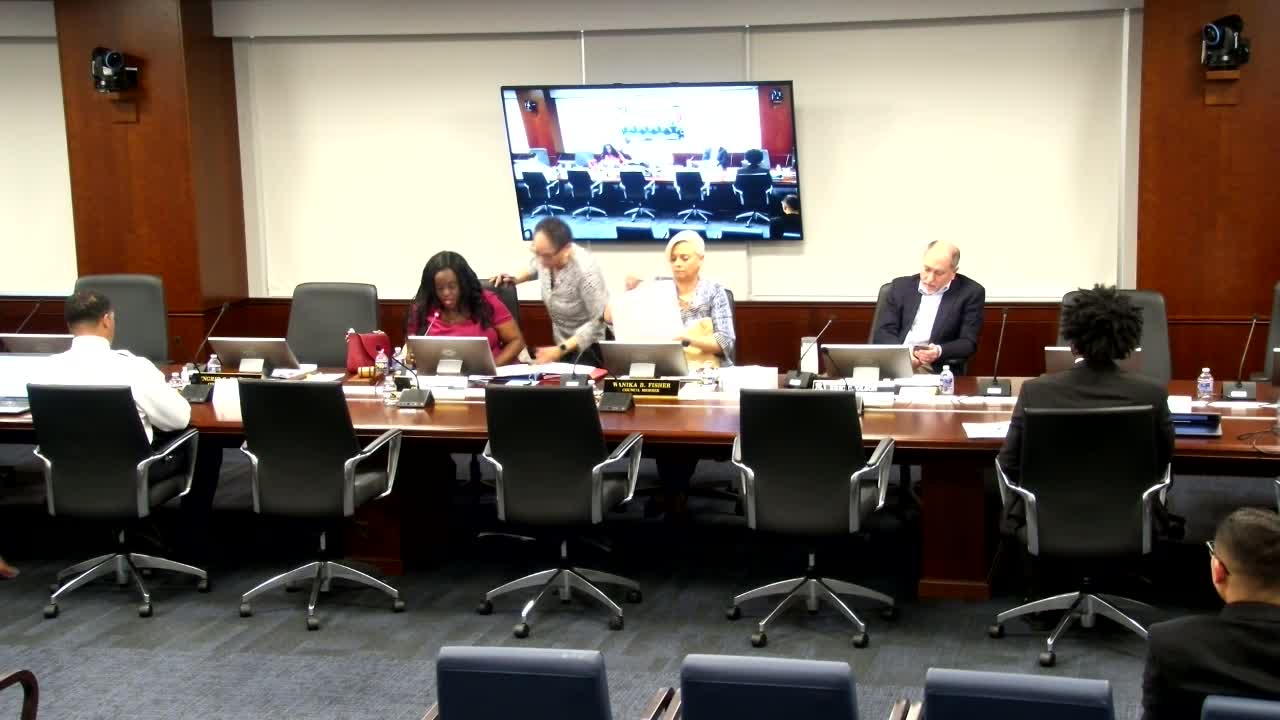
Prince George’s County’s Health, Human Services and Public Safety Committee voted 4–0 to give a favorable recommendation to CB 20‑20‑25, a bill that would raise fire inspection fees and increase the top civil fine for reckless endangerment from $5,000 to $10,000.
Prince George’s County’s Health, Human Services and Public Safety Committee voted 4–0 to give a favorable recommendation to CB 20‑20‑25, a bill that would raise fire inspection fees and increase the top civil fine for reckless endangerment from $5,000 to $10,000.
The bill, presented to the committee as CB 20‑20‑25 and sponsored at the request of the county executive, proposes amendments to the county fire prevention code to increase inspection fees, raise civil monitoring fines and adjust language related to dwellings and storage to mitigate fire hazards. Committee staff and legal counsel told members the change to a $10,000 maximum for certain violations is supported by state law governing fire prevention codes, not by the county’s Express Powers Act.
Why it matters: Committee members said the higher fine is aimed at reducing illegal, promoter-run large parties that have led to violent incidents and strain emergency response. Assistant Fire Chief Aaron White told the committee that lowering the threshold for what constitutes a risky “group” from 100 people to 50 would make it easier for fire officials to intervene. “Increasing the fine to $10,000 really hits them in their pockets,” White said, adding the goal is to deter promoters who repeatedly host large unpermitted events.
What counsel said: An Office of Law attorney, identified as Maddox during the hearing, explained that the county’s authority to set penalties for fire prevention comes from the Maryland Public Safety Article, §9‑701, and is not subject to the $5,000 cap found in the Express Powers Act. “The Express Powers Act is not applicable in this instance,” Maddox said, describing his interpretation of the statutory framework that permits the county to adopt higher penalties under its fire prevention authority.
Enforcement and evidence: Committee members pressed fire officials on how inspectors would document group sizes and support fines in hearings or appeals. Assistant Chief White said inspections are typically triggered after police or neighbors report a problem; enforcement actions often rely on on-site observations and photographic evidence gathered during operations. Several council members noted that many recipients of higher penalties could be expected to appeal to the county’s Board of Appeals, and asked whether inspectors would collect and retain evidence sufficient to withstand appeals.
Structure of penalties: The draft language differentiates between lower-level civil fines for routine code violations and the larger monetary penalty for repeated or particularly risky reckless‑endangerment violations. Committee staff flagged that the ordinance retains $250 (initial) fines for lower-level offenses while reserving the $10,000 maximum for repeated civil violations or violations specifically enumerated as reckless endangerment.
Fiscal impact and other effects: County budget analysts said the change would produce a favorable fiscal impact from additional fees and fines, while cautioning there could be secondary effects such as an increase in false alarm responses. Analysts also highlighted that inspection fees have not been adjusted in about 20 years and that the increase aims to align costs with current operating needs.
Committee action and next steps: After questions and discussion, Councilmember Austin moved a favorable recommendation; Vice Chair Wanika Fisher seconded. The roll-call vote recorded aye votes from Chair Blige, Vice Chair Wanika Fisher, Councilmember Olson and Councilmember Watson. The committee’s favorable recommendation advances CB 20‑20‑25 to the full Council for further consideration.
Details to watch: The bill’s final language (including how “group” is defined, which violations trigger the higher civil penalty, and the schedule of inspection fees) will be important in determining enforcement outcomes, who is targeted by the ordinance and how often fines are appealed.