Get Full Government Meeting Transcripts, Videos, & Alerts Forever!
Get email alerts on the Deepfakes topic
No spam. Unsubscribe anytime.
Senate committee lays over bill to require apps to disable ‘nudify’ notification functions
Summary
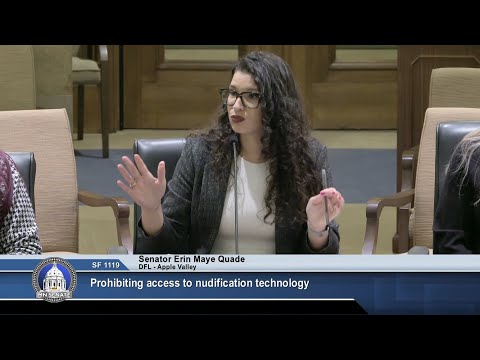
Senator McQuade, sponsor of Senate File 1119, asked the Minnesota Senate Judiciary Committee to hear her bill that would require apps, platforms and websites accessible in Minnesota to disable notification or “nudify” functions that enable generation of nonconsensual sexualized imagery.
Senator McQuade, sponsor of Senate File 1119, asked the Minnesota Senate Judiciary Committee to hear her bill that would require apps, platforms and websites accessible in Minnesota to disable notification or “nudify” functions that enable generation of nonconsensual sexual images and videos.
The bill drew testimony from two Minnesota residents who said artificially generated sexual images made with easy-to-access online tools had caused significant personal and professional harm. “It broke me open to be violated in this way. I missed 2 months of work, depleted my savings, and went into debt to try and recover,” said Megan Hurley, identifying herself as a lifelong Minnesota resident and a massage therapist. Jessica Gustales, another Minnesota resident who testified, said she had been “afraid to leave my house for weeks” after a private photo was used to create multiple pornographic images and videos.
McQuade told the committee the proposal is targeted at the platforms and services that allow or enable creation of realistic sexualized images, not at the individual users who may upload or generate them. “Make no mistake, these apps, platforms, and websites are as easy to access as ChatGPT,” McQuade said. She said Minnesota’s 2023 law criminalizing dissemination of nonconsensual sexual deepfakes addressed sharing but not the upstream creation of such material, and that this bill aims to stop creation at the source.
Committee members asked technical and jurisdictional questions about how the bill defines “person” and who could be held liable. McQuade said that the bill uses the term “person” consistent with existing statutory definitions to cover businesses and entities that own or control a website or app. She also said the bill’s scope would reach platforms accessible to Minnesotans even if those platforms are based outside the state.
Senators discussed enforcement and penalties. One senator raised concern that stiff penalties could unduly burden young people who might use such apps on phones; another said the committee intentionally focused the bill on disabling the function at the platform level rather than criminalizing individual users because the underlying tools are easy to obtain. Committee members also questioned a provision tied to grant administration, noting language in the bill that would allow up to 10% of certain appropriations to be used for grant administration; several senators said that percentage was higher than typical and should be revisited in finance or omnibus discussions.
The committee adopted an A10 amendment offered by Senator Rasmussen that the sponsor described as clarifying language consistent with existing statutory phrasing; the amendment was approved by voice vote. After discussion the committee laid over Senate File 1119 as amended; McQuade said the bill is expected to be carried into the judiciary omnibus and then to finance, where appropriation and administration language could be adjusted.
The testimony and discussion highlighted three themes: the harms victims report from synthetic pornographic imagery, the committee’s effort to target platform functionality rather than individual users, and intra-committee questions about penalties and how related appropriations could be administered.
The bill will return to the legislature as part of continuing committee work; no final vote on enactment was taken at this hearing.