Get Full Government Meeting Transcripts, Videos, & Alerts Forever!
Get email alerts on the Equal Rights Amendment topic
No spam. Unsubscribe anytime.
Minnesota House committee hears hours of testimony on proposed Equal Rights Amendment; bill laid over
Summary
A Minnesota House committee heard pro and con testimony on House File 501, a proposed constitutional amendment to add explicit nondiscrimination protections including disability, gender identity, and pregnancy; the committee laid the bill over for possible inclusion, with no final vote recorded.
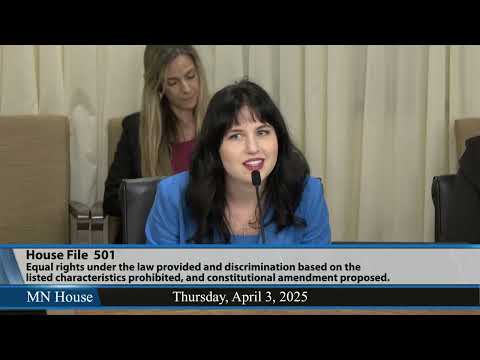
Representative Finke presented House File 501, a proposed amendment to the Minnesota Constitution that would prohibit discrimination on grounds the sponsor described as including race, color, national origin, ancestry and disability and additional categories referenced in testimony.
The sponsor said the amendment "makes important and significant changes to how our state defends the rights of all of our neighbors," and asked the committee to lay the bill over for possible inclusion. After more than an hour of public testimony and member discussion, the chair renewed a motion to lay HF 501 over for possible inclusion; the committee took no final vote.
The bill’s sponsor, Representative Finke, told the committee the amendment is intended to expand constitutional protections and said, "It is long past time for that to change." Finke emphasized that the proposal is meant to protect multiple communities, including people with disabilities and transgender people, and reserved further remarks to closing comments and public testimony.
Supporters who testified said the amendment would strengthen enforcement and signal state commitment to nondiscrimination. Gene Martinez, advocacy coordinator for The Arc Minnesota, said the proposed amendment "would greatly benefit the disability community" and "would help close gaps in enforcement, making it easier to challenge discrimination in court and hold institutions accountable." Tenzin Choe Sung, representing the Asian American Organizing Project, urged an "inclusive, possible equal rights amendment" and said a survey the organization conducted found "over 80% of Asian Americans in Minnesota support abortion access," arguing the amendment would "cement the fact that reproductive rights are human rights." Former state representative Betty Folliard and other proponent witnesses urged the committee to let voters decide the amendment on the ballot.
Opponents raised concerns about effects on religious freedom, protections for women and girls, and reproductive rights. Renee Carlson, general counsel for True North Legal, said the proposal "undermines long standing legal protections for pre born children, people of faith, women, and girls," and warned that adding protections for gender identity and expression without explicit religious exemptions could limit religious organizations’ legal defenses. Rebecca Delahunt, director of public policy for Minnesota Family Council, cited an international review of gender-identity services (the Cass review) and recounted accounts she said were in committee materials regarding placements of incarcerated people at a women’s facility; she argued the amendment could force changes in private spaces and programs.
Several members spoke during debate. Representative Jones expressed support for explicitly listing protected classes, saying federal protections have at times been insufficient. Representative Howard urged giving Minnesotans the chance to vote on the question. Representative Davis and Representative Joy expressed opposition, calling out omission of explicit religious or conscience protections and saying the amendment would have consequences for women and preborn children. Representative Bonner, Representative Kraft and others urged passage to the ballot and framed the measure as an assurance of equal protection under the law rather than an expansion of rights for one group over another.
In closing remarks Representative Finke said the amendment asks Minnesotans to decide what values to enshrine in the state constitution and said, "Discrimination is very much legal and protected act in this country in many ways, in many places." The chair renewed the motion to lay HF 501 over for possible inclusion; the committee directed no further immediate action and did not record a roll-call vote at the hearing.
The record of the hearing includes written materials and multiple public testimonies both supporting and opposing the amendment. The committee may schedule further consideration or amendment before deciding whether to advance the proposal to the floor or to place it on a ballot for a public vote.