Get Full Government Meeting Transcripts, Videos, & Alerts Forever!
Get email alerts on the Higher Education Budget topic
No spam. Unsubscribe anytime.
Assembly panel hears that proposed ~8% CSU cuts and a deferred compact payment would strain campuses and students
Summary
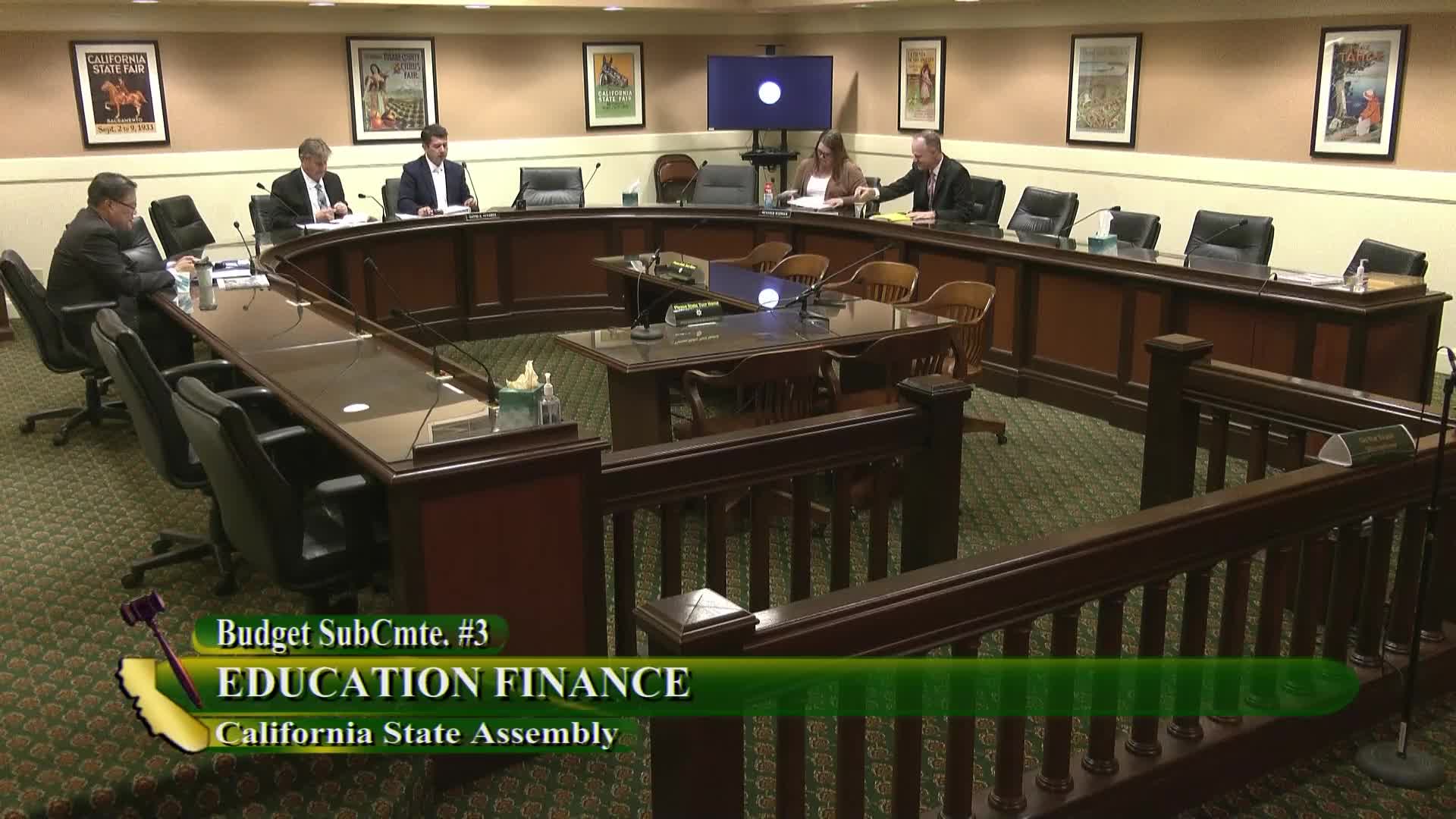
Chair David Alvarez convened the California State Assembly Budget Subcommittee No. 3 on Education Finance to examine the governor’s 2025‑26 budget proposal for the California State University system, where Department of Finance testimony directed CSU to plan for a 7.95% reduction in ongoing General Fund support — roughly $375.2 million — and deferred a scheduled compact payment.
Chair David Alvarez convened the California State Assembly Budget Subcommittee No. 3 on Education Finance to consider the Governor’s 2025‑26 budget proposals affecting the California State University (CSU) system and the State Library. Department of Finance testimony said CSU should plan for a reduction of 7.95% in ongoing General Fund support — “totaling approximately $375,200,000 beginning in the 2025‑26 fiscal year,” the department told the committee.
Why it matters: CSU officials, the Legislative Analyst’s Office and campus representatives said the package of reductions and a deferral of a scheduled 5% compact payment would deepen existing budget shortfalls and likely reduce course offerings, increase class sizes and slow students’ progress to degrees. The system already has taken personnel and course reductions in prior years and flagged multi‑campus and program adjustments.
Devin Mitchell of the Department of Finance told the subcommittee the budget defers the 5% compact increase (about $252.3 million in the year cited) and maintains the statewide reductions enacted in last year’s budget. Natalie Gonzalez of the Legislative Analyst’s Office recommended rejecting the deferral, saying the state has not identified how it would be paid and that deferral “would either likely not provide the deferred payments to CSU or these payments would come at the expense of other programs.”
CSU officials said campuses are already operating under pressure. Ryan Storm, assistant vice chancellor for budget at the Chancellor’s Office, listed recent system actions taken to reduce costs and described prior gaps in CSU finances, warning that another reduction on top of prior shortfalls would “negatively impact students and their services.” Storm told the committee, “We have already had 1,208 jobs that have been reduced on 17 of our campuses.” Nathan Evans, deputy vice chancellor for academic and student affairs, said CSU resumed enrollment growth in recent years but that the proposed cuts would threaten the system’s gains and its ability to serve Californians.
Lawmakers pressed for alternatives to a blunt, systemwide cut. The Legislative Analyst’s Office said lawmakers could be more “surgical” — for example, reducing central or institutional support in targeted ways — but cautioned that some campuses are already “at the point where they are starting to remove teaching faculty and direct student supports,” and that forcing uniform cuts to instruction could produce very different outcomes at different campuses.
Several committee members and speakers asked about multi‑campus administrative consolidations and mergers as a way to achieve savings. CSU officials described ongoing work — for example, the announced administrative sharing among East Bay, San Francisco and Sonoma campuses and a planned merger between Cal Maritime and Cal Poly San Luis Obispo — but said it is too early to project realized savings.
Public testimony and campus representatives emphasized student impacts. Faculty and staff union leaders and student representatives urged the Legislature to reconsider reductions and seek other savings; faculty and department chairs reported immediate course reductions and warned of requests for deeper programmatic cuts if the budget stands.
Looking ahead: The subcommittee requested further detail from the administration, LAO and CSU on (1) specific options for directing reductions away from instruction and student services, (2) projected savings and timelines from announced mergers and shared‑services efforts, and (3) reporting that would show where recent augmentations and cuts have been invested on a campus‑by‑campus basis.
Ending note: The hearing made clear the committee will continue oversight, seeking more granular options to protect instruction and student access while confronting anticipated state budget pressures.